



Key Takeaways
- Investment bank J.P. Morgan has revised its Brent crude projections downward for late 2026 and 2027
- The firm projects Brent will reach $86/barrel in Q3 2026 and decline to $80/barrel in Q4 2026
- Prices are forecast to finish 2026 at $78/barrel before dropping to a $64 average throughout 2027
- Sluggish demand and disappointing inventory withdrawals drive the bearish revision
- Energy companies are relying heavily on Strategic Petroleum Reserve drawdowns rather than depleting commercial stockpiles
Investment banking giant J.P. Morgan has revised its price projections for Brent crude downward for the latter half of 2026, citing disappointing demand trends and underwhelming inventory reductions.
The financial institution’s updated forecast calls for Brent crude to trade at an average of $86 per barrel during the third quarter of 2026, declining to $80 per barrel in the final quarter.
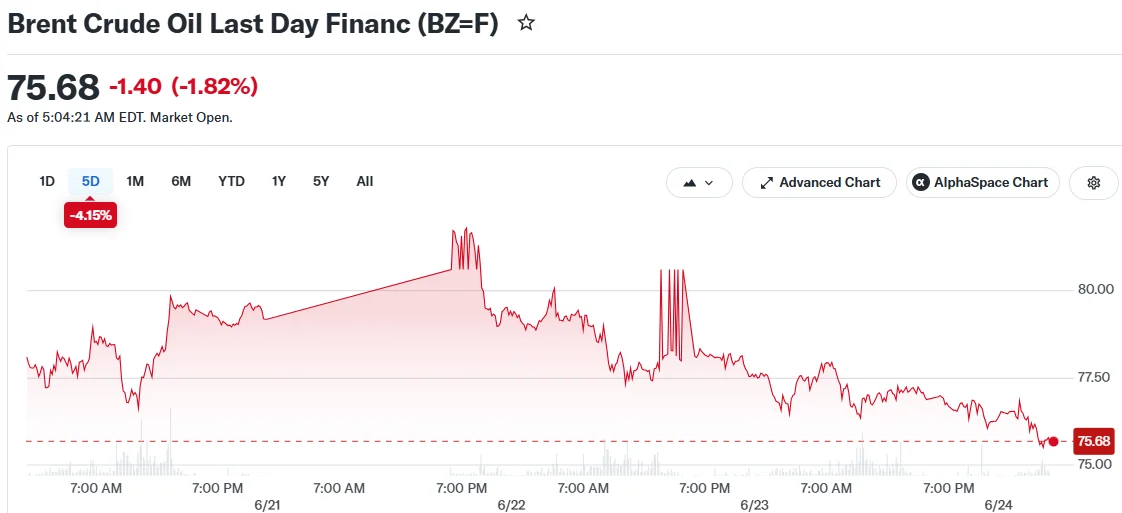
As 2026 draws to a close, J.P. Morgan anticipates Brent will settle around $78 per barrel. The bank’s outlook grows considerably more bearish for 2027, with analysts forecasting an annual average of just $64 per barrel.
Lackluster Demand and Stockpile Draws Fall Short
Commercial petroleum inventories held by OECD nations have declined at a slower pace than J.P. Morgan initially anticipated. Compounding this issue, demand destruction has exceeded the bank’s earlier estimates.
These twin headwinds have collectively eased upward pressure on oil prices. According to J.P. Morgan, the crude market has achieved equilibrium through a pathway substantially different from its original modeling.

The confluence of softer consumption patterns and modest inventory withdrawals indicates diminished fundamental support for higher price levels compared to the bank’s previous assumptions.
Current Flow Dynamics and Government Reserve Utilization
Crude oil flows are presently operating at approximately 8.6 million barrels daily. June data shows flows averaging 6.3 million barrels per day, representing an improvement over the volumes recorded during April and May.
Despite this increase in petroleum movement, commercial operators have shown marked reluctance to tap their proprietary oil inventories. These companies have instead depended almost exclusively on government-mandated Strategic Petroleum Reserve releases to maintain refinery operations.
J.P. Morgan anticipates that OECD stockpiles will decrease by another 50 million barrels spanning April through July within its updated second-half projection framework.
The investment bank also highlighted the possibility of excess supply accumulating during Q4 2026 and extending into the first six months of 2027. Should this scenario materialize, producers would face pressure to curtail production in early 2027 following a period of maximized output during late 2026.
J.P. Morgan’s analysis did not identify any particular catalyst that might alter this trajectory before the conclusion of the year.
The adjusted projections signal a more conservative stance on worldwide petroleum demand as the year progresses. The $64 average anticipated for 2027 represents a significant decline from the $80-$86 range forecast for the second half of 2026.
The research note contained no modifications to the bank’s perspectives on alternative energy commodities.
J.P. Morgan released this forecast revision on June 24, 2026.
Get 3 Free Stock Ebooks
Discover top-performing stocks in AI, Crypto, and Technology with expert analysis.
- Top 10 AI Stocks - Leading AI companies
- Top 10 Crypto Stocks - Blockchain leaders
- Top 10 Tech Stocks - Tech giants



