



TLDR
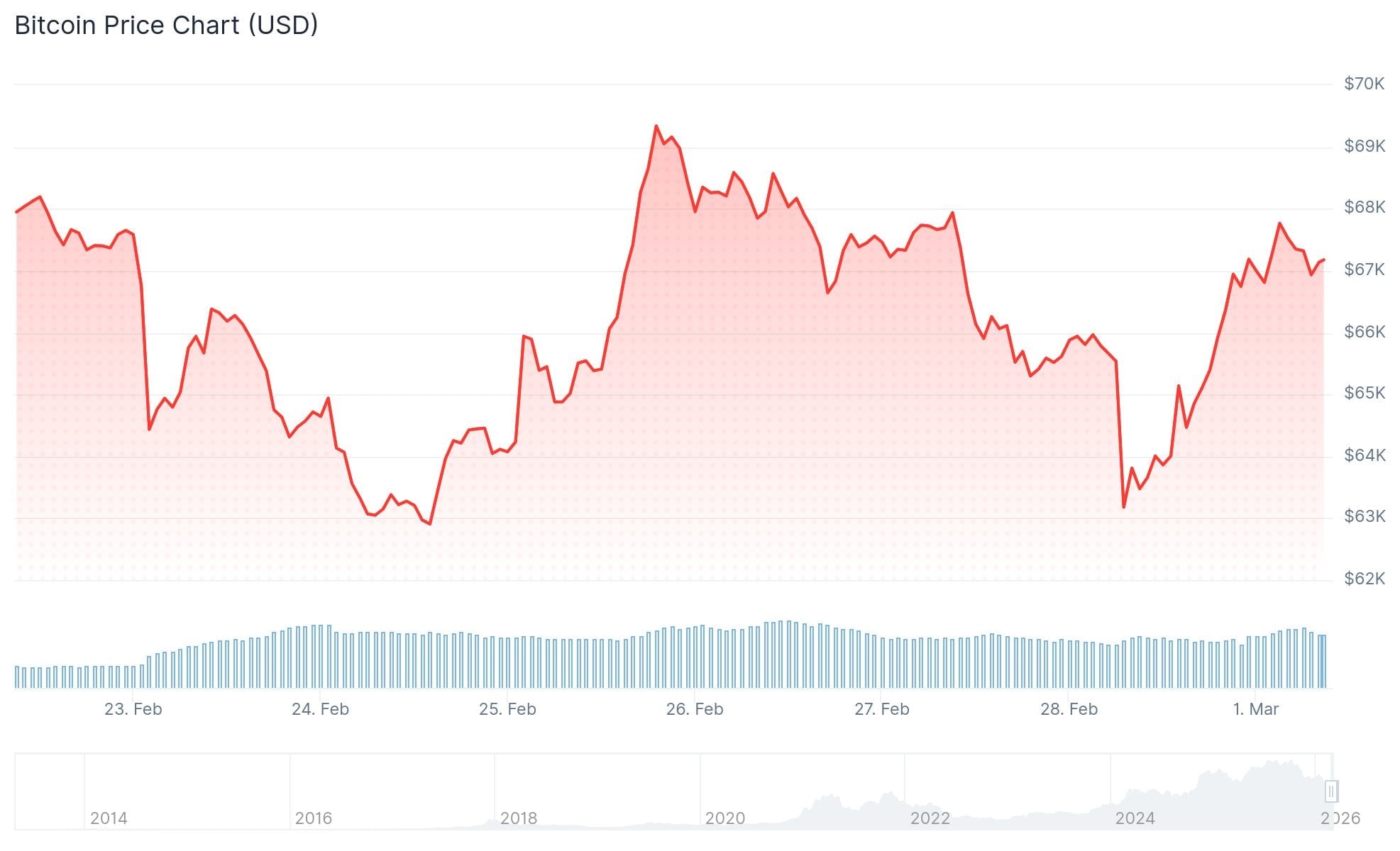
- Bitcoin remains stuck trading in the mid-$60,000 range while ether hovers near $2,000 amid declining trading activity on major platforms.
- According to JPMorgan analysts, passage of the Clarity Act could serve as a significant catalyst for cryptocurrency markets during late 2026.
- The proposed legislation would divide regulatory authority for digital assets between the CFTC and SEC, while allowing projects to raise $75 million without complete SEC registration.
- Progress on the bill has halted in Congress after Coinbase pulled its endorsement due to concerns about stifling innovation and market competition.
- Morgan Stanley is seeking federal trust bank authorization from the OCC to offer digital asset custody services directly to clients.
Bitcoin has remained trapped in a narrow trading channel around the mid-$60,000 level for several weeks now. Ether continues hovering near the $2,000 mark, while trading activity on leading exchanges has noticeably declined. Market participants are searching for a meaningful catalyst to disrupt this stagnation.
Analysts at JPMorgan believe they may have identified such a catalyst. In a recent research note, a team headed by Nikolaos Panigirtzoglou highlighted the Clarity Act — proposed U.S. legislation addressing crypto market structure — as a possible catalyst for upward momentum in the latter half of the year.
“We continue to believe that a potential approval of the market structure legislation most likely by mid year could serve as a positive catalyst for crypto markets,” the research team noted.
The Clarity Act would establish a regulatory framework that splits oversight responsibilities for cryptocurrency between the Securities and Exchange Commission and the Commodity Futures Trading Commission. Digital assets would receive classification as either securities or digital commodities based on their fundamental characteristics.
According to JPMorgan’s assessment, placing major cryptocurrencies under CFTC supervision would substantially decrease regulatory ambiguity. The legislation includes a grandfather provision that would grant commodity status to specific tokens — such as XRP, Solana, Litecoin, Hedera, Dogecoin, and Chainlink — provided they’re connected to spot ETFs that launched prior to January 1, 2026.
The proposed framework would additionally permit emerging crypto ventures to secure up to $75 million in annual funding without completing full SEC registration processes, though disclosure requirements would still apply. JPMorgan’s research team suggested this provision could reignite domestic token launches and venture capital activity that has migrated to foreign jurisdictions.

Clarity Act Hits a Wall
Despite its potential benefits, the legislation has encountered significant obstacles. The Senate Banking Committee indefinitely postponed a scheduled markup session in early 2026 following Coinbase‘s decision to rescind its endorsement. The nation’s largest cryptocurrency exchange expressed concerns that the bill’s current language might constrain innovation, undermine competitive dynamics, and impose restrictions on stablecoin reward programs.
Coinbase CEO Brian Armstrong attributed the legislative delays primarily to banking industry lobbying organizations rather than individual financial institutions. The bill remains in legislative limbo as congressional members attempt to resolve disagreements surrounding critical provisions.
Meanwhile, traditional financial institutions continue advancing their crypto initiatives. Morgan Stanley has submitted a formal application to the Office of the Comptroller of the Currency requesting approval for a national trust bank charter. The proposed institution, to be named Morgan Stanley Digital Trust National Association, would establish operations in Purchase, New York.
Morgan Stanley Goes All-In on Crypto Custody
Upon receiving regulatory approval, the subsidiary would provide digital asset custody solutions, facilitate token transfers associated with client portfolios, and deliver staking capabilities. The entity would operate without accepting customer deposits or extending credit facilities.
Morgan Stanley oversees approximately $9 trillion in client assets across its platforms. The financial giant initially introduced Bitcoin investment products to its wealth management clientele in 2021 and subsequently expanded cryptocurrency trading capabilities through its E*Trade brokerage in 2025.
During January 2026, the firm submitted applications for spot Bitcoin, Solana, and Ethereum exchange-traded funds while appointing Amy Oldenburg to lead its digital asset strategic initiatives. Obtaining a federally regulated trust bank charter would enable Morgan Stanley to internalize custody and staking operations, diminishing dependence on external service providers such as Zerohash.
The OCC’s public feedback window remains open until March 20, 2026. Upon approval, Morgan Stanley would join an established group of trust banks providing digital asset services, including BNY Mellon and State Street.
Get 3 Free Stock Ebooks
Discover top-performing stocks in AI, Crypto, and Technology with expert analysis.
- Top 10 AI Stocks - Leading AI companies
- Top 10 Crypto Stocks - Blockchain leaders
- Top 10 Tech Stocks - Tech giants



