



Key Takeaways
- The Japanese yen weakened to 162.41 against the dollar on Tuesday, its lowest point since 1986.
- Market participants are assigning greater probability to Federal Reserve rate increases in 2024.
- Tokyo deployed 11.7 trillion yen ($72.25 billion) during April and May to bolster the currency, with limited lasting impact.
- Finance Minister Satsuki Katayama indicated readiness to respond but avoided aggressive intervention rhetoric.
- The euro simultaneously declined versus the dollar, hovering around $1.1396, approaching a 12-month low.
The Japanese currency tumbled to a four-decade low against the U.S. dollar during Tuesday’s trading session. The greenback climbed as high as 162.41 yen before stabilizing near 162.15.
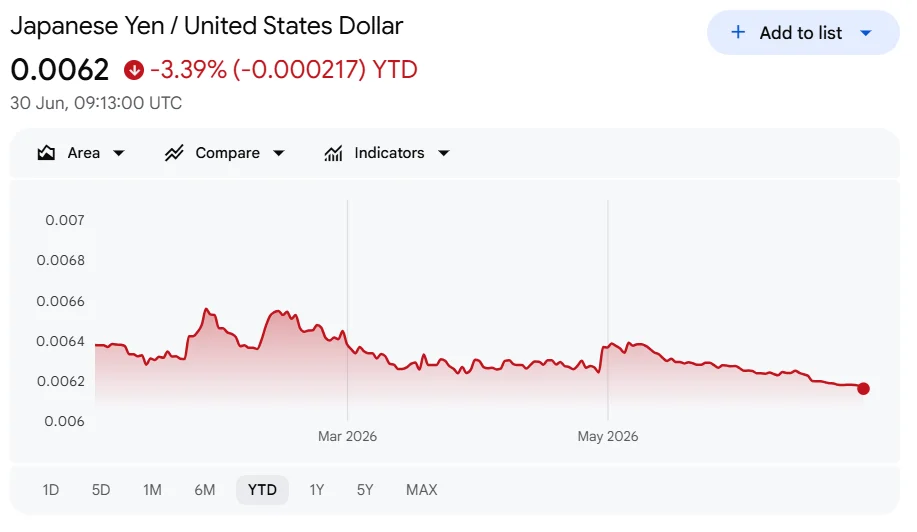
This represents the yen’s most significant depreciation since 1986. The dramatic decline has sparked intense speculation about whether Japanese authorities will launch another currency intervention campaign.
Fed Rate Expectations Fuel Dollar’s Ascent
The primary catalyst behind the yen’s decline stems from mounting anticipation of higher U.S. interest rates. Persistent inflation continues to exceed the Federal Reserve’s 2% objective.
During the latest Federal Reserve policy meeting, nine out of nineteen officials projected at least one rate increase before year-end. This hawkish pivot has channeled significant capital flows into dollar-denominated assets.
Lee Hardman, senior currency analyst at MUFG Bank, suggested the Fed might overlook recent inflationary upticks. Nevertheless, he emphasized that no definitive indicators have emerged that would prompt the central bank to soften its hawkish stance.

Market participants are now intensely focused on Thursday’s employment report from the United States. Disappointing employment figures could fundamentally alter expectations regarding the Fed’s monetary policy trajectory.
Tokyo’s Intervention Strategy Under Scrutiny
The Japanese currency has depreciated for four consecutive quarters, representing its most extended losing streak since 2020. The yen is positioned for a 2% quarterly decline.
Japanese monetary authorities committed 11.7 trillion yen, approximately $72.25 billion, throughout April and May attempting to arrest the currency’s slide. While these efforts temporarily strengthened the yen, the effect proved ephemeral.
Hardman observed that the unsuccessful spring intervention may render Japanese officials more hesitant about future market operations. He suggested policymakers might demonstrate increased tolerance for depreciation provided the decline remains orderly rather than disruptive.
Finance Minister Satsuki Katayama reiterated Tokyo’s preparedness to take action when circumstances warrant. However, her measured tone notably lacked the forceful language typically preceding imminent intervention.
A critical distinction from the spring episode is that the yen’s current weakness is predominantly concentrated against the dollar. The euro exchanged at 184.97 yen, elevated by historical standards yet remaining below its April peak of 187.95.
Broader Currency Market Weakness
The U.S. dollar index, measuring the currency’s performance against six major counterparts, stood at 101.32. The index is poised for a 1.4% quarterly advance, following a 1.6% increase during the opening quarter.
The euro declined 0.24% to $1.1396, nearing the one-year low established last week. Softer-than-anticipated inflation readings from France and several German states intensified downward pressure on the common currency this week.
The European Central Bank implemented a rate increase earlier this month, with markets anticipating another hike before December. This outlook could shift if inflationary pressures moderate or economic activity deteriorates substantially.
Sterling retreated 0.2% to $1.3234. Commodity-linked currencies also experienced headwinds as energy prices softened.
Norway’s crown depreciated to its weakest position versus the dollar in half a year. The Canadian dollar traded close to a 14-month trough, while the Australian dollar touched a three-month nadir at $0.6867.
As Tuesday’s session concluded, the dollar maintained its position near the 40-year zenith against the yen, with market attention pivoting toward Thursday’s U.S. employment data for additional guidance.
Get 3 Free Stock Ebooks
Discover top-performing stocks in AI, Crypto, and Technology with expert analysis.
- Top 10 AI Stocks - Leading AI companies
- Top 10 Crypto Stocks - Blockchain leaders
- Top 10 Tech Stocks - Tech giants



