


TLDR
Escalating Middle East conflict involving Iran has triggered major disruptions to LNG shipments passing through the Strait of Hormuz, causing European gas prices to spike.
Following drone strikes on energy infrastructure, QatarEnergy suspended operations, creating immediate pressure on global LNG availability.
Benchmark Dutch TTF natural gas futures climbed by up to 49% intraday as traders reacted to supply concerns.
Since abandoning Russian gas supplies in 2022, Europe has become increasingly dependent on LNG imports from the Middle East.
Market analysts caution that extended supply interruptions could drive European gas prices significantly higher and strain worldwide energy systems.
Escalating tensions in the Middle East sent European natural gas prices surging as critical energy transportation channels faced significant disruption. Financial markets moved swiftly in response to mounting concerns over liquefied natural gas deliveries.
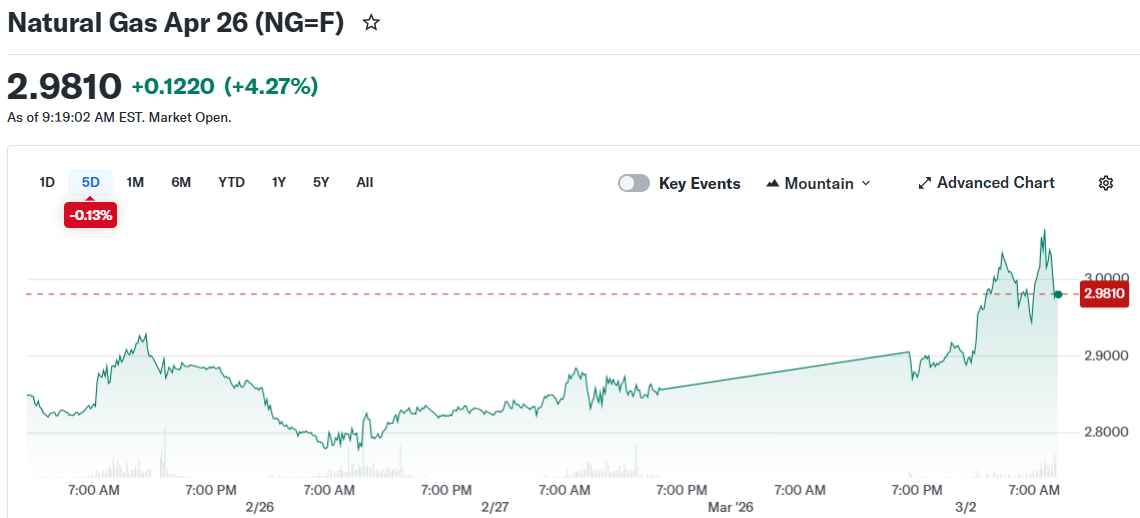
European gas benchmarks jumped approximately 25% at the opening bell. The Dutch TTF contract, Europe’s primary pricing reference, subsequently rallied to register gains approaching 49% during active trading.
Price momentum accelerated following heightened military operations in the Gulf region. Conflict involving Iran has created substantial obstacles for vessels navigating the Strait of Hormuz, one of the world’s most strategic energy chokepoints.
This narrow waterway facilitates passage for a substantial portion of international LNG cargo. Maritime traffic has experienced sharp declines as threats to vessel safety have mounted.
Qatar’s national energy company suspended natural gas operations following targeted drone strikes on production infrastructure. As the world’s leading LNG exporter, Qatar supplies approximately 20% of global liquefied natural gas volumes.

Europe Faces Renewed Supply Vulnerability
The European continent finds itself particularly vulnerable to LNG supply interruptions. Following the 2022 energy emergency, the region dramatically reduced its dependence on Russian gas delivered via pipeline.
Qatar has emerged as a primary LNG source for European buyers. The majority of these shipments must traverse the Strait of Hormuz en route to import facilities across Europe.
Natural gas storage levels decline naturally through winter as heating demand peaks. This seasonal pattern requires European nations to secure additional LNG imports for inventory replenishment.
Energy analysts have drawn parallels between current conditions and the 2022 supply crisis. That earlier episode resulted in widespread industrial curtailments and contributed to accelerating consumer price inflation.
Investment bank Goldman Sachs issued projections indicating that a four-week suspension of LNG transit through the Strait would likely drive European gas prices upward by more than 100%. Under this scenario, prices could reach €74 per megawatt hour.
Should disruptions persist beyond two months, pricing could surge past €100 per megawatt hour. Historical data shows that price levels in this range have previously forced significant demand destruction throughout European economies.
Worldwide Energy Markets Register Concern
Commodity markets across the energy complex moved rapidly in response to emerging supply risks. Oil prices gained ground as market participants assessed potential disruption impacts throughout the broader region.
Approximately 80 million tonnes of liquefied natural gas transit the Strait of Hormuz annually. This volume accounts for nearly one-fifth of total global LNG trade.
Crude oil shipments through this strategic waterway represent another vital component of international energy infrastructure. Roughly 20% of worldwide petroleum production moves through the channel.
Reports emerged over the weekend indicating damage to three crude tankers operating in the affected area. Transport delays have amplified price volatility across energy markets.
Charter costs for crude carriers have experienced dramatic increases in recent trading sessions. Certain Asia-bound routes from Gulf loading terminals have seen freight rates multiply threefold within the past thirty days.
Asian LNG benchmark prices are positioned for potential increases as well. International natural gas markets operate with significant interconnectivity, meaning supply disruptions in one region typically ripple across others.
Domestic U.S. natural gas prices have demonstrated relatively muted responses thus far. American LNG export infrastructure is operating at near-maximum capacity, restricting the ability to rapidly scale up international deliveries.
European trading desks remain concentrated on LNG supply continuity. Market observers are closely monitoring whether normal shipping operations through the Strait of Hormuz can resume within the near term.
Get 3 Free Stock Ebooks
Discover top-performing stocks in AI, Crypto, and Technology with expert analysis.
- Top 10 AI Stocks - Leading AI companies
- Top 10 Crypto Stocks - Blockchain leaders
- Top 10 Tech Stocks - Tech giants



