



Key Highlights
- Trading volume for HYPE ETFs from Bitwise and 21Shares increased by 50%, recording $25.5 million in combined net inflows during Wednesday’s session.
- Eric Balchunas, Bloomberg’s ETF analyst, described the volume pattern as “very rare,” noting that most ETF launches experience declining activity after launch day.
- The HYPE token has gained 120% since the start of 2025 and rose 18.5% over the last 24 hours to reach $56.
- Analytics from Santiment indicate that a short squeeze occurred after traders heavily shorted the token on May 18-19, only to see prices continue rising.
- HYPE futures open interest remains above $1.92 billion, with fresh market participants entering positions despite ongoing liquidations.
The native token of Hyperliquid, HYPE, has surged to $56, marking an 18.5% increase over the past day and a remarkable 120% gain since the beginning of 2025, based on CoinGecko tracking data.
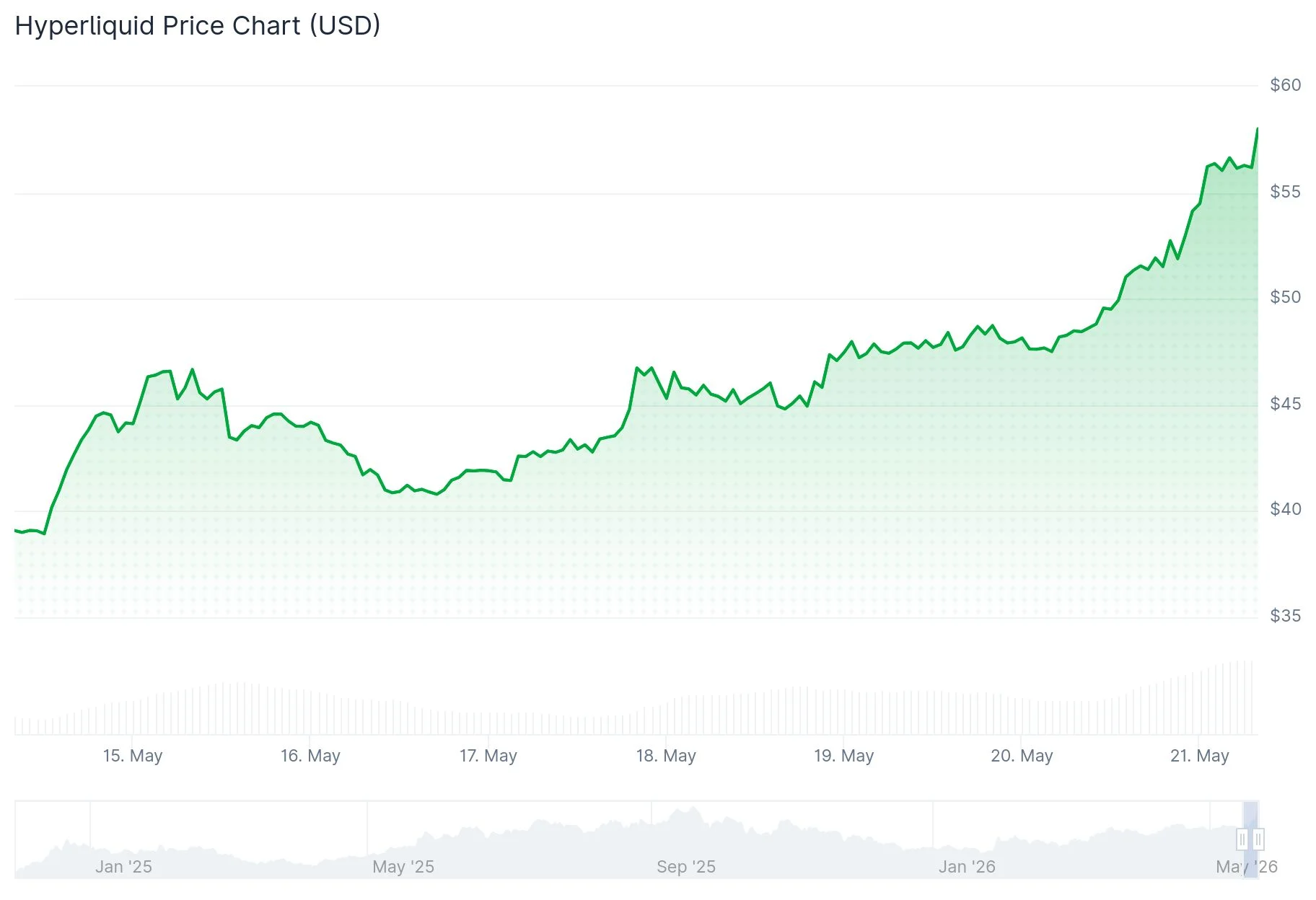
This price appreciation has been strongly correlated with renewed institutional participation in the asset, spurred by two recently launched US-based exchange-traded funds.
The two HYPE-tracking ETFs — 21Shares’ offering (THYP) and Bitwise’s product (BHYP) — have collectively generated approximately $41 million in trading value since debuting this month.
21Shares introduced its ETF on May 12, pulling in $1.2 million in initial net inflows. Bitwise entered the market two days later on May 14, attracting $750,000 in inflows.
Eric Balchunas from Bloomberg Intelligence highlighted on X that this volume growth pattern was “very rare.” According to him, most newly launched ETFs experience strong opening-day activity followed by a steep drop-off. The HYPE ETFs have demonstrated the reverse trend, with volume building progressively.

Balchunas linked this unusual performance to market timing: while traditional assets including equities, fixed income, Bitcoin, and gold have been declining, HYPE has maintained its upward trajectory.
Short Squeeze Drives Price Action
Cryptocurrency data provider Santiment revealed on X that market participants had taken aggressive short positions against HYPE on May 18 and 19. Funding rate metrics displayed a pronounced spike toward negative territory, signaling widespread bearish positioning with expectations of declining prices.
Contrary to expectations, the token’s price continued climbing. This forced short sellers into covering their positions through buying, creating additional upward momentum — a textbook short squeeze scenario, as Santiment explained.
Open interest across HYPE futures contracts continues trading above $1.92 billion. Santiment observed that unlike standard liquidation scenarios, fresh traders continued establishing positions even while others faced forced exits.
Wednesday represented the peak inflow day for both exchange-traded products. The 21Shares vehicle attracted $16.6 million, while Bitwise’s fund secured $8.8 million.
Market Analyst Projects $60 Price Level
Cryptocurrency market analyst AltcoinSherpa has projected that “$60 is probably next” for the HYPE token. He characterized the present $50 level as suboptimal for short-term position traders but appealing for those with longer investment horizons due to what he perceives as constrained downside exposure.
From a technical perspective, HYPE has maintained levels above a support band spanning $45 to $47. The Relative Strength Index has remained within the 50–65 range, staying below the 70 threshold that would signal overbought conditions. MACD technical indicators have displayed bullish crossover patterns.
Near-term resistance is positioned between $50 and $52. A decisive breakout above this zone could establish a trajectory toward the prior all-time peak near $59.
Grayscale submitted an application for its own HYPE ETF in March. Blockchain monitoring service Lookonchain identified two wallets associated with Grayscale that acquired $25 million worth of HYPE tokens during the previous week and subsequently staked them.
HYPE was trading around $51.62 at press time, reflecting an 8.36% gain over the preceding 24-hour period.
Get 3 Free Stock Ebooks
Discover top-performing stocks in AI, Crypto, and Technology with expert analysis.
- Top 10 AI Stocks - Leading AI companies
- Top 10 Crypto Stocks - Blockchain leaders
- Top 10 Tech Stocks - Tech giants



