



Key Takeaways
- Maelstrom’s Arthur Hayes revealed HYPE as his firm’s top altcoin holding with a $150 target price
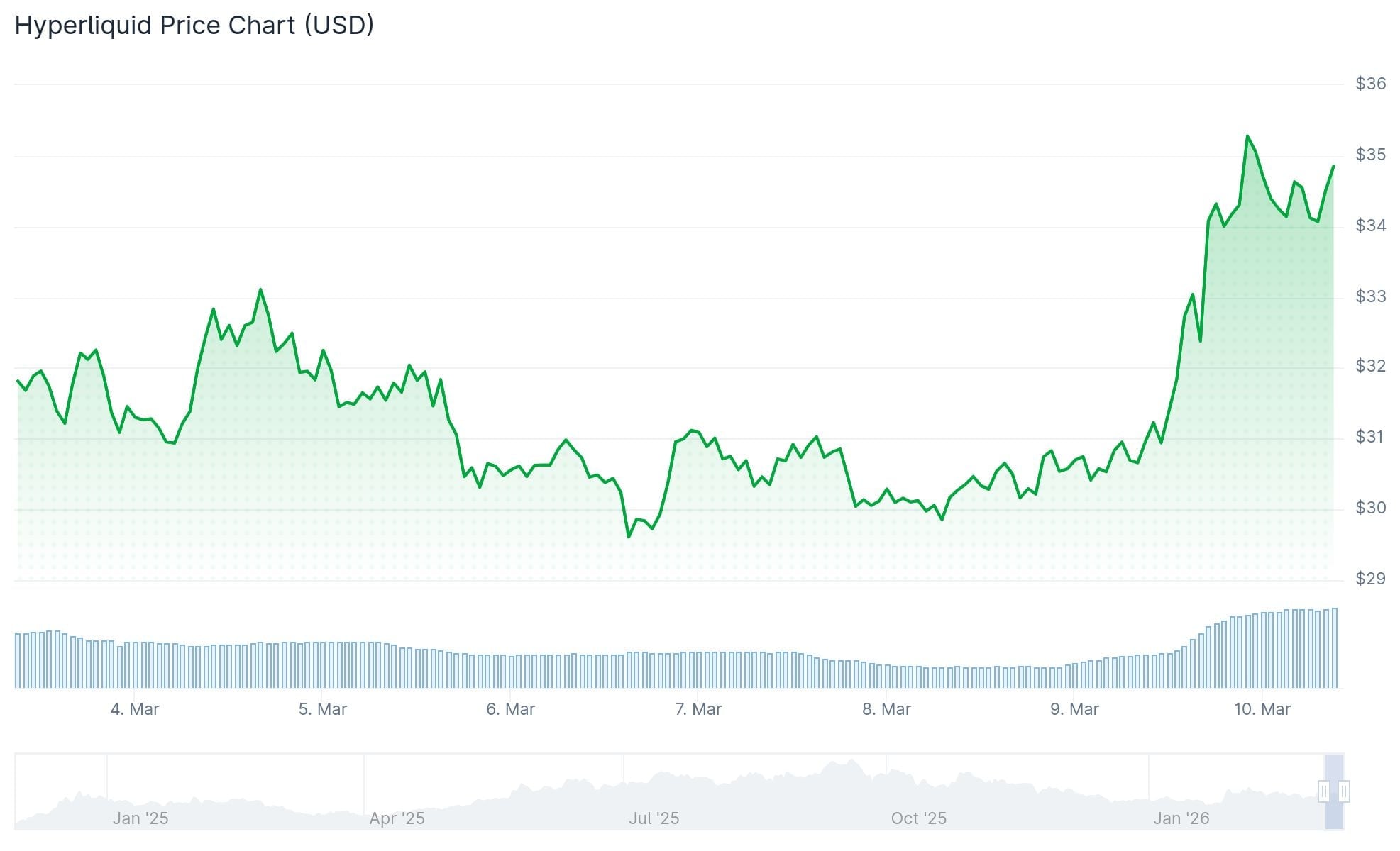
- The HYPE token jumped 11.3% over 24 hours to approximately $35, significantly outpacing Bitcoin’s 3.1% increase
- According to Hayes, Hyperliquid allocates 97% of platform revenue to purchase HYPE tokens from the open market
- Achieving the $150 price point requires Hyperliquid to generate $1.4 billion in yearly revenue — a milestone already reached in August 2025
- Hayes calculates a conservative valuation of approximately $58 for HYPE, representing a 75% premium over current trading levels
The Hyperliquid native token HYPE experienced a double-digit rally exceeding 11% on Monday following Arthur Hayes’ announcement that Maelstrom has established it as the firm’s dominant altcoin investment.
In a comprehensive analysis, Hayes outlined his reasoning for a $150 valuation target on HYPE, describing Hyperliquid as the leading decentralized exchange (DEX) platform for perpetual futures contracts.
HYPE reached approximately $35 during the past 24-hour trading session. Meanwhile, Bitcoin registered a modest 3.1% gain over the identical timeframe, momentarily challenging the $70,000 resistance level before retreating.
Over the trailing twelve months, HYPE has delivered returns exceeding 100%. In comparison, Bitcoin has declined approximately 15% during the same window. HYPE continues trading over 40% beneath its historical peak of $59, established in September 2025.
Hayes’ Investment Thesis on HYPE
According to Hayes, Hyperliquid stands as the highest revenue-producing cryptocurrency project excluding stablecoin platforms. He emphasizes that the protocol directs 97% of generated revenue toward repurchasing HYPE tokens through open market transactions.

“No other project in all of crypto hands as much money back to token holders as Hyperliquid,” Hayes stated in his Substack publication.
Reaching his $150 projection necessitates Hyperliquid expanding its 30-day annualized revenue to $1.4 billion — a benchmark the platform already achieved in August 2025. The target also presumes a valuation multiple expansion from approximately 12x earnings to around 25x.
Hayes maintains that Hyperliquid’s growth trajectory doesn’t require expansion of the broader crypto derivatives sector. Instead, capturing an additional 3.97 percentage points of market share from centralized trading platforms would suffice.
HIP-3 Implementation and Additional Revenue Streams
Hayes highlights HIP-3, Hyperliquid’s permissionless framework for launching perpetual contracts, as a critical catalyst for expansion. Participants who lock 500,000 HYPE tokens gain the ability to deploy new trading pairs utilizing the platform’s infrastructure.
Initial offerings through this system encompass precious metals like silver and gold, alongside major equity indices including the Nasdaq 100 and S&P 500. Hayes reports that HIP-3 generated trading volumes now represent nearly 10% of total Hyperliquid revenue just four months post-implementation.
His financial projections anticipate 160% revenue growth from HIP-3 across a six-month horizon. Additionally, he identifies HIP-4, an upcoming permissionless prediction markets capability, as a potential catalyst excluded from his baseline forecast.
Addressing token dilution concerns, Hayes observes that the development team released approximately 20% of allocated tokens during November and December 2025, subsequently reducing distributions to roughly 1% throughout January and February 2026.
Under a conservative scenario — applying a compressed 12x earnings multiple — Hayes establishes a floor valuation near $58 for HYPE. At the time of publication, HYPE was exchanging hands at $33.24.
Get 3 Free Stock Ebooks
Discover top-performing stocks in AI, Crypto, and Technology with expert analysis.
- Top 10 AI Stocks - Leading AI companies
- Top 10 Crypto Stocks - Blockchain leaders
- Top 10 Tech Stocks - Tech giants



