


TLDR
- Wall Street’s Goldman Sachs advises investors to view market declines as opportunities, citing robust fundamentals
- Middle East tensions persisted into day five, with fresh Israeli operations targeting Tehran
- Tehran’s intelligence agency allegedly contacted American officials through CIA channels seeking conflict resolution
- Crude benchmarks retreated modestly following diplomatic developments, Brent hovering around $82
- Major index futures reversed morning declines after news of Iran’s diplomatic initiative emerged
Wall Street futures pushed higher midweek following intelligence that Tehran’s security apparatus initiated confidential communications with US intelligence services to discuss de-escalation with Israel.
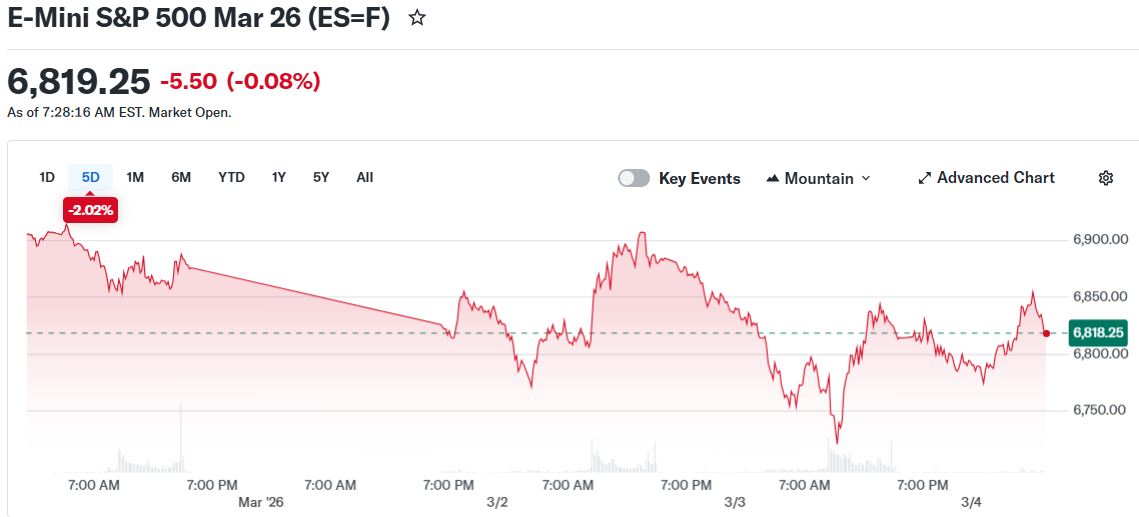
S&P 500 contracts advanced 0.1% while Nasdaq 100 futures climbed approximately 0.2%, erasing morning red ink. Dow Jones industrial average futures hovered near unchanged territory following Tuesday’s broad selloff across major indices.
Military operations continued Wednesday in their fifth consecutive day. Israeli forces conducted additional strikes against targets in Tehran while Iranian authorities organized memorial services for Supreme Leader Ali Khamenei, who perished in weekend bombardments.
Global financial markets have experienced significant turbulence from the escalating hostilities. South Korean exchanges recorded historic single-session losses amid concerns about broader regional instability.
News of Tehran’s diplomatic initiative provided temporary relief to anxious traders. Nevertheless, Washington officials reportedly expressed doubt about the overture’s sincerity, while market watchers cautioned against reading too much into preliminary contacts.

Goldman Sachs Says Stay Calm and Buy
Goldman Sachs analysts, under Peter Oppenheimer’s leadership, issued guidance recommending investors interpret market weakness as accumulation opportunities. Their thesis centers on solid corporate profit trajectories and fundamental economic strength limiting downside potential.
“We see correction risks as high given current valuations, but expect this to present a buying opportunity with relatively low risk of a more protracted and deep bear market,” Oppenheimer wrote.
The research group acknowledged that worldwide equity markets trade at elevated multiples compared to two-decade historical norms. This valuation backdrop amplifies vulnerability to disruptions including Middle Eastern conflict and anxiety surrounding artificial intelligence displacement.
Oppenheimer added that “most geopolitical shocks in recent years have not had a long-lasting impact on markets.”
Oil and the Strait of Hormuz
Energy market dynamics have emerged as a primary investor preoccupation. President Trump announced Tuesday that Washington would arrange protection and insurance coverage for petroleum carriers navigating the Strait of Hormuz, where maritime activity has slowed considerably amid Iranian intimidation.
Brent crude contracts declined more than 2% following diplomatic reports, settling near $82 per barrel. West Texas Intermediate fell toward $75 territory.
Elevated energy costs threaten to reignite inflationary pressures, potentially constraining the Federal Reserve’s flexibility on monetary policy adjustments.
Market participants are carefully monitoring Wednesday’s ADP employment figures. The private sector jobs data precedes Friday’s comprehensive labor market release, both critical factors shaping Federal Reserve interest rate projections.
Quarterly results from Broadcom, Costco, and Alibaba remain on tap for the current week.
Get 3 Free Stock Ebooks
Discover top-performing stocks in AI, Crypto, and Technology with expert analysis.
- Top 10 AI Stocks - Leading AI companies
- Top 10 Crypto Stocks - Blockchain leaders
- Top 10 Tech Stocks - Tech giants



