


Key Takeaways
- Goldman Sachs reaffirms $5,400 per troy ounce gold forecast through end-2026
- March saw gold plunge 13–15%, marking its worst monthly performance since 2009
- Middle East tensions and inflation concerns have delayed expected Federal Reserve rate cuts
- Analysts expect central bank purchasing to accelerate and lift prices
- Bear case scenario projects potential drop to $3,800 under extreme conditions
Goldman Sachs continues to stand behind its projection that gold will climb to $5,400 per troy ounce before 2026 ends. The investment bank issued this reaffirmation in a research note published Monday, March 31, 2026.
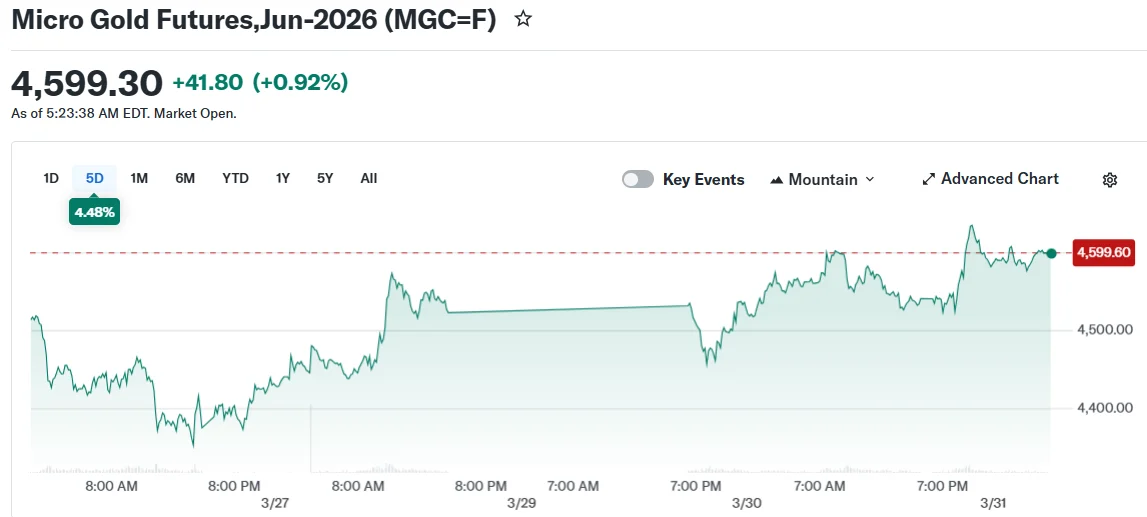
March has proven brutal for gold investors. The precious metal has tumbled approximately 13% this month, hovering around $4,500 on Tuesday. This represents gold’s sharpest single-month decline in 17 years. After touching a peak near $5,500 on January 29, gold has been in retreat mode.
Escalating warfare across the Middle East stands as the primary catalyst behind the selloff. The ongoing conflict has choked energy supply chains and sparked inflation anxieties, prompting financial markets to abandon expectations for Federal Reserve interest rate reductions in 2026.
Goldman analysts Lina Thomas and Daan Struyven calculate gold’s present fair value at approximately $4,550, factoring in today’s macroeconomic landscape. This valuation presumes existing policy hedges stay intact.
The research team contends that gold hasn’t lost its status as a safe-haven investment. They explain that gold responds distinctly based on inflation’s underlying cause. Supply-shock inflation, like current conditions, generally benefits broad commodity markets. Gold shines brightest when inflation fears stem from questions about central bank reliability.

“Similar to 2022, gold usually lags initially during supply disruption scenarios,” the analysts explained. Rising yields increase the opportunity cost associated with non-yielding gold, while equity market selloffs can trigger margin-call liquidations.
Three Pillars Supporting Goldman’s Bullish Outlook
Goldman’s $5,400 projection relies on three fundamental drivers. The first involves normalizing speculative positions within the Comex futures marketplace, which the firm values at roughly $195 per troy ounce.
The second pillar centers on Goldman’s economics team projecting two Federal Reserve rate reductions during 2026, which analysts calculate would contribute approximately $120 per ounce to gold prices.
The third component anticipates renewed momentum in central bank gold acquisitions, returning to approximately 60 tonnes monthly. Goldman calculates this factor alone could inject $535 per troy ounce into prices.
Speculative net positions on Comex have declined to the 39th percentile. Goldman characterizes the market as being in “cleaner” condition and representing a “more attractive entry point.”
Potential Downside Scenarios
Goldman acknowledges meaningful downside possibilities. Extended disruption affecting the Strait of Hormuz, coupled with additional equity market deterioration, could drive gold toward $3,800 in a worst-case scenario.
The firm dismissed speculation about Gulf region central banks liquidating gold holdings. Gulf states maintain smaller gold allocation percentages compared to Turkey, which offloaded approximately 52 tonnes. These nations manage their currencies through dollar-pegged mechanisms, making U.S. Treasury liquidations more probable than gold disposals.
Looking beyond the immediate horizon, Goldman identifies upside potential exceeding $5,400. Geopolitical disruptions and mounting concerns regarding Western fiscal stability could propel gold to $5,700, potentially reaching $6,100 with increased hedging activity.
The Iranian conflict has now extended one month without signs of resolution. President Trump has issued warnings that the U.S. would strike Iran’s energy infrastructure should the Strait of Hormuz blockage persist.
Get 3 Free Stock Ebooks
Discover top-performing stocks in AI, Crypto, and Technology with expert analysis.
- Top 10 AI Stocks - Leading AI companies
- Top 10 Crypto Stocks - Blockchain leaders
- Top 10 Tech Stocks - Tech giants



