


Key Highlights
- Goldman Sachs reduced its 2026 year-end gold price projection from $5,400 to $4,900 per ounce
- The downgrade arrives after the Federal Reserve maintained current interest rates with potential increases under consideration
- Federal Reserve Chair Kevin Warsh adopted a hawkish stance, emphasizing inflation remains well above the 2% objective
- May 2026 US inflation reached 4.2%, surpassing analyst predictions
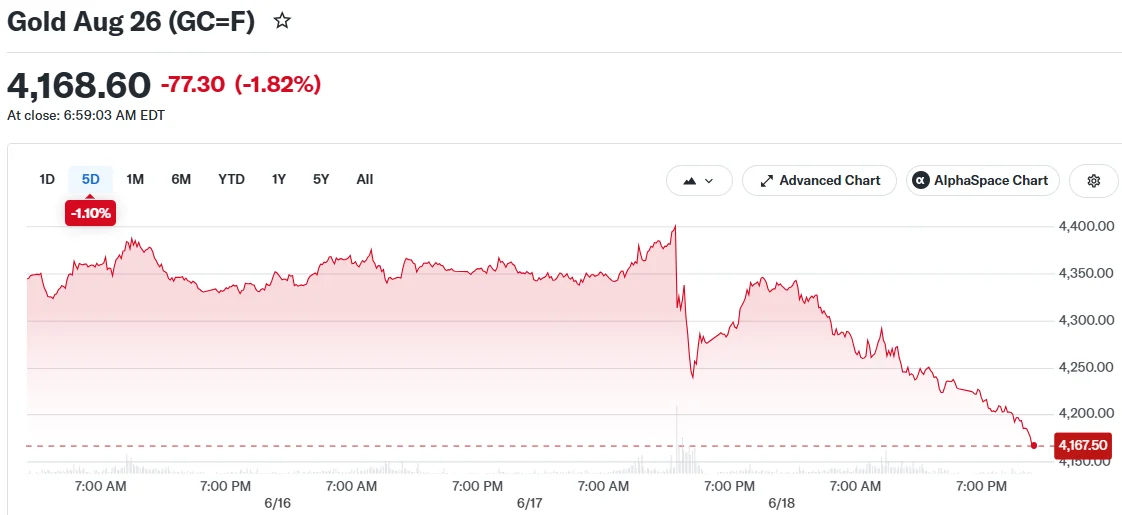
- Bullion prices have declined approximately 26% from the January 2026 record peak of $5,626.80
Bullion markets touched unprecedented levels in early 2026 as market participants flocked to defensive assets amid escalating US-Iran tensions. However, the landscape has shifted dramatically. Persistent inflationary pressures, dollar strength, and an increasingly restrictive Federal Reserve stance have triggered a substantial price correction.
Investment strategists Lina Thomas and Daan Struyven from Goldman Sachs adjusted their year-end precious metals outlook, lowering their gold target from $5,400 to $4,900 per ounce. The analysts characterized their perspective as “structurally constructive but tactically cautious,” acknowledging heightened downside vulnerabilities in the immediate term.
The investment bank released its updated analysis on Thursday, immediately following the Federal Reserve’s decision to maintain its benchmark interest rate at the current level during its most recent policy meeting.
Inflation in the United States climbed to 4.2% in May 2026, exceeding market forecasts. The central bank’s 2% inflation objective remains considerably distant, and newly appointed chair Kevin Warsh expressed significant concern during his inaugural meeting at the helm.
Warsh’s policy messaging was characterized as “surprisingly hawkish” by Goldman strategists. Financial markets have started incorporating the possibility of an interest rate increase before year-end.

Should the Federal Reserve proceed with tightening monetary policy, Goldman cautioned that precious metals could experience additional losses — potentially declining to $4,400 by December. The research team noted that investment demand for gold as a macroeconomic policy hedge might “unwind more persistently” under such conditions.
Dramatic Reversal From Peak Valuations
The precious metal achieved an all-time record of $5,626.80 during late January 2026. This rally was fueled by the escalating US-Iran confrontation, which created significant disruptions to worldwide energy distribution networks and prompted investors to pivot toward traditional safe-haven instruments.
Since reaching that apex, gold has experienced a decline approaching 26%. The commodity was changing hands in the $4,145 to $4,166 range at the time of publication, with variations across different trading platforms.
Spot gold appeared headed for its third consecutive weekly loss as of Friday’s trading session. Silver experienced parallel weakness, retreating 2.5% to settle at $64 per ounce.
Geopolitical Developments Remain Influential
A potential peace accord between the United States and Iran gained traction after American authorities announced the removal of sanctions on Iranian maritime operations on Thursday. Petroleum transport vessels began transiting through the Strait of Hormuz following this development.
Nevertheless, emerging reports indicate that Israel has intensified military activities involving Lebanon, potentially jeopardizing any diplomatic progress. A complete collapse of peace negotiations could regenerate safe-haven appetite for precious metals.
Morgan Stanley similarly reduced its bullion forecast to $5,200, identifying ascending bond yields as a primary headwind.
Goldman maintains expectations for gold to conclude the year above present trading levels, despite the lowered projection. However, the trajectory remains fundamentally dependent on forthcoming Federal Reserve policy actions.
Strategists anticipate continued near-term headwinds, while acknowledging medium-term upside potential contingent on evolving macroeconomic circumstances.
At publication time, the SPDR Gold Shares ETF was mirroring the broader weakness observed across bullion markets.
Get 3 Free Stock Ebooks
Discover top-performing stocks in AI, Crypto, and Technology with expert analysis.
- Top 10 AI Stocks - Leading AI companies
- Top 10 Crypto Stocks - Blockchain leaders
- Top 10 Tech Stocks - Tech giants



