


TLDR
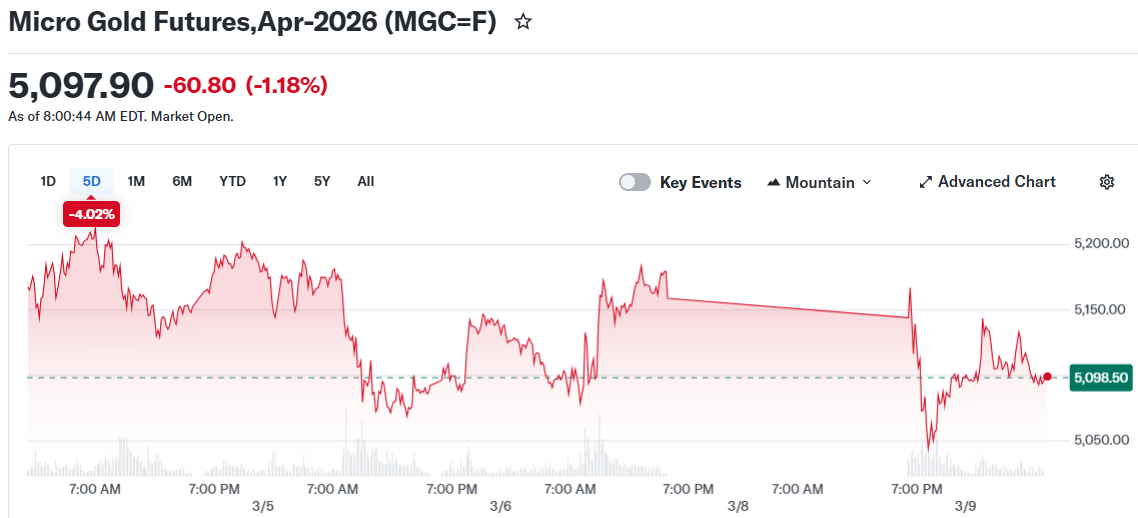
- Gold prices declined 1.5% to $5,096.51/oz during Monday trading, with the session’s lowest point reaching $5,015.23/oz
- Crude oil prices surged dramatically — with Brent approaching $120/barrel — triggering inflation concerns that impacted gold negatively
- The dollar index climbed by as much as 0.7%, creating downward pressure on precious metal valuations
- Despite the decline, gold maintains its position above $5,000/oz and shows approximately 18% gains for the year
- Monday witnessed losses across multiple precious metals including silver, platinum, and palladium, with silver recovering significantly
Precious metals experienced significant downward pressure on Monday as the ongoing US-Israel military engagement with Iran reached its tenth day, triggering dramatic increases in crude oil valuations and dollar strength — creating a challenging environment for gold and related assets.
The spot price for gold decreased 1.5% to reach $5,096.51/oz during mid-morning trading hours in London. The metal touched its session bottom at $5,015.23/oz, momentarily threatening to fall beneath the psychologically important $5,000 threshold. Meanwhile, gold futures contracts declined 1.1% to settle at $5,104.04/oz.
The precious metal’s retreat occurred as Brent crude oil experienced a dramatic surge of up to 30%, momentarily approaching the $120 per barrel mark. This followed weekend military operations by US and Israeli forces targeting Iranian petroleum infrastructure. Tehran retaliated by launching attacks on maritime vessels navigating the Strait of Hormuz, a critical chokepoint responsible for approximately 20% of worldwide oil transportation.
The dramatic oil spike immediately triggered concerns among market participants regarding inflationary pressures and their potential impact on monetary policy decisions.
Inflation Concerns Shift Federal Reserve Outlook
Elevated petroleum prices create ripple effects throughout the broader economy, potentially accelerating inflation metrics. This scenario diminishes expectations for Federal Reserve interest rate reductions — and may even increase the probability of rate hikes. Gold, which generates no yield, typically underperforms when interest rate expectations trend upward or remain elevated.

The Bloomberg Dollar Spot Index advanced 0.3% during Monday’s session following the previous week’s 1.3% gain. Dollar appreciation makes gold purchases more costly for international buyers, compounding the pressure on prices.
“During episodes of geopolitically induced market turbulence, market participants occasionally liquidate holdings such as gold to generate liquidity,” explained Christopher Wong, strategist at Oversea-Chinese Banking Corp. “After this period concludes, geopolitical instability generally continues to support safe haven asset demand during price corrections.”
This conflicting dynamic — safe haven appeal versus interest rate considerations — has characterized gold’s volatile price action throughout recent weeks. The precious metal has oscillated between $5,000/oz and the record peak near $5,600/oz established in late January.
Gold experienced approximately 2% depreciation during the previous week. Friday’s disappointing US employment data temporarily boosted expectations for rate cuts, but the petroleum price surge quickly overshadowed that sentiment.
Broader Precious Metals Weakness
Silver momentarily traded below the $80/oz level before staging a recovery. The session concluded with silver down 0.9% at $83.82/oz. Platinum declined 1.8% while palladium fell 1.7%. Copper futures decreased 0.7% to $12,781.0 per ton.
Notwithstanding Monday’s retreat, gold maintains approximately 18% appreciation for the current year. Central bank acquisitions have provided consistent support, with the People’s Bank of China extending its gold purchasing streak to 16 consecutive months through February.
Ed Meir, analyst at Marex, noted in a Friday research report that a rapid conflict resolution would likely diminish dollar strength and support gold prices, whereas a protracted military engagement would drive yields and the dollar higher based on inflation expectations. Brent crude was most recently trading approximately 12.5% higher for the session.
Get 3 Free Stock Ebooks
Discover top-performing stocks in AI, Crypto, and Technology with expert analysis.
- Top 10 AI Stocks - Leading AI companies
- Top 10 Crypto Stocks - Blockchain leaders
- Top 10 Tech Stocks - Tech giants



