


TLDR
- Gold remains confined to a $4,400–$4,600/oz trading corridor over the last ten days
- Diplomatic efforts between Washington and Tehran persist without meaningful progress
- Rising inflation concerns drive market expectations for a Federal Reserve rate increase by year-end
- Currency strength and monetary policy now outweigh geopolitical risk in gold pricing
- Precious metals sector sees weakness across silver and platinum as well
The price of gold continues to hover around the $4,500 per ounce level as market participants monitor ongoing diplomatic discussions between the United States and Iran. The yellow metal has failed to establish directional momentum beyond a restricted price band.
Asian trading sessions on Wednesday saw spot gold quoted at $4,505.93 per ounce. Futures contracts advanced a modest 0.1% to reach $4,539.01 per ounce. However, as European markets opened, futures retreated 0.4% to settle at $4,483.80.
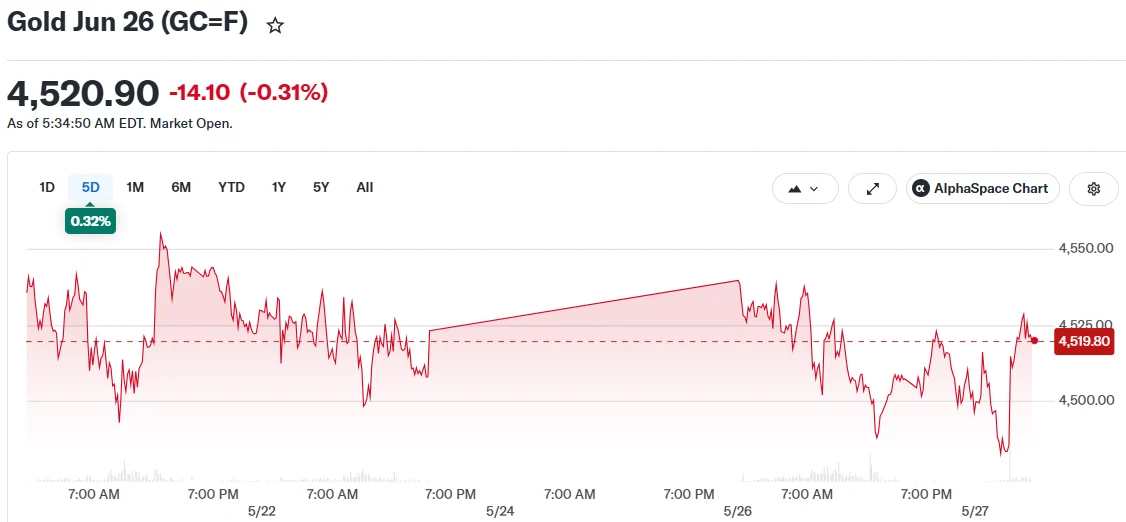
For approximately ten days, the precious metal has remained locked within the $4,400 to $4,600 boundaries. Market participants are navigating conflicting signals stemming from Middle Eastern tensions alongside domestic economic indicators.
According to reporting from Al Jazeera, indirect diplomatic channels between American and Iranian representatives remain active. Nevertheless, significant gaps persist on critical matters such as Tehran’s atomic program and jurisdiction over the strategically vital Strait of Hormuz.
Military action by American forces against locations in Iran’s southern region earlier this week triggered a Tuesday selloff before prices partially stabilized.

Inflation Fears Weigh on Gold
The primary headwind facing gold currently stems from inflation dynamics rather than military confrontations. Recent economic releases revealed energy-fueled price acceleration throughout March and April.
This development has prompted financial markets to anticipate potential interest rate increases from major central banking institutions, particularly the Federal Reserve. Elevated borrowing costs traditionally diminish gold’s attractiveness since they increase the opportunity cost of maintaining non-yielding assets.
CME Fedwatch data indicates markets are currently assigning nearly a 40% probability to a Federal Reserve rate hike occurring before December’s conclusion.
Analysts at ANZ noted in their research commentary that heightened inflation prospects have strengthened market conviction regarding potential monetary tightening. They emphasized that any sustainable gold rally would require decoupling from its present correlation with broader risk-sensitive assets.
Simon-Peter Massabni from XS.com observed that gold’s traditional safe-haven characteristics are facing scrutiny. He highlighted that monetary policy direction, dollar valuation, and market liquidity factors have eclipsed geopolitical and military developments in determining price action.
Gold’s Safe-Haven Role Under Pressure
Market behavior suggests participants view inflationary pressures as the more immediate concern. The conventional wisdom that Gold appreciates during crisis periods is encountering challenges.
Since the escalation of US-Iran hostilities, gold has demonstrated relatively weak performance. The metal’s crisis-hedge appeal has been diminished by mounting concerns over monetary policy tightening.
Broader precious metals weakness emerged on Wednesday across the sector. Spot silver declined 0.3% to $76.79 per ounce. Spot platinum retreated 0.9% to $1,948.63 per ounce.
Market attention now turns to forthcoming American economic releases scheduled for this week. Thursday brings revised first-quarter GDP figures alongside the PCE price index, which represents the Federal Reserve’s favored inflation gauge.
These data points possess the potential to recalibrate interest rate expectations and generate significant price movement in gold markets in either direction.
Get 3 Free Stock Ebooks
Discover top-performing stocks in AI, Crypto, and Technology with expert analysis.
- Top 10 AI Stocks - Leading AI companies
- Top 10 Crypto Stocks - Blockchain leaders
- Top 10 Tech Stocks - Tech giants



