


TLDR
- Precious metal prices advanced more than 1% Friday following Iran’s declaration that the Strait of Hormuz would remain accessible to commercial shipping throughout the ceasefire period
- President Trump revealed a 10-day truce between Israel and Lebanon, stating the US and Iran are nearing a comprehensive agreement
- Crude oil markets tumbled dramatically, with Brent benchmark declining 8.3% following the Iranian foreign minister’s statement
- Bullion is poised to secure its fourth consecutive weekly advance, despite trading approximately 9% beneath pre-conflict price levels
- Speculative investors have reduced their net bullish positions on gold to levels not seen in more than 24 months
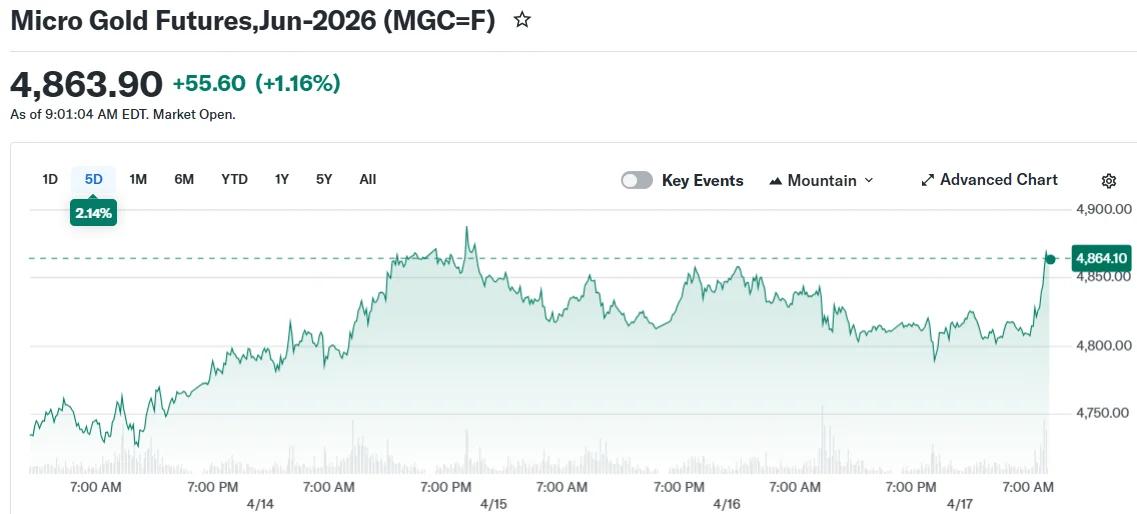
Spot gold values climbed to $4,843.17 per troy ounce during Friday’s morning session, representing a 1.1% increase, after Iran’s Foreign Minister Abbas Araghchi announced via X that the Strait of Hormuz would be accessible to all commercial shipping for the ceasefire’s duration.
The strategic waterway handles approximately 20% of global petroleum and natural gas transport. Its practical blockade following the outbreak of hostilities in late February triggered the most severe energy supply crisis on record and propelled crude prices substantially upward.
Brent crude contracts dropped 8.3% in response to Araghchi’s announcement. American equity index futures amplified their advances following the development.
President Trump disclosed a 10-day cessation of hostilities between Israel and Lebanon on Thursday. Israeli Prime Minister Benjamin Netanyahu verified the arrangement.
Trump indicated that Iran had accepted conditions regarding nuclear armaments it had historically opposed, noting that Washington and Tehran are approaching a comprehensive agreement. He stated Iran has committed to abstaining from nuclear weapon possession for over two decades.

Iran has requested the elimination of international economic penalties in exchange. Trump mentioned he would contemplate prolonging the ceasefire if diplomatic efforts with Tehran continue progressing favorably.
Discussions between Washington and Tehran could potentially restart as soon as this weekend, Trump indicated. Certain European and Middle Eastern Gulf state officials have forecast that a complete agreement might require up to half a year.
What the Ceasefire Means for Gold
Gold has experienced downward pressure throughout most of the seven-week period since hostilities commenced. Elevated petroleum prices intensified inflation concerns, prompting market participants to anticipate central banks maintaining or increasing borrowing costs. Precious metals typically underperform during periods of elevated interest rates.
The American currency also appreciated during the conflict, partially because substantial domestic energy production insulated the US economy from supply chain disruptions. A robust dollar increases gold’s cost for purchasers transacting in alternative currencies. The dollar index was heading toward a 0.5% weekly decline on Friday.
Bullion has staged a recovery in recent weeks but remains approximately 9% below levels observed before the conflict initiated in late February.
Federal Reserve Bank of New York President John Williams commented Thursday that prevailing uncertainty complicates providing definitive rate guidance, though he continues anticipating reductions over an extended timeframe.
Hedge Fund Positioning at Two-Year Low
Speculative funds decreased their net bullish positions on gold to the weakest level in over 24 months during the week concluded April 7, based on recent regulatory data.
Ole Hansen, head of commodity strategy at Saxo Bank, noted the diminished positioning “reduces the risk of further long liquidation” and establishes capacity for renewed purchasing if market conditions remain favorable.
Gold futures contracts were exchanging at $4,865.09 per troy ounce as of Friday morning in New York, up 1.2% for the session. Silver advanced 0.7% to $78.96 per ounce.
Get 3 Free Stock Ebooks
Discover top-performing stocks in AI, Crypto, and Technology with expert analysis.
- Top 10 AI Stocks - Leading AI companies
- Top 10 Crypto Stocks - Blockchain leaders
- Top 10 Tech Stocks - Tech giants



