


TLDR
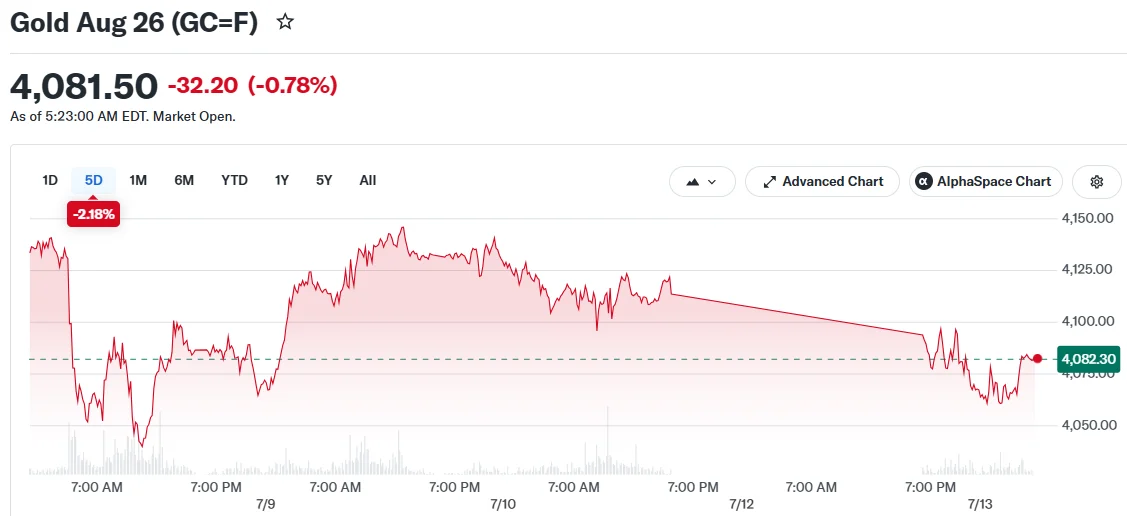
- Gold declined more than 1.5% Monday, trading around $4,057 per ounce following weekend military action between U.S. and Iran
- Crude oil prices surging on supply disruption concerns, threatening to reignite inflationary pressures
- Elevated energy costs may force the Federal Reserve to maintain aggressive monetary policy stance, weighing on precious metals
- Market participants await Tuesday’s consumer inflation data and new Fed Chair Kevin Warsh’s debut testimony before Congress
- The yellow metal discovered support around $4,000 recently; breaking through $4,200 resistance could trigger broader upward momentum
Precious metals experienced significant selling pressure Monday following weekend military operations by the United States against Iranian facilities, which propelled crude oil prices higher and rekindled worries about inflation.
As of approximately 01:05 ET, spot gold declined 1.54% to reach $4,057.76 per ounce. Futures contracts for gold decreased 1.17% to $4,065.45. Silver experienced steeper losses, falling 2.80% to $58.19 per ounce, while platinum declined 1.61% to $1,604.60.
The recent military escalation occurred after U.S. forces targeted Iranian installations in response to an assault on a Cyprus-registered cargo ship navigating through the strategically vital Strait of Hormuz. Iranian authorities announced the critical waterway would stay closed indefinitely. American officials challenged this assertion.
Oil prices climbed over 3% Monday after spiking nearly 5% earlier in the session. Market participants are factoring in potential supply chain disruptions through the Strait of Hormuz corridor.
Inflationary Concerns Weigh on Precious Metals
Surging energy costs are reviving anxieties about a fresh wave of inflation. This development could compel the Federal Reserve to maintain elevated interest rates for an extended period, creating headwinds for gold.

Gold generates no yield or dividends. When bond yields and the dollar strengthen, gold loses its appeal among investors. The U.S. Dollar Index climbed 0.3% Monday, compounding downward pressure on the precious metal.
The Federal Reserve’s June policy meeting minutes, published last week, revealed multiple committee members believed there was justification for tightening monetary policy further. Officials also highlighted increasing unease about price pressures, even as employment concerns diminished.
The Federal Reserve’s next scheduled policy meeting takes place July 28–29.
Critical Economic Releases Could Shape Gold’s Direction
Market attention has now shifted to two significant upcoming events. The first is Tuesday’s release of U.S. consumer price index figures. The second is Federal Reserve Chair Kevin Warsh’s inaugural appearance before Congress.
Either event carries substantial market-moving potential. Inflation data exceeding forecasts could strengthen the dollar and pressure gold lower. Conversely, softer readings might provide support for the precious metal.
Tony Sycamore, market analyst at IG, noted that gold remains exceptionally responsive to both geopolitical developments and U.S. inflation statistics currently.
He indicated that gold maintained support around the $4,000 threshold last week. A decisive breakout above $4,200–$4,220 could facilitate a recovery toward the 200-day moving average positioned near $4,491.
Nevertheless, Sycamore cautioned that robust CPI figures could solidify market expectations for an additional Fed rate increase before 2025 concludes.
Gold continues navigating between geopolitical uncertainty providing price support and monetary policy considerations exerting downward pressure. Currently, macroeconomic factors appear to be dominating price action.
Get 3 Free Stock Ebooks
Discover top-performing stocks in AI, Crypto, and Technology with expert analysis.
- Top 10 AI Stocks - Leading AI companies
- Top 10 Crypto Stocks - Blockchain leaders
- Top 10 Tech Stocks - Tech giants



