


Key Takeaways
- Gold futures declined 0.2% to reach $4,400.50 per ounce on Tuesday amid U.S. dollar strength.
- Spot prices tumbled as much as 2%, marking a roughly 21% decline from the late-January high of $5,594.82.
- Market volatility increased following Saudi Arabia’s agreement to allow U.S. military operations from King Fahd air base.
- Global X ETFs and Standard Chartered analysts maintain bullish outlooks, projecting gold could hit $5,375–$6,000 before year-end.
- Yardeni Research’s Ed Yardeni continues to forecast $10,000 per ounce by decade’s end despite near-term weakness.
The precious metal has officially crossed into bear market territory after plummeting more than 20% from its peak earlier this year. However, market experts suggest this downturn could be temporary.
Spot gold experienced a sharp decline of up to 2% during Tuesday’s trading session before recovering slightly to close at $4,335.97 per ounce. Gold futures similarly retreated approximately 2% to settle at $4,317.80. The commodity has now shed roughly 21% of its value since reaching a late-January high of $5,594.82.
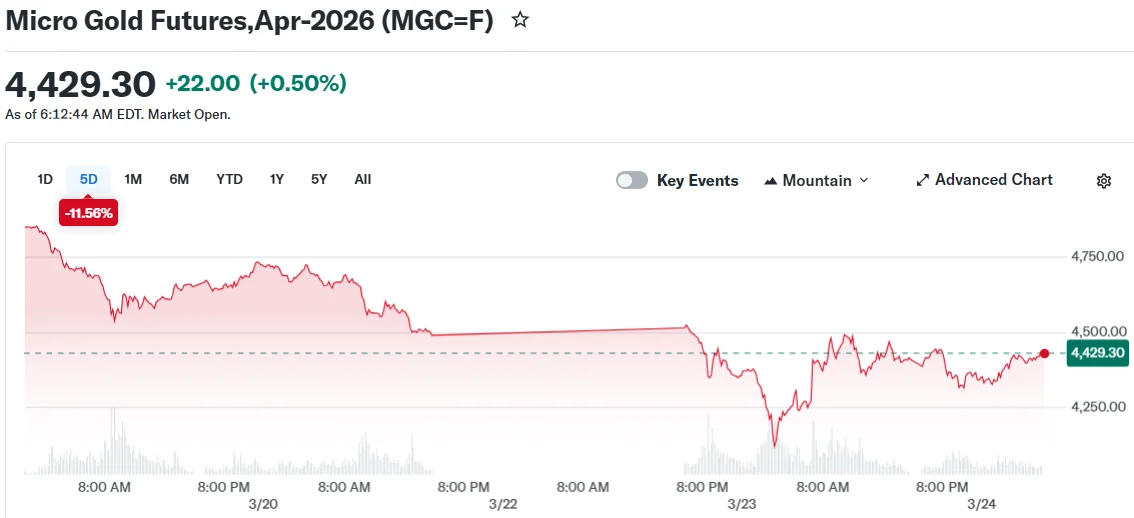
Continuous futures contracts for gold also experienced a modest 0.2% decline, settling at $4,400.50 per ounce. Meanwhile, the U.S. Dollar Index climbed 0.4%, creating additional headwinds for the yellow metal. Since gold trades in U.S. dollars, currency appreciation makes purchases more costly for international investors.
Gold has surrendered 17% of its value throughout March, based on FactSet analytics. Meanwhile, the dollar index has appreciated approximately 3% since hostilities with Iran commenced on February 28.
Tuesday’s decline was partially attributed to a Wall Street Journal report revealing that Saudi Arabia granted U.S. forces access to the King Fahd air base. This development represented a notable departure from the kingdom’s previous stance refusing to permit its facilities for operations in the Iranian conflict.

Neil Welsh, metals division head at Britannia Global Markets, noted that financial markets continue demonstrating heightened sensitivity to geopolitical shifts. Without a discernible path toward conflict resolution, he cautioned that gold market turbulence will likely persist.
The price retreat also followed President Donald Trump’s Monday announcement ordering a five-day suspension of planned attacks on Iranian energy facilities. This development temporarily reduced geopolitical tensions that had previously underpinned gold valuations.
Wall Street’s Case for Higher Gold Prices
Notwithstanding the dramatic correction, numerous market strategists refuse to view this as a fundamental shift in gold‘s trajectory. They emphasize central bank accumulation, persistent geopolitical risks, and anticipated dollar weakness as rationale for maintaining optimistic positions.
Ed Yardeni, who leads Yardeni Research, adjusted his year-end projection downward to $5,000 per ounce from $6,000. However, he confirmed to CNBC his continued conviction in a $10,000 per ounce valuation by 2030.
Justin Lin, an investment strategist with Global X ETFs, established his year-end forecast at $6,000, characterizing the recent decline as “a compelling entry point for investors.” He attributed the selloff to transitory factors including elevated interest rates and portfolio adjustments.
Lin emphasized that his optimistic perspective exists independently of Middle Eastern tensions. He identified sustained central bank purchasing and capital flows from Asian gold exchange-traded fund participants as primary catalysts.
Standard Chartered similarly maintains a constructive view on precious metals. Senior Investment Strategist Rajat Bhattacharya stated the institution anticipates gold rebounding toward $5,375 within the next quarter, following the completion of current selling pressure. He identified technical price support near the $4,100 threshold.
Central Bank Demand Provides Foundation
Emerging economy central banks have consistently accumulated gold reserves as part of dollar-diversification strategies. Lin suggested a “high likelihood” that monetary authorities will accelerate purchases following the recent price decline.
Bhattacharya noted that renewed U.S. dollar weakness would provide additional tailwinds for gold valuations. Market participants anticipate Federal Reserve rate reductions at some juncture, which could exert downward pressure on the greenback.
Standard Chartered identifies technical price support for gold in the vicinity of $4,100 per ounce.
Get 3 Free Stock Ebooks
Discover top-performing stocks in AI, Crypto, and Technology with expert analysis.
- Top 10 AI Stocks - Leading AI companies
- Top 10 Crypto Stocks - Blockchain leaders
- Top 10 Tech Stocks - Tech giants



