


TLDR
- Gold futures declined 0.7% to settle at $5,191.60 while maintaining support above $5,100 on Feb. 26, 2026
- Diplomatic negotiations between Washington and Tehran remain a critical factor that could trigger significant price movement
- Weekly performance shows impressive gains exceeding 3.5%, fueled by geopolitical risks and trade policy concerns
- Chart analysis indicates bullish momentum with upside targets at $5,500 followed by $6,000
- Elevated U.S. borrowing costs continue to pressure gold by making yield-generating investments more competitive
The precious metal experienced a modest retreat during Thursday’s early session on Feb. 26, 2026. Comex gold futures for New York delivery slipped 0.7% to reach $5,191.60 per troy ounce.
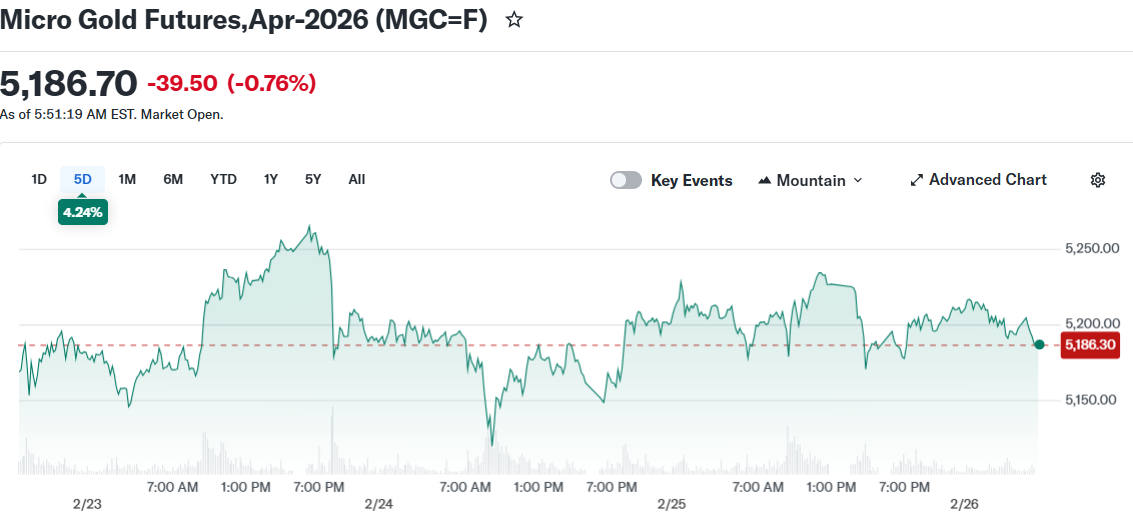
Despite this pullback, the precious metal maintained solid footing above the psychologically important $5,100 threshold. Weekly performance remains impressive, with gains surpassing 3.5%.
The modest decline reflected investor calculations about the Federal Reserve’s monetary stance potentially remaining unchanged for an extended period. Since gold generates no yield, elevated interest rates diminish its relative attractiveness against alternative investments.
Market participants were simultaneously monitoring scheduled diplomatic discussions between Washington and Tehran on Thursday. These negotiations are viewed as a pivotal near-term catalyst for precious metal valuations.
Steve Witkoff, serving as America’s lead negotiator with Iran, has cautioned that Tehran possesses the capability to generate weapons-grade nuclear material within a matter of days. This assessment has maintained heightened vigilance among market participants.

According to analysts and diplomatic sources referenced by the Wall Street Journal, Iran’s atomic program hasn’t seen substantial development since coordinated U.S.-Israeli strikes targeted its three primary nuclear facilities last June.
Tony Sage, who leads Critical Metals as CEO, noted that financial markets are paying close attention to these diplomatic exchanges. He suggested that failed negotiations might drive capital flows toward defensive holdings like gold.
Research teams at ING indicated that any conflict escalation involving Iran would probably strengthen gold’s pricing floor. They emphasized that the fundamental factors supporting the metal’s previous rally continue to hold firm.
Technical Setup Points Higher
From a chart perspective, indicators suggest upward momentum. Joseph Chai, an analyst with RHB Retail Research, identified a new bullish candlestick formation on daily timeframes indicating reduced downward pressure.
Chai believes gold buyers have regained control of market direction. His analysis points to potential advancement toward the $5,500 per ounce resistance zone.
Should prices breach $5,500, Chai projects a subsequent move toward $6,000 per ounce. Both 20-day and 50-day simple moving averages are sloping upward, reinforcing this constructive view.
What’s Keeping a Lid on Prices
The primary headwind facing gold currently stems from interest rate projections. Should the Federal Reserve maintain its current policy stance for an extended duration, assets without yield face stiffer competition from income-generating alternatives.
However, growing ambiguity surrounding American trade policies has partially counterbalanced this negative influence. Protective portfolio positioning has prevented prices from breaching the $5,100 floor.
Spot gold demonstrated resilience in Asian trading sessions, advancing 0.6% to $5,196.37 per ounce, recovering some ground lost during early futures trading.
As Thursday progressed, market attention remained concentrated on the Washington-Tehran diplomatic outcome as the next significant driver for the precious metal’s trajectory.
Get 3 Free Stock Ebooks
Discover top-performing stocks in AI, Crypto, and Technology with expert analysis.
- Top 10 AI Stocks - Leading AI companies
- Top 10 Crypto Stocks - Blockchain leaders
- Top 10 Tech Stocks - Tech giants



