



TLDR
- Nationwide gasoline prices surpassed $4 per gallon for the first time since late summer 2022, reaching an average of $4.018 nationally.
- Oil benchmark prices have jumped approximately 50% in the last month following the outbreak of the US-Iran conflict.
- Emergency policy measures from the Trump administration, including ethanol and shipping regulation waivers, have failed to lower fuel costs.
- Diesel prices reached $5.45 per gallon — marking an unprecedented monthly increase.
- Goldman Sachs updated its Brent oil projection to $115 for April, while some market watchers suggest prices could reach $200 if hostilities persist into June.
Fuel costs across the United States breached a significant threshold this Tuesday, surpassing $4 per gallon for the first time in nearly three years. According to GasBuddy, a leading fuel price tracking service, the nationwide average reached $4.018 per gallon, representing an unprecedented monthly price escalation.
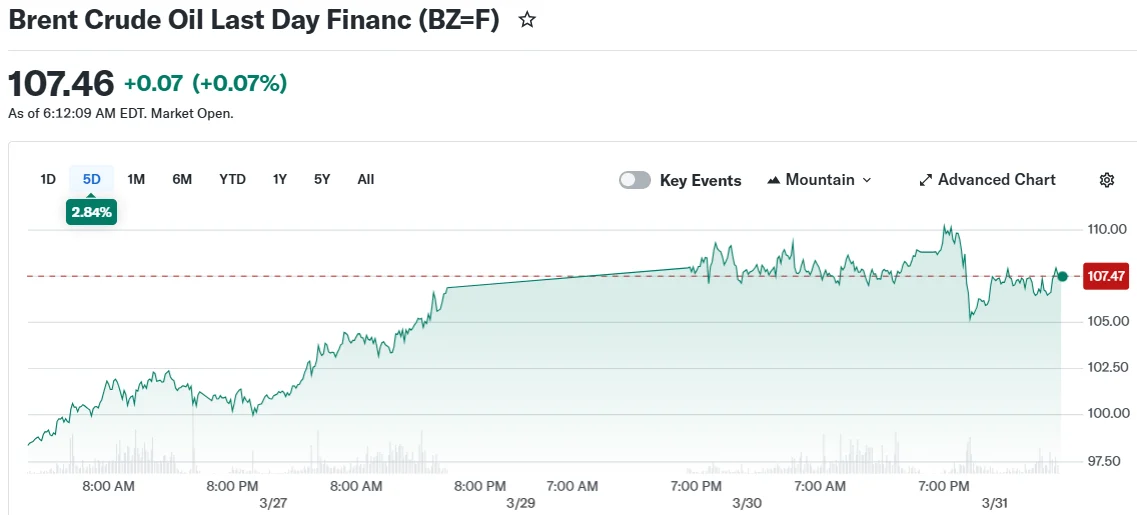
This dramatic increase stems directly from the continuing US-Iran conflict, which has now entered its fifth week. During this period, both Brent crude and West Texas Intermediate have experienced approximately 50% gains, with Brent currently trading around $107.80 per barrel and WTI hovering near $102 per barrel.
Compared to this time last year, average fuel prices have climbed roughly $1 per gallon. The vast majority of this increase has occurred since military operations commenced.
The transportation industry faces even steeper challenges. Diesel fuel averaged $5.45 per gallon nationwide on Tuesday — another record-breaking monthly surge, according to GasBuddy data.
On March 25, the administration issued emergency regulatory relief, suspending federal restrictions on E15 gasoline — a more affordable fuel mixture with higher ethanol content. Additionally, the White House temporarily lifted Jones Act shipping regulations for 60 days, which typically increase domestic transportation expenses.

Despite these interventions, consumer prices have continued their upward trajectory without any meaningful relief.
The Strait of Hormuz Problem
Even with a potential swift resolution to the conflict, oil prices are unlikely to decline rapidly. The critical issue centers on the Strait of Hormuz, a vital waterway that transported approximately 20% of the world’s oil and natural gas supplies before the current crisis erupted.
According to a Wall Street Journal report citing senior administration sources, President Trump has indicated openness to scaling back military operations even if the Strait remains substantially blocked. As long as this crucial shipping lane continues to face disruptions, energy prices are expected to stay in triple-digit territory.
The consequences are spreading throughout Asia. Since most crude oil passing through the Strait was destined for Asian refining facilities, the disruption has forced dramatic responses. Bangladesh has temporarily closed universities, while Pakistan and the Philippines have implemented reduced workweek schedules to conserve energy resources.
Defense Secretary Pete Hegseth and Chairman of the Joint Chiefs of Staff Gen. Dan Caine were slated to address the media Tuesday morning at 8 a.m. Eastern time.
What Analysts Are Saying
Goldman Sachs revised its Brent crude forecast upward from $85 to $115 for April, attributing the adjustment to extended disruptions and heightened risk premiums associated with the Strait of Hormuz situation. High-ranking Saudi officials have developed scenarios projecting Brent at $180 if the conflict extends through April. Meanwhile, Macquarie analysts have warned that Brent could exceed $200 per barrel should hostilities continue into June.
Premium gasoline grades and aviation fuel are experiencing similar price pressures. While retail consumers face significant pain at the pump, commercial fleet operators are absorbing even more substantial costs on diesel fuel.
Brent crude futures were last recorded trading near $107.61, showing modest gains during the trading session.
Get 3 Free Stock Ebooks
Discover top-performing stocks in AI, Crypto, and Technology with expert analysis.
- Top 10 AI Stocks - Leading AI companies
- Top 10 Crypto Stocks - Blockchain leaders
- Top 10 Tech Stocks - Tech giants



