



Key Highlights
- Ethereum currently trades around $2,024, battling to maintain the crucial $2,000 support threshold
- Large wallets containing 100,000+ ETH have increased their total to 17.41 million ETH, marking a nine-week peak
- Crypto analyst Ted highlights declining spot market interest and ETF outflows, noting that each minor price bounce gets reversed
- Publicly-traded Bit Digital acquired 8,568 ETH valued at approximately $20 million during the recent price decline
- Standard Chartered continues projecting a $40,000 ETH long-term price objective despite present market softness
As of May 31, 2026, Ethereum is exchanging hands near the $2,024 mark, maintaining position slightly above a crucial support threshold that market participants have been monitoring intently. The price movement has remained largely range-bound following several turbulent trading sessions centered around the $2,000 psychological barrier.
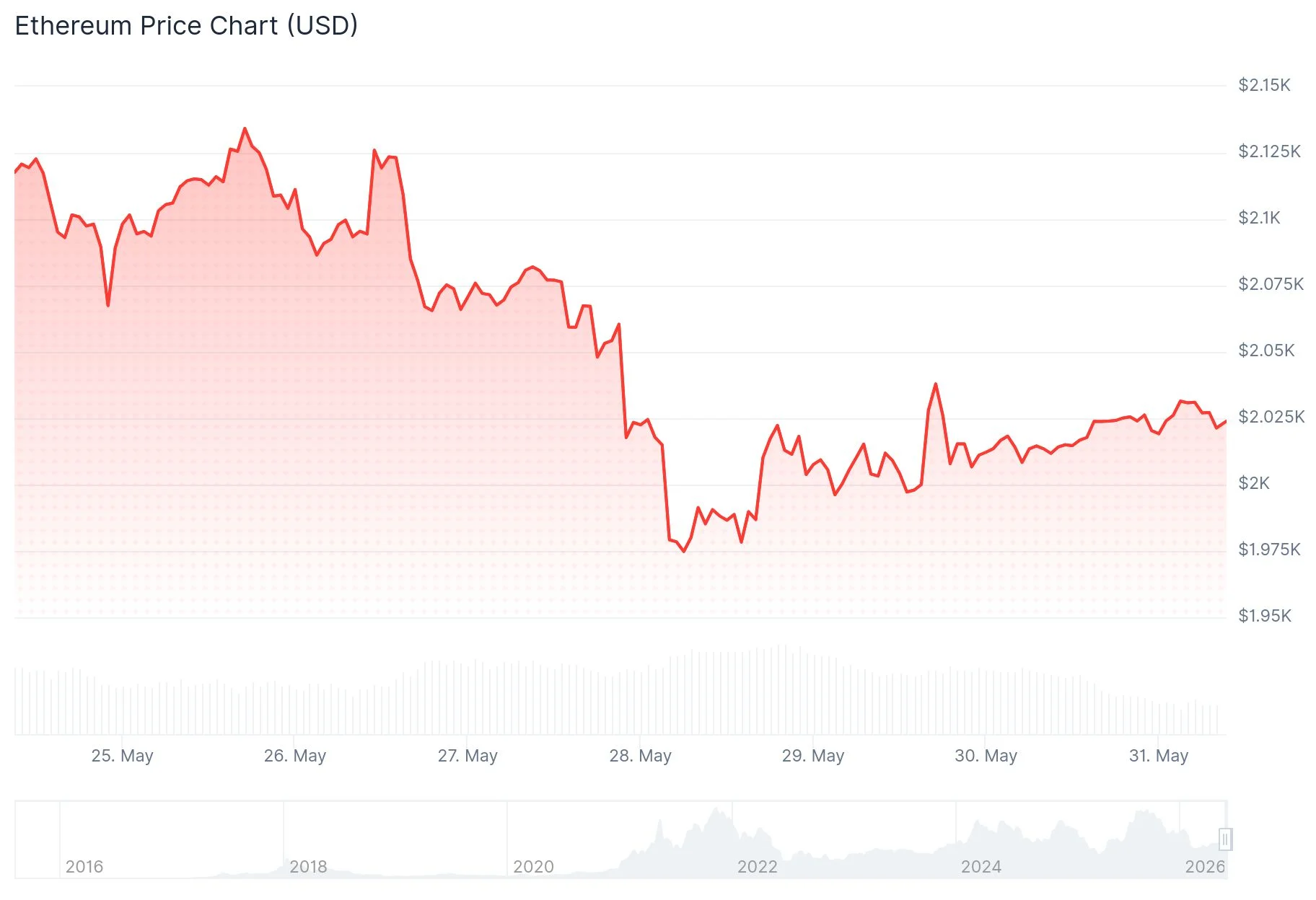
Market sentiment appears divided. While near-term technical indicators suggest vulnerability, blockchain data reveals a contrasting narrative developing beneath the price action.
Crypto analyst Ted shared his assessment on X, noting that while ETH maintains its position above $2,000, the technical configuration appears precarious. His analysis highlights diminishing spot market activity, negative ETH ETF flows, and consistent reversal of upward price movements. According to Ted, without a definitive close above $2,050, the probability of additional downside pressure remains significant.
The $2,000–$2,050 range has emerged as the focal point for short-term chart analysis. Sustained defense by buyers could enable a push toward $2,100. A breakdown would expose the next critical zone near $1,994, with additional support identified between $1,900–$1,850.
Major Holders and Corporate Entities Continue Accumulation
Despite sideways price movement, substantial holders have been systematically expanding their positions. Blockchain analytics from Santiment reveal that addresses containing a minimum of 100,000 ETH have grown their collective balance to 17.41 million ETH. This represents the highest concentration observed in more than nine weeks. These whale entities now control 22.03% of the total circulating Ethereum supply.

Corporate accumulation continues as well. Public company Bit Digital, listed on Nasdaq, acquired an additional 8,568 ETH valued near $20 million, elevating its total Ethereum reserve beyond 158,000 ETH. This purchase occurred during the current phase of price consolidation.
Reports indicate that Bitmine’s Tom Lee also allocated $50 million toward ETH purchases, reinforcing the accumulation trend observed at these price levels.
This week, Standard Chartered reiterated its long-term price projection of $40,000 for ETH, pointing to expanding tokenization of real-world assets and decentralized finance adoption as catalysts not yet reflected in current valuations.
Critical Price Zones Under Observation
Examining the ETH/BTC trading pair, Ethereum has experienced relative weakness against Bitcoin beginning in August 2025. The pair has now arrived at a significant long-term support area, prompting close monitoring for potential reactions. Analyst Daan Crypto Trades observed that previous periods of ETH/BTC strength were partially driven by substantial buyer activity. Without renewed catalysts, recovery momentum may develop gradually.
Trader Tardigrade identified that Ethereum has been constructing a pattern of ascending lows spanning multiple market cycles, a formation that has historically preceded significant recoveries. While the current structure awaits confirmation, parallels to previous cycle troughs maintain longer-term optimistic scenarios.
Resistance zones for ETH are positioned at $2,050, $2,100, and $2,200, with $2,500 representing a broader target should bullish momentum resurface. For downside scenarios, $1,994 and $1,850 constitute the most closely monitored support levels among traders.
Bit Digital’s most recent treasury acquisition of 8,568 ETH, executed during the ongoing price dip, stands as the latest documented institutional purchase activity.
Get 3 Free Stock Ebooks
Discover top-performing stocks in AI, Crypto, and Technology with expert analysis.
- Top 10 AI Stocks - Leading AI companies
- Top 10 Crypto Stocks - Blockchain leaders
- Top 10 Tech Stocks - Tech giants



