



Key Takeaways
- Jeffrey Wilcke, an Ethereum co-founder, deposited 79,258 ETH (approximately $157M) onto Kraken exchange on March 7
- Ethereum creator Vitalik Buterin offloaded 17,196 ETH (roughly $35M) during February, contributing to insider distribution
- Since the beginning of 2026, ETH has declined 34%, currently hovering between $1,944 and $1,976
- A single day saw Ethereum spot ETFs experience $82.85M in net withdrawals, with Fidelity’s FETH responsible for $67.57M
- Technical analysts caution that ETH might decline to $1,800 or potentially $1,500 if critical support zones fail
On March 7, Ethereum co-founder Jeffrey Wilcke executed a substantial transfer of 79,258 ETH to the Kraken cryptocurrency exchange. At the time of the transaction, this represented a value of roughly $157 million.
The on-chain movement was detected by Lookonchain, a blockchain intelligence platform, which observed activity across four separate wallet addresses. These wallets had remained dormant for approximately seven months prior to this recent activity.
Analysts at SpotOnChain discovered an interesting “round-trip” transaction pattern. The identical wallets had previously withdrawn the exact same quantity of ETH from Kraken approximately 10 months earlier, at a time when Ethereum was valued near $2,600.
This pattern indicates the tokens were likely held in custody and are now being returned to the exchange platform, presumably for liquidation purposes. Wilcke maintains an on-chain balance of 27,241 ETH, currently valued at approximately $53.56 million.
In recent years, Wilcke has withdrawn from active participation in Ethereum’s core development. His attention has pivoted toward private gaming projects.

Buterin’s Recent Sales Activity
During February, Vitalik Buterin liquidated 17,196 ETH, totaling approximately $34.96 million. This sale surpassed his publicly announced intention to sell 16,384 ETH.
According to Buterin’s statements, proceeds from these sales will fund open-source initiatives spanning software and hardware development in the financial, governance, and biotechnology sectors. His holdings have decreased from over 240,000 ETH at the start of 2026 to approximately 224,000 ETH currently.
Additionally, an ancient Ethereum ICO-era wallet recently became active. After remaining untouched for 10.6 years, this wallet transferred 100.275 ETH. The original investment during the ICO phase was a mere $124.
Ethereum Price Action Weakens
Since the start of 2026, ETH has experienced a 34% decline. Recent trading activity has confined the price within a range of $1,944 to $1,990.
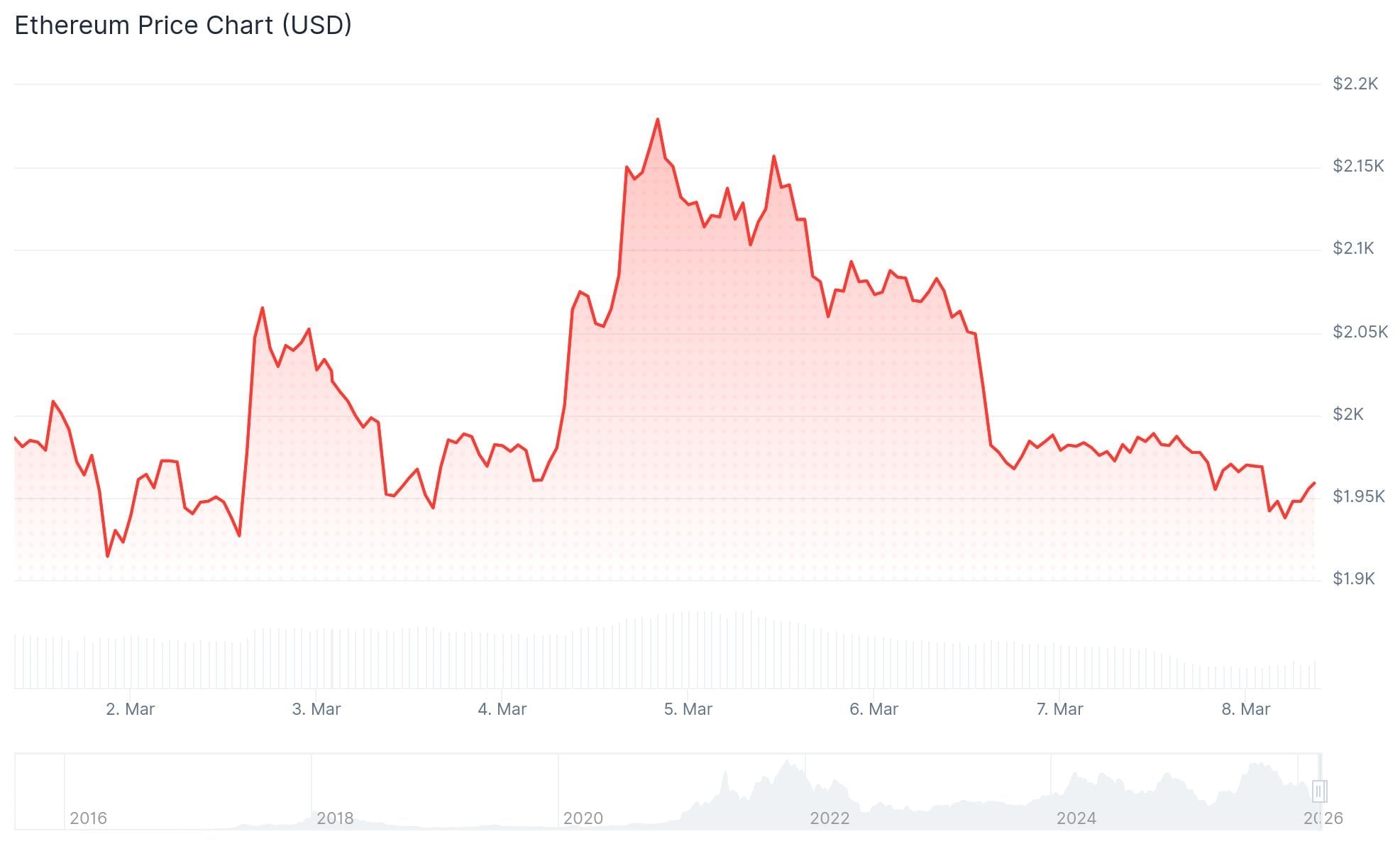
Early in the trading week, ETH bounced from approximately $1,900 to reach a local peak near $2,180 on March 5. However, this upward momentum dissipated rapidly, dragging the price back beneath the $2,000 threshold.
The nearest support level resides around $1,960. The critical psychological barrier stands at $2,000, with a more substantial resistance zone extending from $2,040 to $2,080.
Ethereum spot exchange-traded funds witnessed $82.85 million in net capital outflows during a single trading session. Fidelity’s FETH product accounted for $67.57 million of these withdrawals. FETH’s aggregate outflows have now climbed to $218 million.
Polymarket analysts assign a 67% probability to ETH declining to the $1,800 level. A technical chartist identified a rising wedge formation that has been developing since early February, with $1,500 representing the subsequent major support target should this pattern break to the downside.
Corporate treasury departments have also reduced their Ethereum accumulation activity as prices have trended downward. The next crucial support area is anticipated between $1,850 and $1,900.
Get 3 Free Stock Ebooks
Discover top-performing stocks in AI, Crypto, and Technology with expert analysis.
- Top 10 AI Stocks - Leading AI companies
- Top 10 Crypto Stocks - Blockchain leaders
- Top 10 Tech Stocks - Tech giants



