


TLDR
- ETH has experienced six straight months of price declines, representing its second-longest continuous losing period since 2018.
- The cryptocurrency is now trading beneath the $2,000 threshold, hovering near its 2018 peak price level.
- Multiple headwinds include large holder distribution, derivative market dynamics, Layer 2 fee cannibalization, and ETF capital outflows.
- Co-founder Vitalik Buterin believes artificial intelligence could accelerate Ethereum’s technical development timeline and strengthen security protocols.
- Financial institutions including Standard Chartered and VanEck maintain bullish long-term forecasts of $7,500 and $10,000 respectively.
The leading smart contract platform has now registered six consecutive months of negative price action, representing its second-longest continuous decline since the 2018 bear market.
CoinGlass data reveals that the only comparable losing streak occurred during 2018’s brutal downturn, when ETH plummeted to levels below $85.
That historic crash resulted from the implosion of the Initial Coin Offering boom, as countless projects that had fundraised through ERC-20 token issuance on Ethereum’s blockchain collapsed.
Today’s prolonged weakness stems from an entirely different combination of market forces.
Market observers identify several contributing factors: distribution by large wallet holders, aggressive selling in derivatives markets, broader macroeconomic instability, capital flight from spot Ethereum ETFs, and revenue erosion from Layer 2 scaling solutions that compete with the main network.

The asset currently trades marginally above its 2018 all-time high, a price point that previously represented a significant psychological barrier.
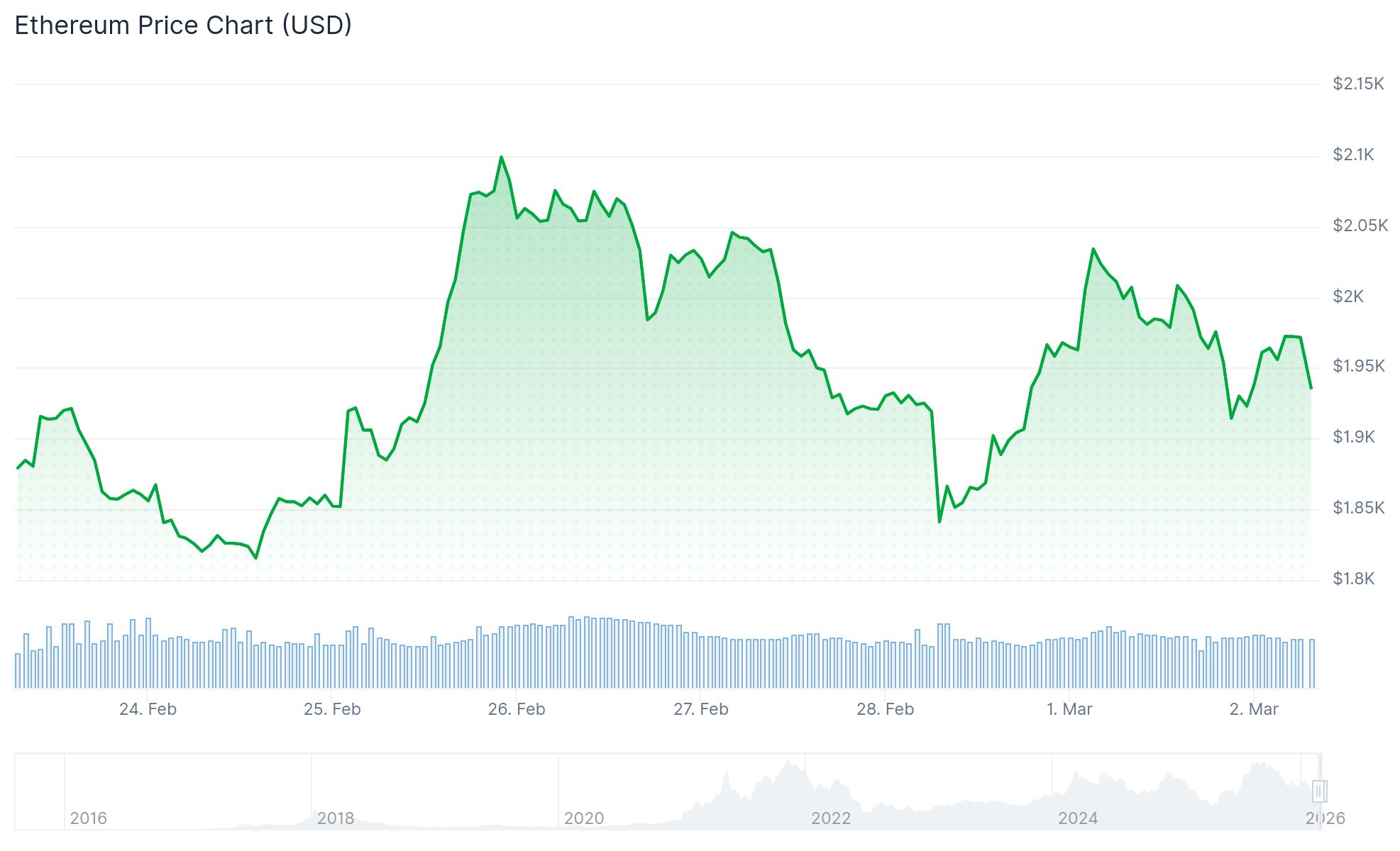
Following a brief climb to $2,054, the token recently slipped under the $2,000 mark. Current trading activity places it beneath the 100-hour Simple Moving Average indicator.
Critical Price Zones Under Observation
The nearest resistance barrier appears at $2,000, with subsequent meaningful levels positioned at $2,120 and $2,155.
Should ETH successfully breach $2,155, the following upside objectives would be $2,220 and $2,250.
Conversely, downside protection exists at $1,920, followed by $1,880. A breakdown below $1,880 could trigger further declines toward $1,840 or $1,800, with $1,740 serving as a more substantial floor level.
Buterin Discusses AI’s Impact on Network Development
Ethereum co-creator Vitalik Buterin recently shared his perspective that artificial intelligence technology could substantially expedite the blockchain’s technical evolution.
His remarks followed an instance where a developer leveraged AI to construct a prototype of Ethereum’s complete 2030 technical roadmap in mere weeks.
Buterin personally experimented with AI-assisted programming, successfully creating a version of his blogging platform in approximately one hour using only his laptop.
He proposed that half of the efficiency improvements enabled by AI should be allocated toward enhanced security measures, including expanded test coverage and formal code verification processes.
“People should be open to the possibility that the Ethereum roadmap will finish much faster than people expect,” Buterin wrote.
He further observed that bug-free programming, previously considered an unrealistic goal, might become the expected standard within cryptocurrency development.
Standard Chartered maintains an extended-term price projection of $7,500 for ETH, grounded in its fundamental role within stablecoins, decentralized finance, and asset tokenization.
VanEck has established a forecast of $10,000, referencing the forthcoming Pectra and Glamsterdam network upgrades, which could enable throughput of 100,000 transactions per second.
ETH currently maintains position above the $1,900 support threshold following its most recent retreat from $2,054.
Get 3 Free Stock Ebooks
Discover top-performing stocks in AI, Crypto, and Technology with expert analysis.
- Top 10 AI Stocks - Leading AI companies
- Top 10 Crypto Stocks - Blockchain leaders
- Top 10 Tech Stocks - Tech giants



