



Quick Summary
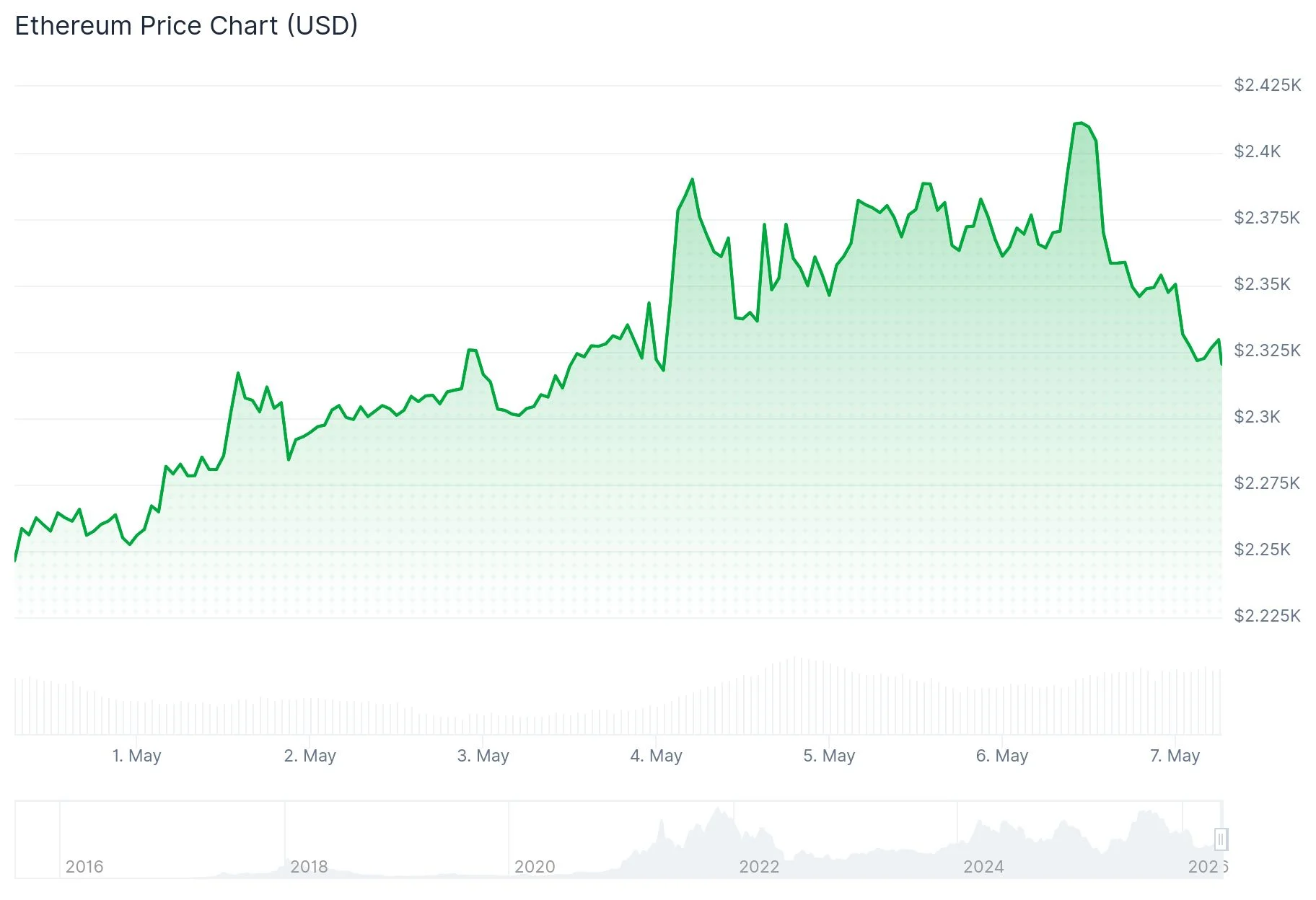
- ETH currently valued at approximately $2,324 with a total market capitalization approaching $280 billion
- Baseline projection for 2030 places ETH at $6,500, representing a market cap near $785 billion
- Optimistic scenario envisions $12,000 per token if institutional capital and asset tokenization accelerate
- Pessimistic outlook forecasts $1,800 if competing networks erode Ethereum’s fee-generating capacity
- Primary catalysts include proof-of-stake rewards, exchange-traded fund flows, tokenized real-world assets, and protocol enhancements
At present, Ethereum (ETH) changes hands around the $2,324 level. Given the circulating supply of approximately 120.7 million tokens, the network commands a valuation close to $280 billion.
As the dominant infrastructure for decentralized finance applications, stablecoin issuance, non-fungible token platforms, and scaling solutions, Ethereum’s future trajectory hinges on a critical dynamic: whether the native asset can maintain its position as the value accrual mechanism for the broader crypto economy.
Distinct from Bitcoin, Ethereum operates without a hard supply ceiling. Nevertheless, the protocol’s fee-burning upgrade (EIP-1559) introduces deflationary mechanics during periods of elevated network utilization, potentially constraining token availability over time.
A measured five-year projection establishes $6,500 as the baseline target, premised on steady expansion across spot ETF adoption, validator participation, Layer-2 ecosystem maturation, stablecoin transaction volume, and the migration of traditional financial instruments onto blockchain rails. This scenario implies an Ethereum market valuation around $785 billion.
Upside Catalysts for Ethereum
The optimistic framework points toward $12,000, corresponding to a fully diluted valuation near $1.45 trillion.

Reaching this threshold demands that Ethereum solidifies its role as the foundational settlement infrastructure for digitized securities and commodities. Traditional finance giants like BlackRock have already entered the space with products such as the iShares Staked Ethereum Trust ETF, demonstrating that conventional asset managers view Ethereum-based instruments as viable investment vehicles.
In March 2026, regulatory authorities signaled progress toward establishing clearer frameworks governing protocol staking mechanisms and the classification of digital assets outside securities regulation. Enhanced regulatory transparency could catalyze broader institutional capital deployment.
Under bullish conditions, spot ETF capital accumulation accelerates, staking mechanisms lock additional supply off exchanges, and the migration of real-world assets onto Ethereum-based infrastructure reaches critical mass.
Downside Risks Facing ETH
The bearish projection settles at $1,800, implying a network valuation around $217 billion.
This outcome materializes if secondary scaling networks capture the majority of transaction activity and fee generation, leaving the base layer with diminished economic throughput. Alternative high-performance blockchains like Solana could claim greater market share. Meanwhile, ETF appetite might plateau, and the broader digital asset market could enter an extended consolidation phase.
The fundamental structural challenge lies in ensuring that while Layer-2 platforms benefit from Ethereum’s security guarantees, sufficient economic value flows back to the base layer rather than remaining siloed within these scaling environments.
Recent protocol improvements including the Pectra and Fusaka upgrades have focused on advancing account abstraction capabilities, expanding blob space for data availability, refining validator operations, and optimizing infrastructure for secondary networks. These technical enhancements seek to preserve Ethereum’s competitive positioning as the settlement backbone.
Current market conditions show ETH trading in the $2,324 range, with institutional engagement expanding through regulated ETF offerings and ongoing regulatory clarification around staking and digital asset classification.
Get 3 Free Stock Ebooks
Discover top-performing stocks in AI, Crypto, and Technology with expert analysis.
- Top 10 AI Stocks - Leading AI companies
- Top 10 Crypto Stocks - Blockchain leaders
- Top 10 Tech Stocks - Tech giants



