


Key Takeaways
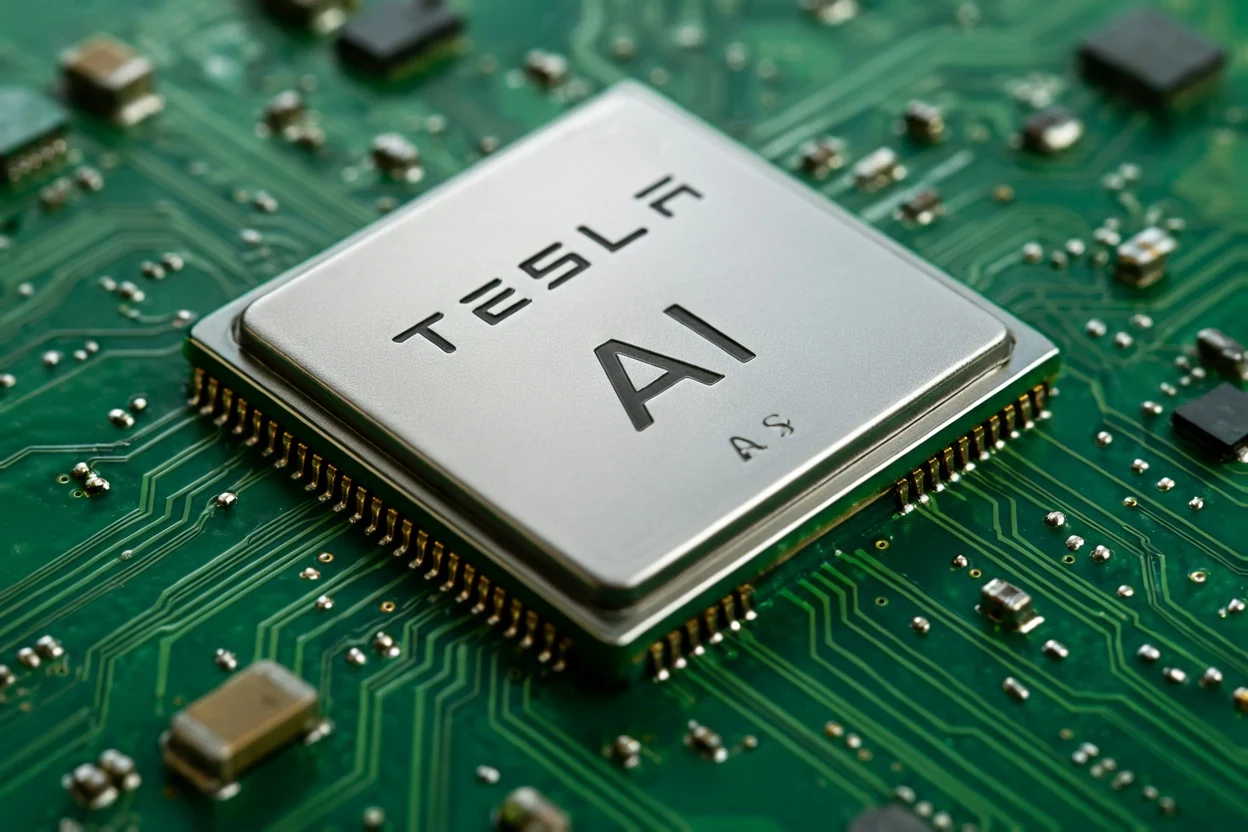
- Elon Musk revealed “Terafab,” an ambitious semiconductor production facility in Austin, Texas, partnering Tesla, SpaceX, and xAI
- Two distinct chips will be manufactured — one for Tesla’s vehicles and Optimus robots, another for space-based AI satellites
- According to Musk, worldwide chip production currently satisfies merely 3% of his companies’ projected requirements
- First production run scheduled for late 2027, with full-scale manufacturing expected in 2028
- Tesla shares declined approximately 2–3% during premarket trading after the announcement
Elon Musk revealed his vision for an extensive semiconductor manufacturing facility named “Terafab” this past Saturday evening, declaring it a collaborative effort between Tesla, SpaceX, and xAI. The disclosure triggered a decline in Tesla shares during Monday’s premarket session.
The announcement took place at a decommissioned power facility in Austin, Texas. Musk outlined Terafab as comprising two distinct fabrication plants, with each dedicated to manufacturing a unique chip architecture.
The first semiconductor will support Tesla automobiles and the Optimus humanoid robot platform. The second chip is designed specifically for artificial intelligence applications in space environments, built to withstand extreme conditions and elevated operating temperatures.
According to Musk, current worldwide semiconductor manufacturing capacity addresses approximately 3% of his enterprises’ future requirements. While acknowledging Samsung, TSMC, and Micron as present suppliers, he emphasized that demand will ultimately exceed total global production capabilities.

The “Terafab” designation reflects Musk’s ambition to manufacture chips requiring one terawatt of power to operate — approximately equal to one billion Nvidia Blackwell processors annually.
SpaceX’s participation came as a surprise to many observers. The aerospace company, which recently consolidated with xAI, is gearing up for a public offering potentially valuing the combined entity at approximately $1.75 trillion.
Financial Investment and Production Schedule
Early development stages will demand investments reaching tens of billions of dollars. Tesla has already allocated roughly $20 billion for new equipment purchases in 2026, a substantial increase from under $9 billion in 2025. Terafab expenditures represent additional spending beyond those projections.
Musk’s timeline aims for initial chip production by late 2027, scaling to maximum output throughout 2028. This accelerated schedule contrasts with traditional semiconductor facilities, which generally require approximately three years from construction start to volume production.
Musk indicated Terafab would ultimately deliver one terawatt of computational power annually. To put this in perspective, current U.S. electricity generation totals approximately half that figure.
Space-Based AI Computing Takes Priority
Among the more unexpected revelations: Musk projects 80% of Terafab’s production will serve space-based artificial intelligence computing needs. SpaceX intends to perform in orbital environments what hyperscale cloud providers currently accomplish in terrestrial data centers.
The facility will concentrate on two-nanometer chip technology, representing the cutting edge of current semiconductor manufacturing.
Tesla shares fell roughly 3.2% on Monday. The stock began the week down 18% for the year, though maintaining a 48% gain over the trailing twelve months.
Shares currently trade at approximately 190 times projected 2026 earnings, reflecting investor expectations for future AI-driven revenue including autonomous taxi services and robotics platforms.
Tesla initiated its robo-taxi operations in Austin this past June and has yet to extend the service to additional markets. The company continues development on a third-generation Optimus robot.
Musk did not specify an exact construction commencement date for the Terafab facility.
Get 3 Free Stock Ebooks
Discover top-performing stocks in AI, Crypto, and Technology with expert analysis.
- Top 10 AI Stocks - Leading AI companies
- Top 10 Crypto Stocks - Blockchain leaders
- Top 10 Tech Stocks - Tech giants



