



Key Highlights
- Major U.S. indices experienced substantial gains with the Dow climbing over 1,000 points (2.4%) while the Nasdaq advanced 3.4% on Tuesday
- Market momentum built following indications that Washington and Tehran could be approaching a resolution to their military standoff
- Iranian President Masoud Pezeshkian announced readiness to conclude hostilities if security assurances are provided
- Reports indicate President Trump discussed with advisors the possibility of concluding operations without fully securing Strait of Hormuz reopening
- Crude prices tumbled significantly on de-escalation news, with Brent falling 2.8%
American equity markets delivered some of their most impressive single-session performances in recent months on Tuesday, March 31, 2026. The powerful upward momentum followed breaking news suggesting both Washington and Tehran might be prepared to conclude their current military engagement.
The Dow Jones Industrial Average advanced 1,061 points, representing approximately 2.4%, and settled around the 46,140 level. The S&P 500 gained 2.7%, reaching approximately 6,496. Leading the charge, the Nasdaq Composite surged 3.4% to finish near 21,517.
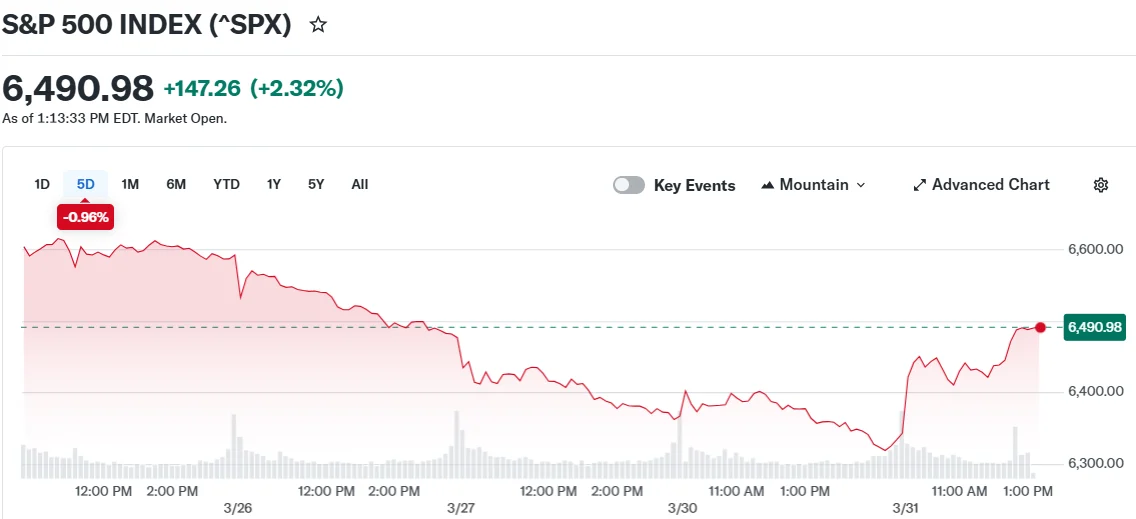
The price action was dramatic and swift. Equity indices spiked rapidly around 12:34 p.m. Eastern Time before experiencing modest pullbacks, though substantial gains persisted throughout the trading session.
The catalyst appeared to stem from two significant news developments. Initially, Iranian state television broadcast President Masoud Pezeshkian’s statement indicating his nation was “prepared to end” hostilities contingent upon receiving security guarantees from the United States.
Subsequently, the Wall Street Journal published a report revealing President Donald Trump had discussed with advisors his openness to concluding military operations. The confrontation had already extended beyond one month at that point.

The Strait of Hormuz has remained substantially closed since hostilities commenced. This blockade has driven petroleum prices significantly higher and sparked concerns about potential global economic contraction.
According to reports, Trump and his team determined that achieving complete reopening of the strait would extend operations beyond his originally stated four to six-week timeframe.
Crude Prices Decline Amid De-Escalation News
Oil prices responded swiftly to peace signals. Brent crude declined 2.8% to settle at $104.40 per barrel. West Texas Intermediate crude dropped 2% to $94.09.
Declining petroleum prices typically alleviate inflationary pressures, which contributed to enhanced market sentiment throughout Tuesday’s session.
The previous session had painted a contrasting picture. Both the S&P 500 and Nasdaq finished Monday’s trading in negative territory, while the Dow managed only minimal gains—just sufficient to escape correction status.
Cryptocurrency Markets Respond to Improved Risk Appetite
Digital asset markets similarly reflected the enhanced risk sentiment. Bitcoin and alternative cryptocurrencies typically correlate with broader risk appetite, and Tuesday’s equity rally attracted renewed buying interest.
The Nasdaq’s 3.4% advance represented its most robust performance in several weeks and lifted technology-oriented assets across multiple sectors.
Tuesday represented the closing session for the first quarter of 2026. Several market participants observed the timing of the rally, suggesting quarter-end portfolio adjustments may have amplified the upward movement.
As of mid-afternoon Eastern Time, the S&P 500 traded at 6,491, the Dow at 46,038, and the Nasdaq at 21,458.
President Trump has not issued an official declaration regarding concluding the conflict, and no formal ceasefire agreement has been announced.
Get 3 Free Stock Ebooks
Discover top-performing stocks in AI, Crypto, and Technology with expert analysis.
- Top 10 AI Stocks - Leading AI companies
- Top 10 Crypto Stocks - Blockchain leaders
- Top 10 Tech Stocks - Tech giants



