


Key Takeaways
- DHL shares declined 3% following a conservative 2026 earnings projection that missed analyst consensus
- Company forecasts 2026 EBIT surpassing €6.2 billion, compared to €6.1 billion recorded in 2025
- Fourth-quarter operating profit declined 1.3% to €1.83 billion, driven by a 36% drop in freight forwarding earnings
- Chief Executive Tobias Meyer indicated the projection doesn’t factor in any global economic recovery
- Falling freight rates across air and ocean channels, combined with sluggish European road freight demand, continue pressuring results
Shares of DHL tumbled 3% on Thursday following the German logistics powerhouse’s announcement of a 2026 earnings projection that fell short of market expectations.
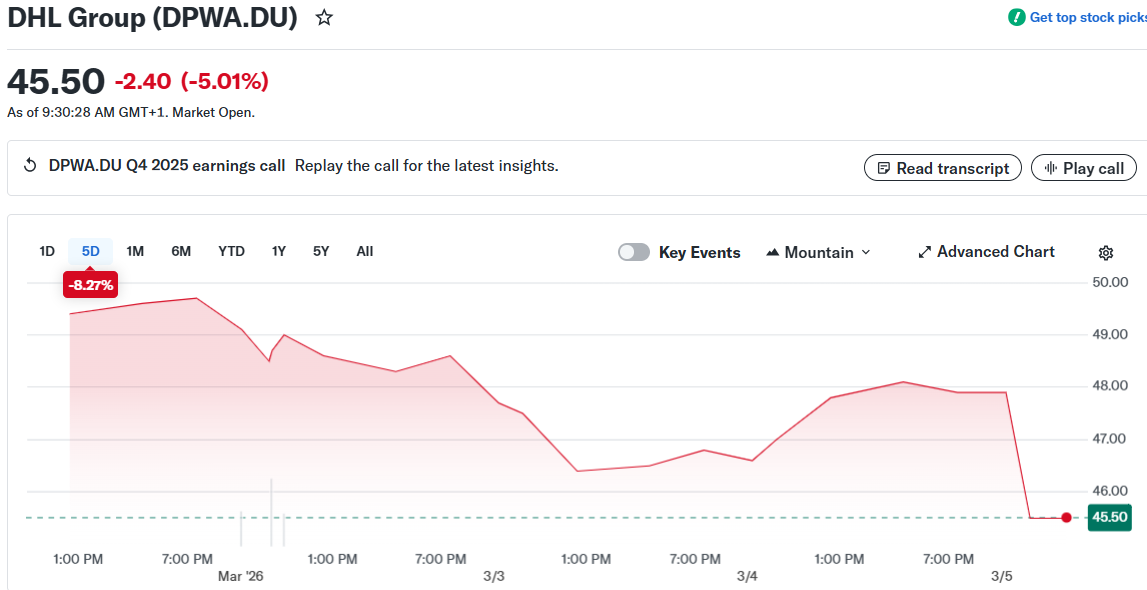
The logistics giant’s stock positioned itself at the lowest point on Germany’s DAX blue-chip index as of 0919 GMT.
DHL projected that earnings before interest and taxes will surpass €6.2 billion ($7.2 billion) for this year. The forecast follows the company’s reported operating profit of €6.1 billion throughout 2025.
This projection landed beneath the consensus estimates compiled from analyst forecasts in the company’s own data collection.
Chief Executive Tobias Meyer spoke candidly about the outlook. “Our forecast does not assume any improvement in the global economic environment,” Meyer stated in the company’s announcement.
Meyer pointed to geopolitical instability and market uncertainty already evident during the opening two months of this year as primary factors influencing the conservative forecast.

Freight Forwarding Division Weighs on Q4 Results
DHL reported a 1.3% decrease in fourth-quarter operating profit, landing at €1.83 billion. The figure aligned closely with analyst predictions.
The freight forwarding segment proved particularly challenging, with earnings plummeting 36% during the three-month period.
Freight forwarding represents a cornerstone of DHL’s worldwide operations, managing the coordination of cargo movement through air, ocean, and land transportation networks.
“In air and ocean freight, we see declining freight rates,” Meyer explained to investors during Thursday’s earnings call.
The road freight sector faces similar challenges. “In road freight, we feel the weak economic situation in Europe, and especially in Germany,” Meyer noted.
European logistics firms have confronted a challenging environment — weakened demand coupled with trade complications stemming from tariffs implemented by U.S. President Donald Trump have intensified sector-wide pressures.
Middle East Operations Provide Bright Spot
Despite broader challenges, DHL maintains certain advantages. Meyer highlighted that the company typically performs better than competitors during Middle East disruptions.
“We have a very well established road network in the Middle East which enables us to bring cargo to those airports that are open,” Meyer explained.
This operational strength serves as a valuable buffer as air and maritime route disruptions stemming from the continuing Middle East conflict impact international shipping operations.
Nevertheless, the overall market conditions remain challenging. Maritime and logistics companies are contending with increasing disruptions throughout global air and sea transportation corridors.
The 36% decline in DHL’s Q4 freight forwarding earnings stands out as the most significant figure from the company’s recent financial report.
The company’s EBIT guidance of “exceeding €6.2 billion” for 2026 signals only incremental advancement beyond the €6.1 billion achieved in 2025.
Get 3 Free Stock Ebooks
Discover top-performing stocks in AI, Crypto, and Technology with expert analysis.
- Top 10 AI Stocks - Leading AI companies
- Top 10 Crypto Stocks - Blockchain leaders
- Top 10 Tech Stocks - Tech giants



