



Key Highlights
- Brent crude climbed to approximately $110 per barrel while WTI hit $96 amid escalating tensions with Iran.
- President Trump pushed back the deadline for potential strikes on Iranian energy assets to April 6, citing diplomatic discussions with Tehran.
- Iranian officials have categorically rejected claims that any direct negotiations with Washington are underway.
- Approximately 8 million barrels per day remain unavailable due to the ongoing Strait of Hormuz disruption.
- Market experts at Macquarie warn that extended hostilities could drive crude prices to $200 per barrel.
Global energy markets are experiencing renewed volatility as the standoff involving the United States, Israel, and Iran continues to choke critical supply channels. Brent crude advanced nearly 2% to reach $109.92 per barrel during Friday trading. Meanwhile, U.S. West Texas Intermediate climbed to $96.08.
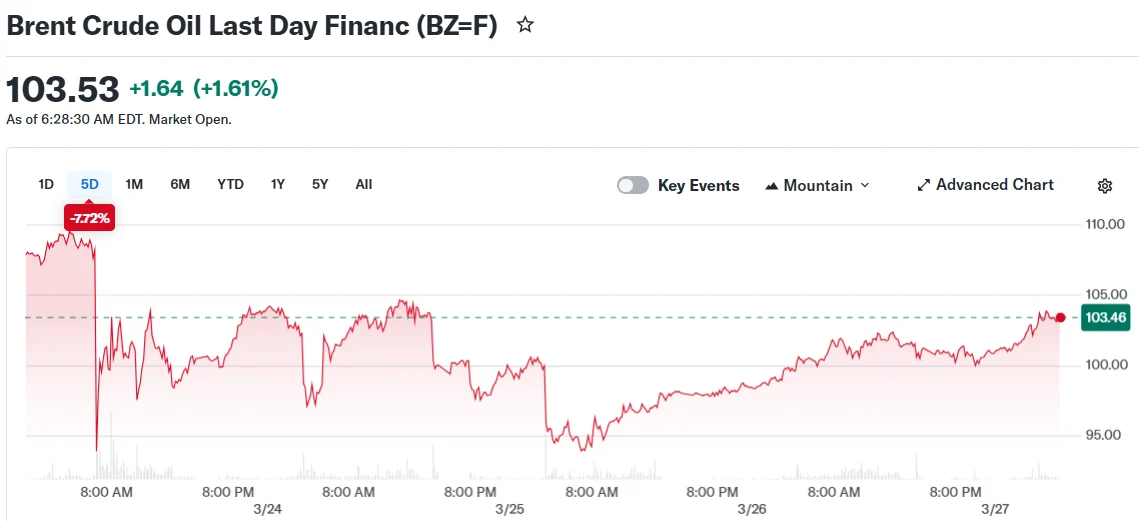
Brent is tracking toward an unprecedented monthly increase for March. The benchmark has jumped approximately 52% during the current month, representing one of the most dramatic single-month rallies in modern trading history.
The hostilities erupted in late February and have resulted in the virtual shutdown of the Strait of Hormuz. This critical passage typically handles roughly 20% of worldwide petroleum shipments.
As the strait remains essentially closed, approximately 8 million barrels daily have been removed from circulation. Ole Hansen, Saxo Bank’s commodities division chief, noted that supply constraints are intensifying rapidly as vessels that departed the Gulf region before the closure have completed their deliveries.
President Trump announced an extension to the White House’s ultimatum regarding Iran’s reopening of the strait or facing American military action against its energy infrastructure. The revised deadline now stands at April 6. Trump attributed the postponement to Iranian requests and characterized ongoing discussions as productive.

Tehran contradicted this account through official channels. Iranian authorities stated that no diplomatic engagement with the United States is currently taking place.
Ongoing Military Operations and Force Deployment
Military operations continue across the region. Israeli forces claimed responsibility for striking Iran’s primary missile and naval mine manufacturing complex located in Yazd. Kuwait confirmed drone assaults on two of its port facilities. Saudi Arabia successfully intercepted unmanned aircraft in its eastern territories.
The Pentagon is allegedly evaluating plans to deploy as many as 10,000 additional ground forces to the area, potentially including elements from the 82nd Airborne Division and Marine Expeditionary Units.
The Trump administration is simultaneously working to organize a high-level meeting in Pakistan scheduled for this weekend, featuring Vice President JD Vance and other top officials to examine potential pathways toward conflict resolution.
Iranian leadership indicated it has declined a 15-point American peace framework and presented its own conditions. These demands include formal acknowledgment of Tehran’s authority over the Strait of Hormuz.
Economic Ripple Effects and Financial Market Reaction
The oil spike is amplifying wider economic anxieties. Government bond yields have climbed as market participants anticipate that elevated energy costs may compel central banks to tighten monetary policy.
The benchmark U.S. 10-year Treasury yield advanced to levels not observed since July. Similar increases occurred in German and French bond markets.
Multiple nations have implemented measures to cushion consumer impact. India reduced levies on diesel and gasoline products. Vietnam suspended fuel-related taxes through mid-April. New Zealand authorities documented evidence of consumer fuel stockpiling.
Macquarie’s research team estimates a 40% probability that hostilities will persist through June. Under that scenario, they project crude could reach $200 per barrel.
Two container vessels associated with China’s Cosco Shipping made an attempt to transit the Strait of Hormuz on Friday before reversing course in proximity to Iranian waters.
Get 3 Free Stock Ebooks
Discover top-performing stocks in AI, Crypto, and Technology with expert analysis.
- Top 10 AI Stocks - Leading AI companies
- Top 10 Crypto Stocks - Blockchain leaders
- Top 10 Tech Stocks - Tech giants



