



TLDR
- WTI crude surpassed $100 per barrel while Brent climbed 4% to approximately $99
- Hormuz Strait remains virtually shut, permitting just four vessel passages on Wednesday
- Tehran implementing toll collection system for ships navigating the waterway
- Iran accuses Washington of ceasefire breaches; Israeli operations in Lebanon escalate tensions
- Major banks project Brent at $80 for fourth quarter while cautioning about potential price spikes
Crude oil markets experienced a dramatic surge Thursday as the recently announced US-Iran ceasefire appeared to crumble and vessel traffic through the critical Strait of Hormuz remained paralyzed.
Brent crude futures advanced 4% to approximately $98.57 per barrel. West Texas Intermediate surged 6.6% to exceed $100 per barrel. Both benchmarks had experienced steep declines Wednesday following Tuesday’s ceasefire declaration.
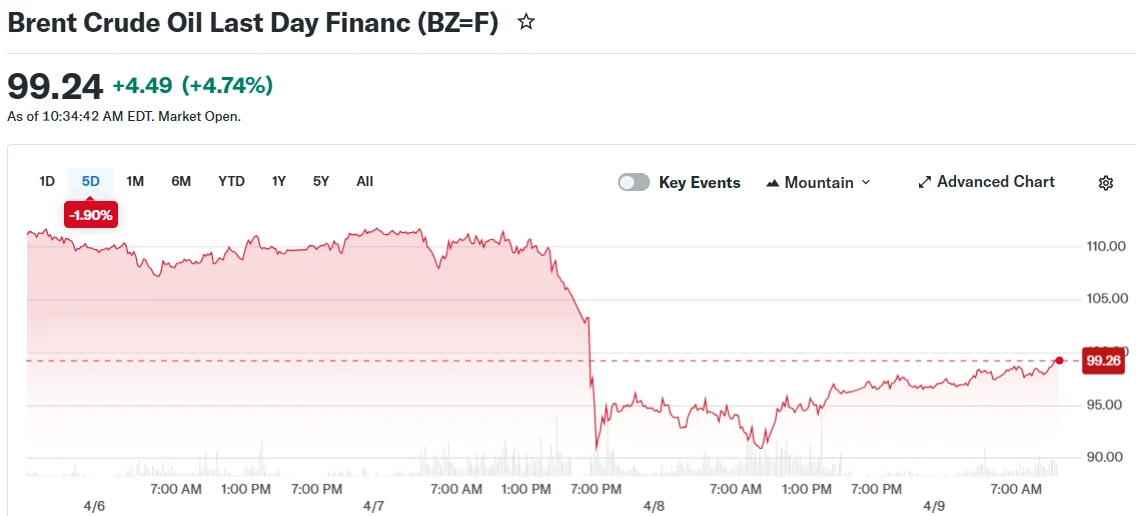
The dramatic price swing occurred as market participants realized the ceasefire framework was not delivering the expected results.
Mohammad Bagher Ghalibaf, Iran’s parliamentary speaker, declared on X that the framework agreement between Washington and Tehran “has been openly and clearly violated.” He cited ongoing Israeli military operations in Lebanon and American drone incursions into Iranian territory as evidence that continued negotiations were becoming “unreasonable.”
Tehran provides support to Hezbollah in Lebanon, and Iranian officials have maintained that any cessation of hostilities must encompass Lebanese territory. However, Washington’s position is that its agreement with Iran does not extend to Lebanon.
Israeli forces conducted strikes against over 100 Lebanese targets on Wednesday alone, marking one of the campaign’s most intensive days. Israeli military operations have persisted despite growing international pressure for de-escalation.

Strait of Hormuz Blockage Drives Oil Prices
The Strait of Hormuz facilitates passage for approximately 20% of global oil supply. The critical waterway has been effectively shuttered since the ceasefire announcement late Tuesday.
According to S&P Global Market Intelligence, just four vessels traversed the strait Wednesday. This figure falls dramatically below typical daily traffic patterns. Reuters confirmed that a single oil tanker completed the crossing within the last 24-hour period.
Tehran has communicated to intermediaries its intention to limit daily crossings to roughly twelve ships while implementing toll charges. Various sources suggest the fee could reach $1 per barrel. Capital Economics characterized this development as transforming the strait from an unrestricted international waterway into a regulated toll passage.
Dr. Sultan Al-Jaber, who leads Abu Dhabi National Oil Company, stated on LinkedIn: “The Strait of Hormuz is not open. Access is being restricted, conditioned and controlled.”
Vessel-tracking service MarineTraffic reports more than 400 ships remain stranded throughout the region.
US Warns of Military Action If Deal Falls Through
Vice President JD Vance declared Wednesday evening that should the strait fail to reopen, the United States is “not going to abide by our terms if the Iranians are not abiding by their terms.”
President Trump posted Thursday morning on Truth Social that American military forces would maintain their Middle East presence “until such time as the real agreement is fully complied with.” He cautioned that if Iran fails to fulfill its obligations, “the ‘shootin’ starts.”
Trump verified in an additional post that Washington and Tehran have reached consensus that the strait will operate openly and safely.
Goldman Sachs researchers indicated expectations for energy shipments to begin recovering this weekend, projecting a gradual month-long restoration to pre-conflict export volumes. They maintained their fourth quarter Brent projection at $80 per barrel while highlighting upside risk factors. Should the strait remain closed for an additional month, prices could average $100 during Q4. If Persian Gulf producers cannot fully restore production capacity, prices might reach $115.
UBS similarly forecasts $80 Brent for Q4, though analysts highlighted unresolved questions, particularly whether Gulf nations including Saudi Arabia and the UAE would risk sending tankers through a strait now under Iranian control. These two nations have a combined 4 million barrels daily of shuttered production.
American and Iranian negotiators are scheduled to convene in Islamabad, Pakistan, this Saturday.
Get 3 Free Stock Ebooks
Discover top-performing stocks in AI, Crypto, and Technology with expert analysis.
- Top 10 AI Stocks - Leading AI companies
- Top 10 Crypto Stocks - Blockchain leaders
- Top 10 Tech Stocks - Tech giants



