



TLDR
- Crude benchmarks retreated modestly following a three-day surge, with Brent settling at $84.58 and WTI at $79.56 per barrel
- Washington conducted military operations against Iranian infrastructure on Wednesday to safeguard Gulf shipping lanes
- Tehran characterized the situation as an “existential war” and signaled potential further disruptions to energy shipments
- The Strait of Hormuz, a critical passage for approximately 20% of global petroleum and natural gas, faces ongoing threats
- American crude stockpiles declined by 1.7 million barrels in the previous week, sustaining supply tension
Crude oil benchmarks experienced a modest pullback on Thursday following a nearly 10% weekly advance, as traders assessed the potential for extended disruptions to a strategically vital maritime corridor.
Brent crude declined 0.4% to settle at $84.58 per barrel, while West Texas Intermediate edged down 0.1% to $79.56 per barrel during early Thursday trading. Both contracts had reached their highest levels in a month earlier in the week as hostilities between Washington and Tehran intensified.
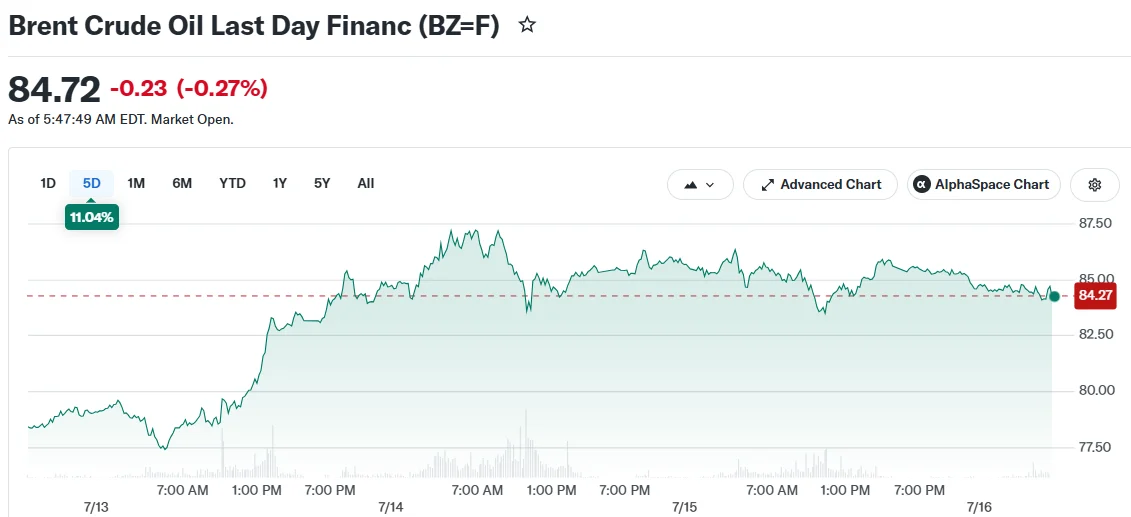
The United States executed renewed military strikes on Wednesday targeting Iranian facilities connected to assaults on commercial vessels in the Persian Gulf region. U.S. officials stated the operations aimed to diminish Tehran’s capacity to endanger maritime commerce.
Iran countered by declaring the confrontation an “existential war” and cautioned that energy shipments from the region could face additional disruptions should hostilities persist.
Hormuz Strait Represents Primary Supply Threat
Traders are monitoring the Strait of Hormuz closely, a confined waterway that handles roughly one-fifth of worldwide crude oil and liquefied natural gas transport. Any prolonged closure would create significant supply constraints across global markets.

Analysts at Jefferies projected the current escalation phase could extend for several weeks, even without developing into comprehensive warfare. They noted this scenario would likely maintain disruptions to strait passage and sustain elevated price levels.
Soojin Kim at MUFG observed that while tanker movements have persisted with American naval support, the escalating crisis jeopardizes export pathways that had enabled Gulf producers to maintain crude flows during previous interruptions.
President Trump is reportedly evaluating expanded military engagement, with possibilities including intensified aerial campaigns and deploying ground troops to capture Iranian-controlled islands near the strait, the Wall Street Journal reported.
Storage Data Reinforces Supply Tightness
The U.S. Energy Information Administration disclosed on Wednesday that crude oil inventories decreased by 1.7 million barrels during the week concluded July 10, approximately matching analyst projections.
Gasoline reserves also contracted by 1.5 million barrels as seasonal travel demand remained robust. Distillate stocks, conversely, expanded by 4.6 million barrels, exceeding forecasts.
ING analysts cautioned that the renewed military confrontation arrives during a particularly sensitive period, highlighting substantial inventory withdrawals throughout the second quarter. They emphasized that global strategic petroleum reserve releases, which had provided market relief in recent months, are scheduled to conclude within weeks.
The International Energy Agency stated in its July Oil Market Report that although crude flows through the strait had partially normalized in June, the latest fighting this month has created uncertainty and may postpone projections for market surplus conditions in 2027.
Get 3 Free Stock Ebooks
Discover top-performing stocks in AI, Crypto, and Technology with expert analysis.
- Top 10 AI Stocks - Leading AI companies
- Top 10 Crypto Stocks - Blockchain leaders
- Top 10 Tech Stocks - Tech giants



