



Key Takeaways
- ADA is currently valued at approximately $0.15 with a total market capitalization ranging from $5.6 billion to $5.9 billion
- The moderate outlook projects prices between $0.60 and $1.00 by 2031, translating to a $24–$40 billion market valuation
- An optimistic scenario sees ADA climbing to $2.00–$3.50 if DeFi adoption accelerates and institutional involvement increases
- A pessimistic outlook suggests ADA could remain stagnant at $0.08–$0.15 without meaningful ecosystem growth
- Weighted analysis across scenarios estimates ADA near $0.85 by 2031
Cardano (ADA) stands as one of cryptocurrency’s most polarizing blockchain platforms. Advocates highlight its academic methodology, robust decentralization, and dedicated following. Detractors argue it has lagged behind competitors like Ethereum, Solana, and emerging Layer 1 alternatives.
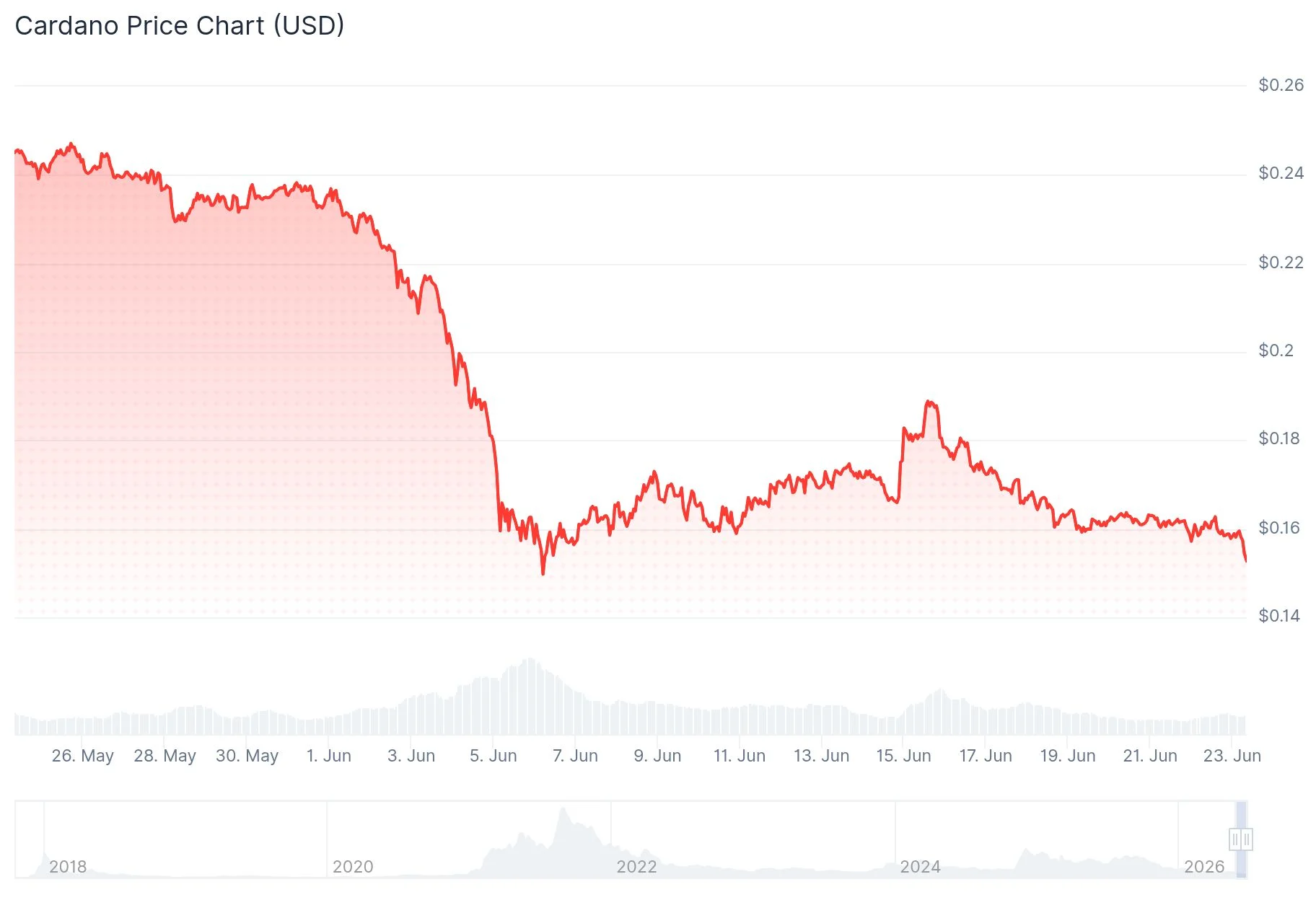
Presently, ADA is valued at approximately $0.15. This valuation places Cardano’s market capitalization between $5.6 billion and $5.9 billion. The circulating token supply stands near 36.4 billion ADA, while the maximum supply is fixed at 45 billion.
This fixed supply ceiling provides ADA with a more straightforward economic model compared to tokens with perpetual inflation. However, supply mechanics alone won’t drive appreciation. Cardano requires genuine demand expansion.
Moderate Scenario: $0.60 To $1.00 By 2031
The most plausible trajectory over the next five years involves steady but unspectacular growth. Under this framework, Cardano maintains its position among major Layer 1 platforms without achieving smart contract dominance.
A valuation range of $0.60 to $1.00 would establish Cardano’s market cap between $24 billion and $40 billion by 2031. This represents significant appreciation from present levels, though it remains beneath ADA’s historical peak.

This projection assumes Cardano captures benefits from broader cryptocurrency market expansion, enhanced on-chain governance structures, and successful scaling implementations. The network has entered its Voltaire development phase, emphasizing community-driven governance mechanisms.
Cardano’s technical evolution has progressed through distinct stages: Byron, Shelley, Goguen, Basho, and currently Voltaire. Each phase has introduced new capabilities, yet market participants continue monitoring for tangible adoption metrics.
Optimistic Scenario: $2.00 To $3.50
For ADA to achieve the $2.00 to $3.50 range, several critical conditions must materialize.
First, genuine network utilization must expand substantially — encompassing more DeFi protocols, stablecoin integration, asset tokenization, and functional applications. Second, scaling enhancements must deliver measurable performance improvements beyond theoretical advancement. Third, institutional investors must recognize ADA as a core regulated Layer 1 investment vehicle.
At a $3.50 price point, Cardano’s market capitalization would approach $140 billion. This doesn’t necessitate surpassing Ethereum or Solana in market share, but does require substantially narrowing the adoption differential.
Pessimistic Scenario: $0.08 To $0.15
Should developer engagement, DeFi liquidity depth, and user adoption remain stagnant, ADA could trade sideways between $0.08 and $0.15 throughout the forecast period. Cardano would preserve its existing community without attracting significant new investment.
Competitive dynamics present the primary headwind. Ethereum commands the largest developer ecosystem. Solana excels in transaction speed and retail user engagement. Emerging blockchain platforms continue vying for capital and attention.
Aggregating all three scenarios with appropriate probability weights yields a central estimate of approximately $0.85 for ADA by 2031.
Get 3 Free Stock Ebooks
Discover top-performing stocks in AI, Crypto, and Technology with expert analysis.
- Top 10 AI Stocks - Leading AI companies
- Top 10 Crypto Stocks - Blockchain leaders
- Top 10 Tech Stocks - Tech giants



