


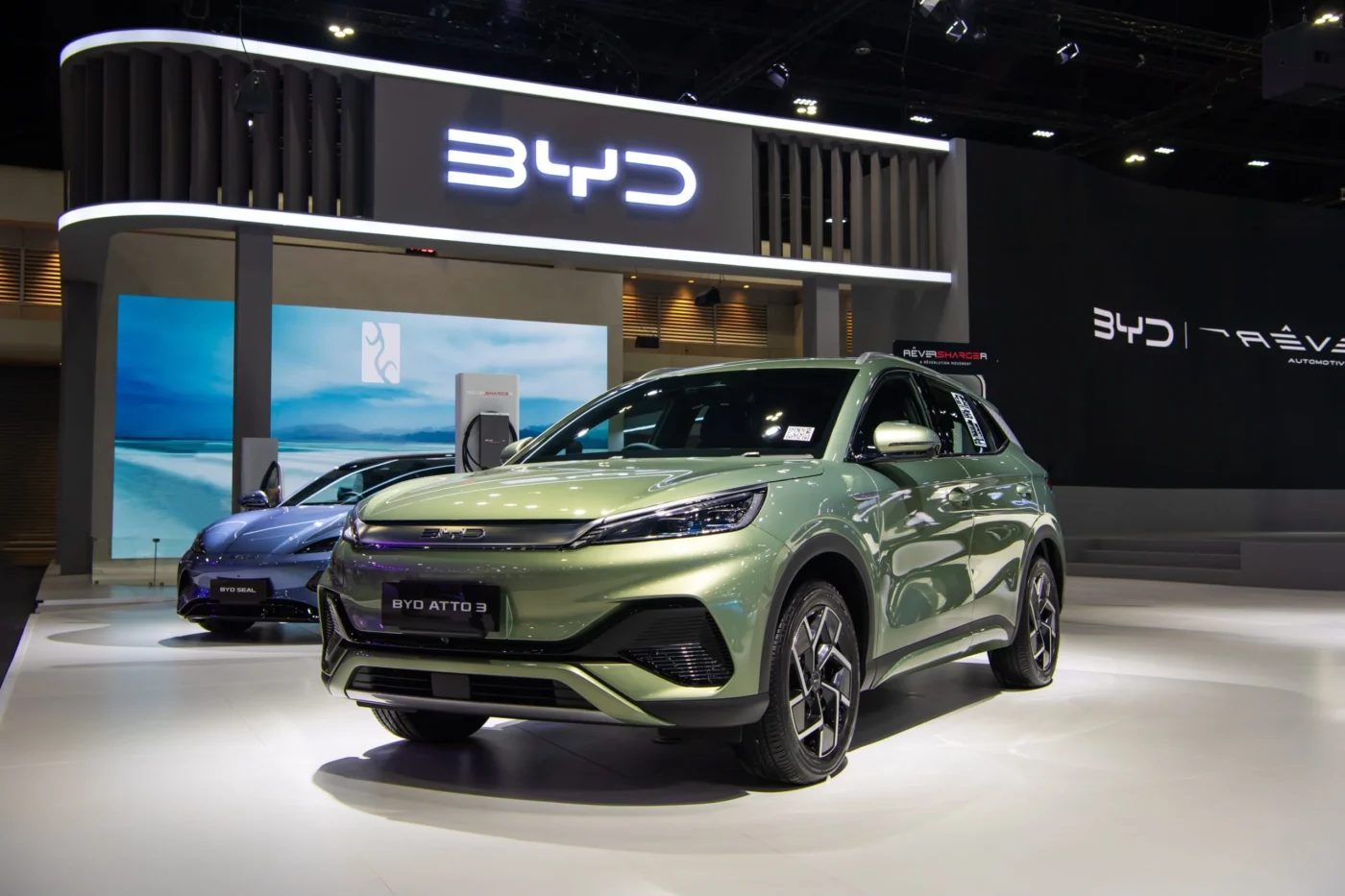
Key Takeaways
- First quarter net income plummeted 55.4% year-over-year to 4.09 billion yuan, marking the company’s sharpest decline since 2020
- Total revenue decreased 11.8% to 150.23 billion yuan, representing the third consecutive quarter of declining sales
- Financial performance matched or exceeded analyst forecasts, propelling Hong Kong-traded shares up 3.9%
- Chinese market sales have contracted for seven consecutive months through March following subsidy eliminations
- International deliveries represented approximately 45% of Q1 vehicle volume, with the company projecting 1.5 million overseas sales by 2026
The Chinese electric vehicle manufacturer delivered its most significant quarterly earnings contraction in over half a decade, yet investors responded positively to results that aligned with tempered expectations.
[[TWITTER_EMBED_0]]
The Shenzhen-based automaker disclosed first quarter net income of 4.09 billion yuan (approximately $600 million), representing a 55.4% year-over-year decrease. Total revenue reached 150.23 billion yuan, declining 11.8% and marking the third straight quarter of revenue contraction.
While the headline figures appeared concerning, the financial performance largely matched Wall Street projections. Revenue actually surpassed consensus estimates of approximately 140 billion yuan. This “relief rally” dynamic propelled BYD‘s Hong Kong-listed shares (1211) upward by 3.9% to HK$107.70 on Wednesday, significantly outpacing the Hang Seng index’s 1% advance. Shares trading on mainland exchanges rose more than 2%.
The Chinese domestic market continues presenting challenges. Government authorities have reduced trade-in incentive programs for budget-tier electric vehicles and plug-in hybrid models, dampening consumer demand in entry-level segments where the automaker maintains its strongest market position, with the majority of product offerings priced below 150,000 yuan.
Domestic competitive pressures are mounting simultaneously. Competitors such as Geely and Leapmotor are aggressively expanding into BYD‘s traditional mass-market territory, further compressing profit margins already weakened by persistent industry-wide pricing conflicts.

The company’s Chinese market deliveries have contracted for seven consecutive months ending in March.
Eugene Hsiao, who leads China equity strategy at Macquarie Capital, emphasized that the automaker requires domestic volume recovery during the second quarter followed by sustained improvement in the third quarter before achieving meaningful profitability gains.
International Markets Deliver Critical Support
Overseas operations are currently shouldering much of the growth burden. International deliveries comprised roughly 45% of the company’s 700,463 total vehicle sales during the first quarter — a striking indicator of how aggressively management has pursued global market expansion.
Company executives have expressed being “highly confident” about achieving their 2026 international sales objective of 1.5 million vehicles, which would constitute growth exceeding 40% compared to 2025 performance. Vincent Sun, an analyst at Morningstar, forecasts export volume will increase between 25% and 30% this year, with overall vehicle sales expanding approximately 12%.
Deliveries across European, Asian, and Middle Eastern markets have accelerated, with international expansion remaining a core strategic imperative. The automaker also realizes superior profit margins on international sales, partially because foreign markets lack the intense pricing competition characterizing the domestic landscape.
Nevertheless, Macquarie’s Hsiao cautioned that international growth alone may prove insufficient to counterbalance domestic market deterioration if current home market trajectories persist.
Premium Positioning and Advanced Charging Technology
The company is simultaneously pursuing upmarket positioning. During last Friday’s Beijing auto show, management initiated pre-order campaigns for its Datang full-size electric SUV, entering an increasingly competitive premium segment where Chinese manufacturers are directly challenging established European luxury brands.
The automaker is also intensifying investment in ultra-rapid charging infrastructure, a strategic initiative designed to attract conventional gasoline vehicle owners who have hesitated to transition due to charging duration concerns.
The company surpassed Tesla to become the global leader in electric vehicle sales during 2025. Its first quarter 2026 financial results highlight the intensifying conflict between deteriorating domestic market conditions and accelerating international market penetration.
Get 3 Free Stock Ebooks
Discover top-performing stocks in AI, Crypto, and Technology with expert analysis.
- Top 10 AI Stocks - Leading AI companies
- Top 10 Crypto Stocks - Blockchain leaders
- Top 10 Tech Stocks - Tech giants



