



Key Takeaways
- Bank of America’s 2026 Brent crude projection now stands at $77.50/barrel, revised upward from $61
- Current Brent trading price sits at $103 per barrel
- Approximately 200 million barrels have been withdrawn from global circulation following the Strait closure
- Price targets for U.S. exploration and production firms increased by roughly 17% across the board
- Top investment choices feature Diamondback Energy (FANG), Devon Energy (DVN), and Ovintiv (OVV)
Bank of America has significantly adjusted its Brent crude oil price projections for 2026 following supply disruptions in the Strait of Hormuz that have tightened global petroleum availability faster than analysts anticipated.
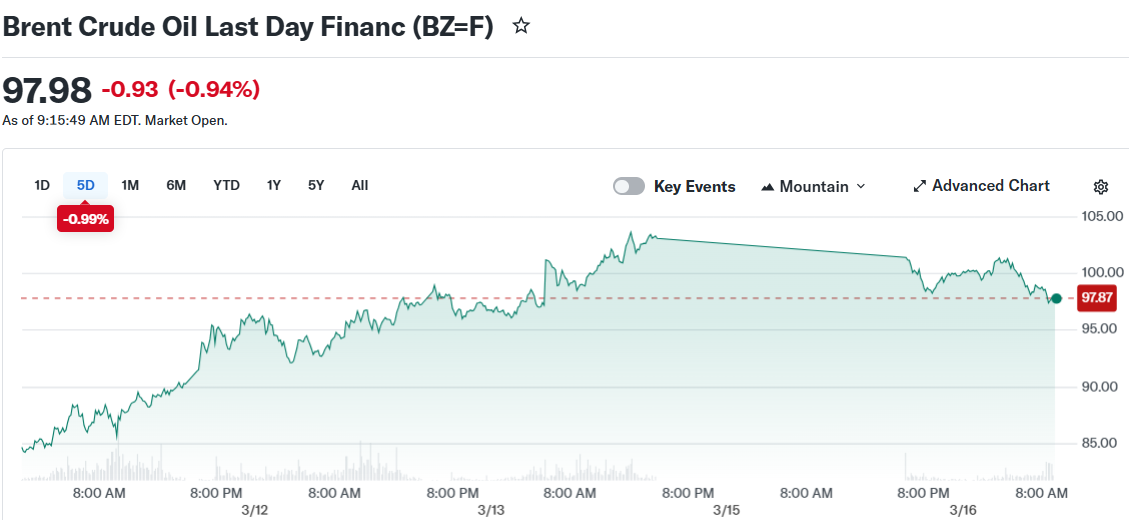
The financial institution’s new projection places Brent at an average of $77.50 per barrel throughout 2026, representing a substantial increase from the previous $61 estimate. Current market activity shows Brent trading at $103 per barrel.
This forecast adjustment stems from an almost complete cessation of petroleum transport through the Strait of Hormuz, a vital corridor for global energy movement. Under normal circumstances, approximately 20 million barrels daily of crude oil and refined petroleum products traverse this strategic waterway.
According to BofA, maritime traffic “stopped dead, almost two weeks ago.” Pipeline alternatives directing flow to the Red Sea have proven insufficient to compensate for the shortfall.
The market impact has been swift and substantial. Close to 200 million barrels of crude oil have been extracted from worldwide inventories. This represents approximately half of last year’s 400 million-barrel stockpile accumulation, eliminated within a matter of weeks.
BofA’s revised outlook presents several scenarios based on potential conflict resolution timelines. Should petroleum flows return to normal by April, Brent would average approximately $70 throughout the year. An extension of disruptions into Q2 would push the average to $85.

A third, less probable scenario envisions Brent averaging around $130 per barrel should interruptions continue through the latter half of 2026.
Post-Conflict Market Dynamics
BofA anticipates markets will transition back into oversupply once hostilities cease, driving Brent downward toward $65 in 2027. This forecast operates under the assumption of no permanent supply damage.
“With no end to the war in sight, oil stockpiles are draining, and firming the fundamental outlook post-war,” noted analysts under the leadership of Kalei Akamine.
The bank has also elevated its mid-cycle oil price benchmark to $70 Brent from $65, positioning it centrally within its $60–$80 long-term commodity range.
A separate analysis from BofA analyst Mensah highlighted that the petroleum price surge may trigger increased capital expenditure throughout the energy industry as firms adjust their investment strategies.
Exploration and Production Stocks Receive Upgrades
The improved oil price environment has translated directly into enhanced valuations for U.S. exploration and production companies. BofA has elevated price targets for oil-exposed E&P stocks by approximately 17% on average.
Diamondback Energy (FANG) continues to hold BofA’s premier position among large-capitalization options.
Devon Energy (DVN) and Ovintiv (OVV) were identified as mid-cap opportunities positioned for valuation reassessment under current petroleum pricing.
BofA maintained its Buy recommendation on California Resources (CRC), citing its capital-efficient 2026 strategy and the prospect of modest production growth in its 2027 maintenance framework.
Get 3 Free Stock Ebooks
Discover top-performing stocks in AI, Crypto, and Technology with expert analysis.
- Top 10 AI Stocks - Leading AI companies
- Top 10 Crypto Stocks - Blockchain leaders
- Top 10 Tech Stocks - Tech giants



