



Key Points
- Friday’s quadruple witching event will trigger the simultaneous expiration of trillions in traditional market derivatives
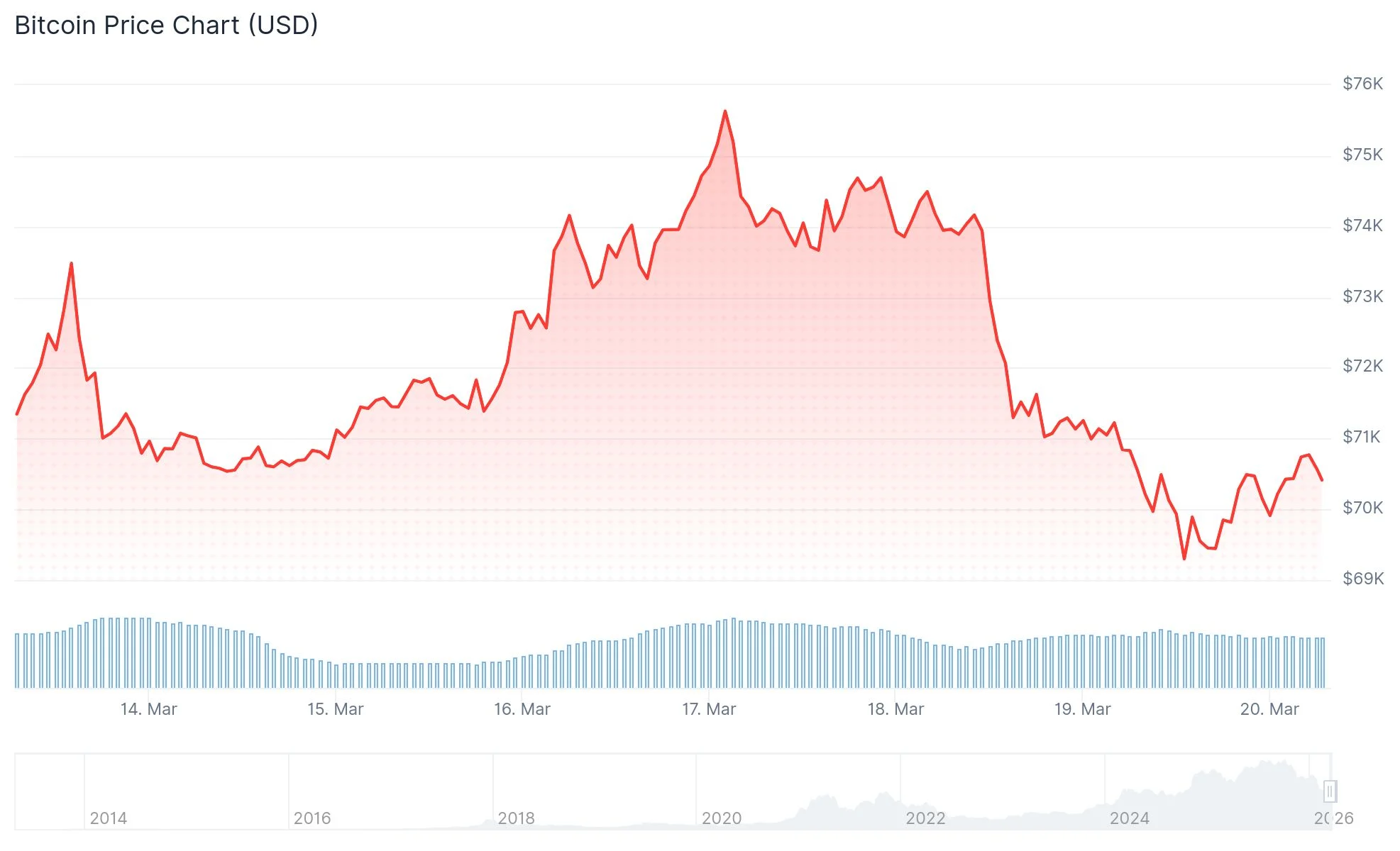
- BTC declined beneath the $70,000 threshold Thursday, failing to maintain crucial support zones
- Historical data reveals Bitcoin typically experiences subdued movement on witching days, followed by extended downward pressure
- Leveraged futures positions, rather than physical spot demand, are fueling the current market downturn
- An additional $13.5 billion in cryptocurrency options contracts will expire on Deribit March 27
Bitcoin slipped beneath the $70,000 mark on Thursday as worldwide financial markets geared up for one of the most significant quarterly derivatives settlements in conventional finance.
The phenomenon known as quadruple witching occurs four times annually — specifically on the third Friday in March, June, September, and December. This event represents the concurrent expiration of equity index futures, equity index options, individual stock options, and individual stock futures.
The magnitude of this quarterly event is substantial. During March 2025, approximately $4.7 trillion in stock and index derivative contracts reached expiration within a single trading session. That particular day witnessed the S&P 500’s highest trading volume for the entire calendar year, based on TradeStation data.
Numbers for the March 2026 settlement have yet to be disclosed.
When these events occur, financial institutions must simultaneously close out, extend, or finalize their positions. Market activity typically surges, and price fluctuations often intensify, particularly during the closing hour of the trading day.

Cole Kennelly, CEO of Volmex Finance, indicated the phenomenon might impact digital asset markets. He stated “quadruple witching could trigger a spike in cross-asset volatility as large derivatives positions expire,” noting that the Bitcoin Volmex Implied Volatility index was already climbing ahead of the event.
Bitcoin’s Historical Performance During Quarterly Witching Events
Analyzing 2025 data, Bitcoin’s price fluctuations on actual quadruple witching dates were predominantly neutral. More significant declines materialized during subsequent days and weeks.
On March 21, 2025, Bitcoin registered minor losses but subsequently found a bottom around $76,000 following market responses to President Trump’s “Liberation Day” tariff announcements. June 20 saw a 1.5% decline, with a local bottom near $98,000 appearing just 48 hours later.
September 19 witnessed a drop exceeding 1%, followed by a dramatic plunge from $177,000 to $108,000 during the next seven days. December 19 concluded roughly 3% higher at $85,000, though within a continuing bearish trend.
The evidence suggests a recurring theme: limited volatility during the actual event, followed by deterioration throughout subsequent trading periods.
Forces Behind Today’s Market Decline
Market analytics indicate the present Bitcoin correction stems primarily from futures market activity rather than physical market participants. The Coinbase premium indicator shifted into negative territory, signaling diminished demand from American investors.
Cryptocurrency analyst IT Tech observed that while spot market liquidation decreased by approximately $40 million, perpetual futures selling reached a substantially higher $506.75 million. This evidence identifies leveraged position holders as the principal drivers of the downturn.
Certain market participants anticipate a possible near-term bounce. Should Bitcoin successfully recapture the $70,000 level promptly, the subsequent objective stands at $76,000. However, a break below $68,300 would expose support zones at $65,000 and $62,000.
Bryan Tan of Wintermute proposed that “being flat is a strong position” under current conditions and advised maintaining cash reserves until market direction becomes more definitive.
External to cryptocurrency, the wider economic landscape presents additional headwinds. Crude oil has climbed toward $120 per barrel, the VIX fear gauge spiked above 35 last week — marking its highest reading in twelve months — and gold retreated below $4,600.
On the horizon, an independent $13.5 billion cryptocurrency derivatives settlement awaits on March 27 via Deribit. Market positioning for that expiration suggests traders favor volatility-oriented approaches rather than making strong directional wagers.
Get 3 Free Stock Ebooks
Discover top-performing stocks in AI, Crypto, and Technology with expert analysis.
- Top 10 AI Stocks - Leading AI companies
- Top 10 Crypto Stocks - Blockchain leaders
- Top 10 Tech Stocks - Tech giants



