



Key Highlights
- BTC declined approximately 3% to roughly $68,500 on Friday, posting a 2.7% loss for the week
- Traders remain anxious ahead of a massive $14 billion Bitcoin options expiration event on Friday, with maximum pain positioned around $75,000
- Market sentiment indicator shows extreme fear at 13 on the Crypto Fear & Greed Index
- Whale and shark addresses accumulated 61,568 BTC throughout the previous month
- Bitcoin ETFs recorded $2.5 billion in net positive flows during the past month despite downward price movement
Bitcoin experienced a roughly 3% decline to $68,507 on Friday, extending a challenging week influenced by persistent geopolitical concerns surrounding Iran and an approaching $14 billion options expiration deadline.
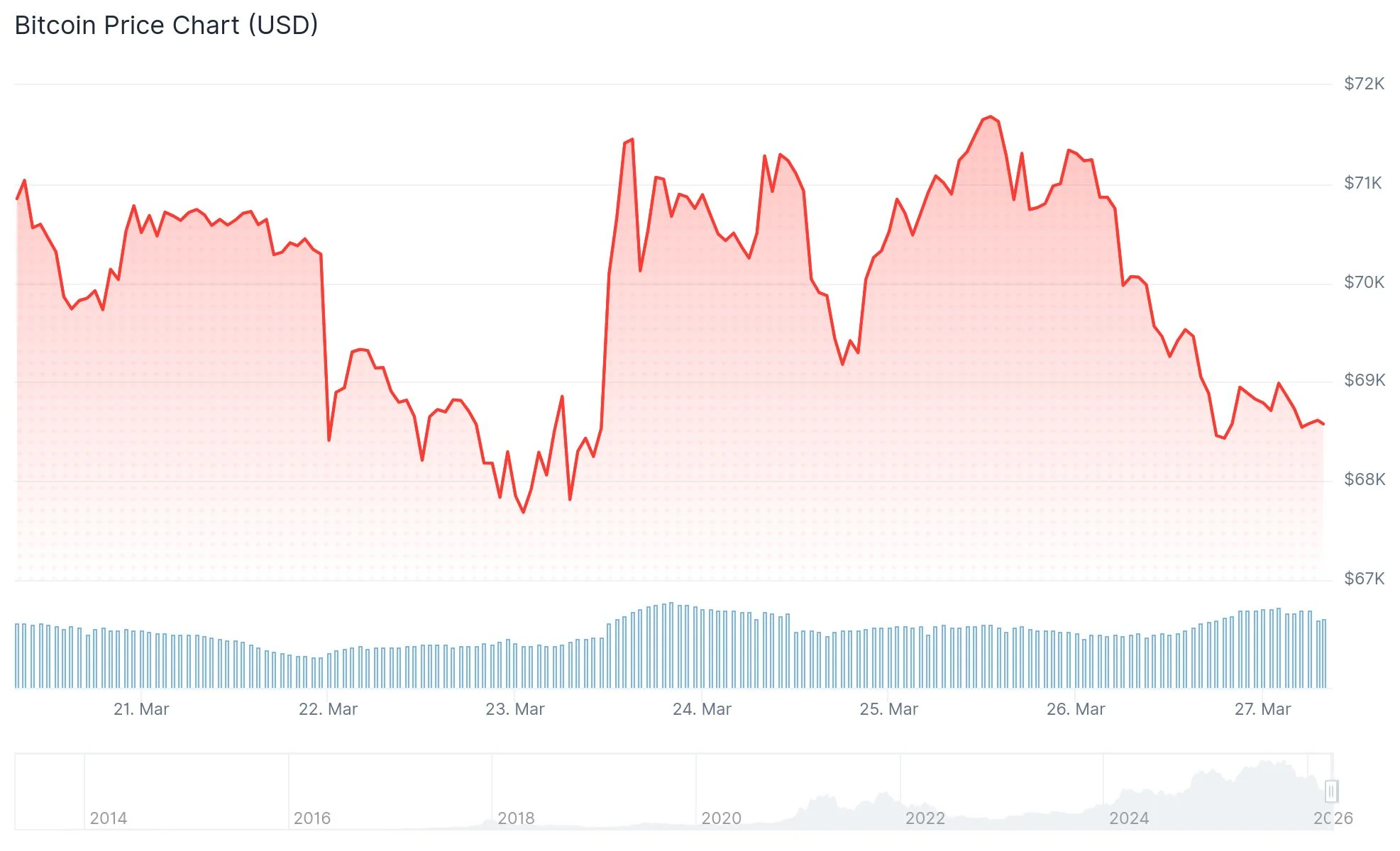
The downturn maintained a consistent trajectory for the fifth straight week. President Trump’s decision to extend the Iran ceasefire timeline by an additional 10 days initially sparked upward momentum and sent crude oil prices lower. However, subsequent reports from the Wall Street Journal indicating the Pentagon’s potential deployment of up to 10,000 additional ground forces to the Middle East quickly reversed those gains.
Brent crude retreated 1.3% to $106 before the military deployment news surfaced. The overall cryptocurrency market capitalization decreased nearly 1%, settling at $2.4 trillion.
Ethereum declined 4.6% to $2,050. Solana experienced a 5.3% drop to $85.93. XRP decreased 2.8% to $1.36, representing a 6.5% weekly loss. Tron stood as the sole major cryptocurrency posting gains, rising 1.2% during the trading session.
Massive $14 Billion Options Expiration Looms
Approximately $14 billion worth of Bitcoin options contracts are scheduled to expire Friday on the Deribit platform. Bloomberg analysts identified the maximum pain threshold near $75,000, representing the price point where the greatest number of contracts become worthless.

Following this expiration event, short-term hedging activities within cryptocurrency markets are anticipated to diminish, potentially leaving Bitcoin increasingly vulnerable to volatility driven by Middle Eastern geopolitical developments.
Bitcoin has encountered persistent resistance attempting to surpass $75,000 since the conflict commenced approximately one month ago. The digital asset has retreated roughly 50% from its late-2025 all-time high near $126,000.
Asian equity markets similarly declined 0.6% on Friday. South Korean technology stocks spearheaded the losses, with Samsung and SK Hynix driving the KOSPI down 2.3%.
Large Holders Continue Accumulation During Downturn
Major Bitcoin holders demonstrate ongoing accumulation behavior. Whale and shark addresses — classified as wallets containing between 10 and 10,000 BTC — expanded their holdings by 0.45% during the previous month, acquiring a total of 61,568 BTC, according to data from on-chain analytics platform Santiment.
Smaller addresses holding less than 0.01 BTC accumulated 213 BTC during the identical timeframe, representing a 0.42% increase.
Dominick John, an analyst with Zeus Research, observed that whales are “quietly stacking during consolidation periods” in anticipation of a potential upward breakout. He highlighted that excessive retail FOMO could trigger a temporary pause or correction before the subsequent accumulation cycle begins.
Bitcoin ETFs registered $2.5 billion in net positive flows throughout the past month, according to Bloomberg data. BlackRock’s bitcoin ETF achieved a ranking within the top 2% of all ETFs by year-to-date inflows.
BlackRock highlighted this week that institutional investors are focusing capital allocation toward bitcoin and ether while maintaining distance from the broader altcoin sector.
The Crypto Fear & Greed Index registered 13 on Friday, firmly within “extreme fear” range, maintaining consistency with measurements recorded throughout February and the preceding week.
The next critical milestone arrives in early April, when Trump’s extended Iran ceasefire deadline reaches expiration.
Get 3 Free Stock Ebooks
Discover top-performing stocks in AI, Crypto, and Technology with expert analysis.
- Top 10 AI Stocks - Leading AI companies
- Top 10 Crypto Stocks - Blockchain leaders
- Top 10 Tech Stocks - Tech giants



