



TLDR
- Bitcoin surged toward $72,000 following U.S. Treasury Secretary Scott Bessent’s intervention to stabilize oil markets.
- A new “Joint Harmonization Initiative” was unveiled by the SEC and CFTC to create unified crypto regulation.
- Exchange-held Bitcoin has dropped to approximately 2.75 million BTC, marking the lowest point since 2019.
- Around 14.5 million BTC remains in the hands of long-term holders showing minimal selling pressure.
- Corporate entities acquired nearly 350,000 BTC during a recent accumulation phase, further reducing available supply.
Bitcoin pushed toward the $72,000 mark on March 13, 2026, propelled by encouraging regulatory developments and mounting evidence of tightening market supply.
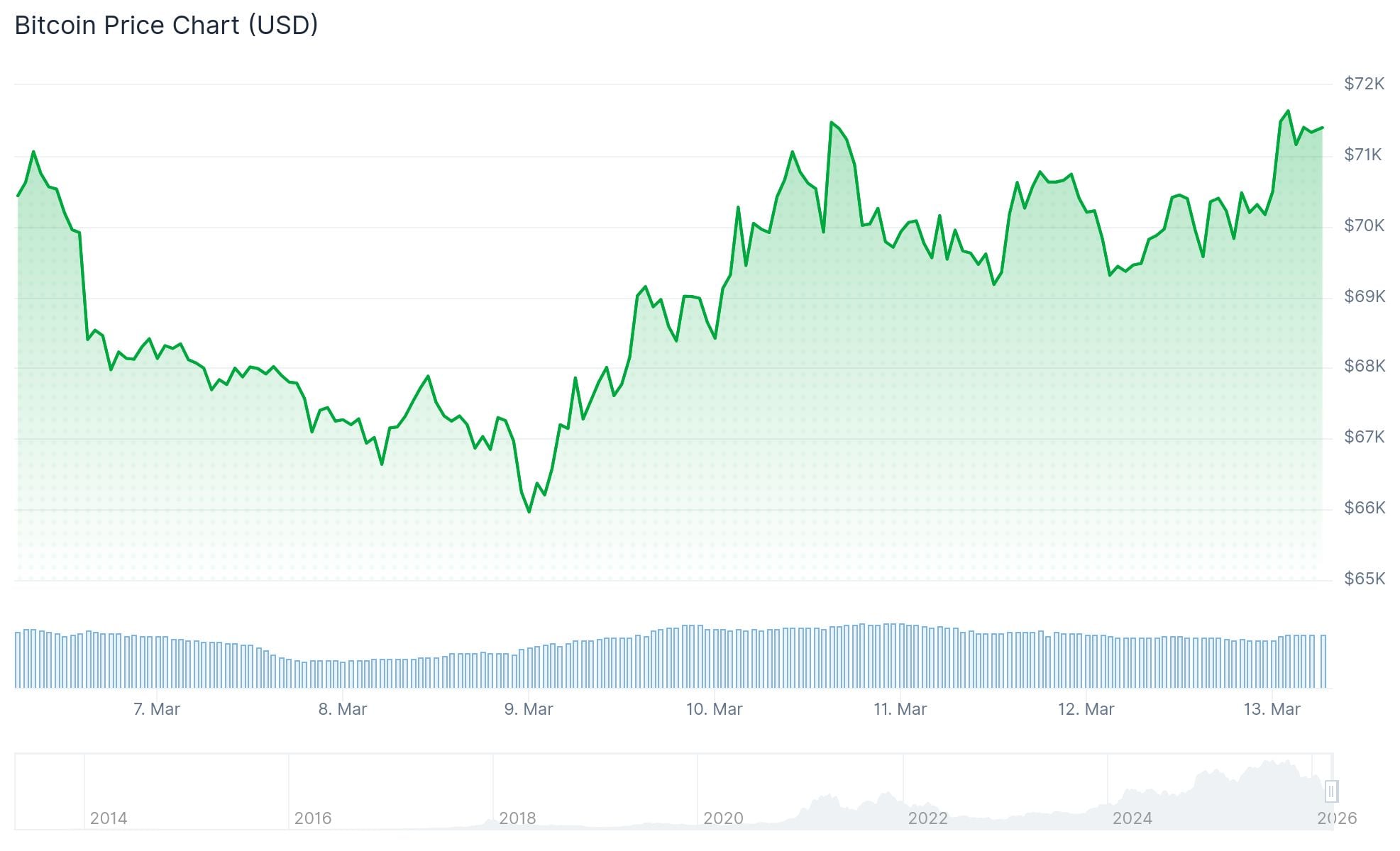
The upward momentum gained traction midweek after the U.S. Securities and Exchange Commission and Commodity Futures Trading Commission revealed plans for collaborative crypto oversight. The initiative, dubbed the “Joint Harmonization Initiative,” represents a significant shift in regulatory approach.
This framework seeks to establish coordinated data-sharing systems, simplify compliance reporting, and eliminate conflicting enforcement actions between the two regulatory bodies. Despite being non-binding, market participants interpreted the announcement favorably.
The development supports President Trump’s ongoing efforts to establish clearer regulatory guidelines for digital assets. Both agencies now operate under pro-cryptocurrency leadership following recent administrative appointments.
Energy markets introduced volatility throughout the week. Crude prices jumped approximately 10% to approach $100 per barrel on Thursday, influenced by escalating U.S.-Israel-Iran geopolitical tensions. This energy spike dampened equity markets and suppressed overall risk sentiment.

On Thursday evening, Treasury Secretary Scott Bessent announced via X that the United States would permit purchases of Russian oil currently held in maritime storage. He characterized the oil price spike as a “short-term and temporary disruption.”
Crude oil prices retreated approximately $2 per barrel following this statement. Bitcoin, which had consolidated around $70,000 throughout Thursday, quickly rallied toward $72,000 in response.
Exchange-Held Bitcoin Reaches Six-Year Low
Bitcoin held across centralized exchanges declined to roughly 2.75 million BTC by March 12, based on CryptoQuant analytics. This represents the smallest exchange balance observed since 2019.
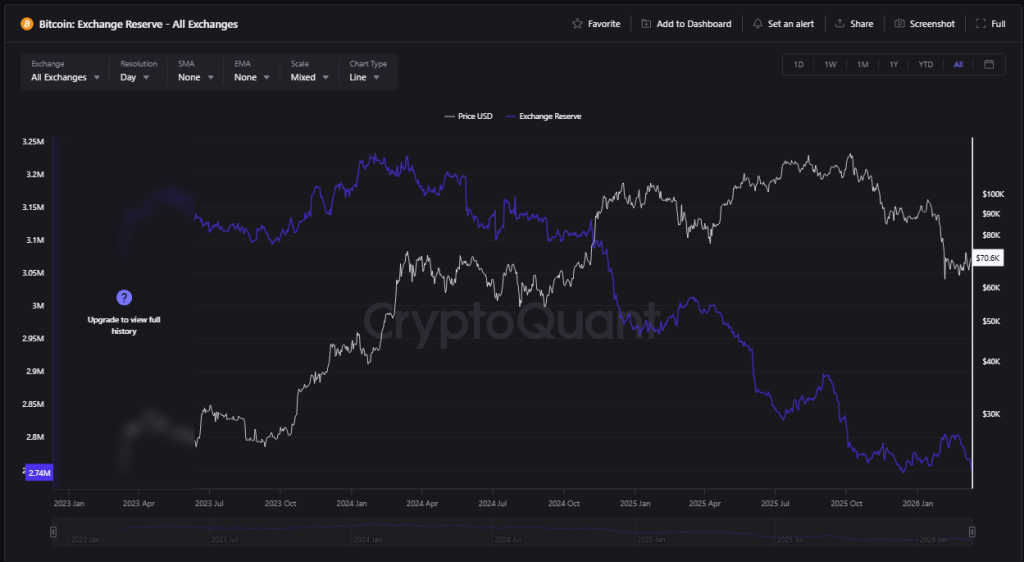
Long-term holders currently possess approximately 14.5 million BTC — defined as coins unmoved for more than five months. Multiple factors have driven this decline: retail and institutional investors transferring assets to cold storage, spot Bitcoin ETFs accumulating supply, and corporations establishing strategic reserves.
Spot ETF products recorded nearly $570 million in net inflows during one week. A single day witnessed exchange outflows totaling 32,000 BTC.
Institutional Accumulation Persists
Strategy, previously operating as MicroStrategy, maintains its acquisition program. Public companies collectively purchased approximately 350,000 BTC throughout a recent accumulation window.
With diminished exchange availability, even modest buying pressure generates notable price impacts. Market observers characterize the current environment as a supply squeeze scenario.
Bitcoin experienced downward pressure throughout February, declining into the low $60,000 range before stabilizing. Trading has since consolidated between $67,000 and $71,000. A decisive move above $72,000 could activate short liquidations, creating additional upward momentum.
Daily transaction volumes remain elevated above $50 billion. Current mining profitability breakeven points hover between $64,000 and $65,000 based on electricity costs.
Get 3 Free Stock Ebooks
Discover top-performing stocks in AI, Crypto, and Technology with expert analysis.
- Top 10 AI Stocks - Leading AI companies
- Top 10 Crypto Stocks - Blockchain leaders
- Top 10 Tech Stocks - Tech giants



