


Key Takeaways
- BTC maintains position around $67,000 even as crude oil climbs beyond $110 per barrel
- Middle East tensions involving the U.S., Israel, and Iran have shaken global markets, yet Wall Street shows resilience
- Spot Bitcoin ETFs registered consecutive weekly inflows totaling $568 million
- BTC demonstrates stronger correlation with U.S. risk assets, mirroring Nasdaq movements and technology equities
- Asian trading sessions witnessed severe declines, with South Korea’s Kospi plummeting over 16%
Bitcoin continues to trade around the $67,000 mark as intensifying military tensions involving the United States, Israel, and Iran have driven crude oil prices beyond $110 per barrel. While international markets have experienced significant volatility, Bitcoin has demonstrated remarkable resilience.
The geopolitical crisis erupted on February 28, immediately sending oil prices across both American and European markets above the $100 threshold. Anxiety surrounding potential supply disruptions through the strategically crucial Strait of Hormuz propelled crude prices even higher by the start of the week.
Markets across Asia experienced the most dramatic impact. Japan’s Nikkei index plunged 10%, India’s Nifty declined 5%, while South Korea’s Kospi suffered losses exceeding 16%. In contrast, U.S. equity futures dipped slightly more than 3% since hostilities commenced.
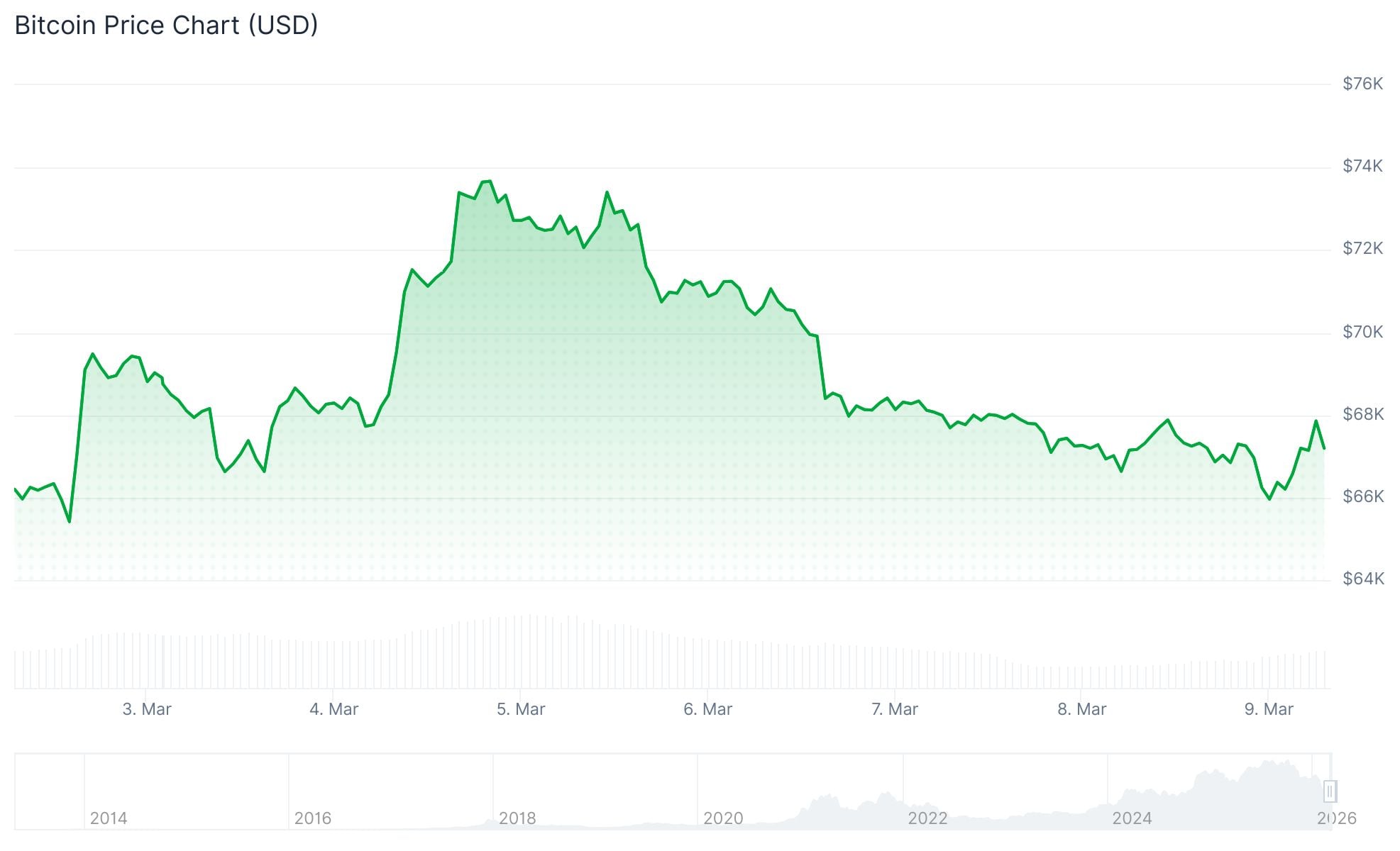
Bitcoin briefly dipped under $66,000 during Monday’s Asian session before rebounding to $67,226. The digital asset had already retreated toward $60,000 prior to the conflict’s outbreak, following several weeks of market participants taking profits.
Bitcoin’s Deepening Connection to U.S. Markets
Market analysts attribute Bitcoin’s resilience to its strengthening correlation with American financial markets. The United States sources its petroleum primarily from Canada and Mexico, and has emerged as the globe’s leading net petroleum exporter. This positioning shields American markets from Middle Eastern supply shocks.

JP Morgan analysts Kriti Gupta and Justin Beimann highlighted that the U.S. imports merely 4% of its crude from Saudi Arabia. They emphasized that American energy self-sufficiency provides a cushion before elevated oil prices impact domestic consumers.
Bitcoin’s movements have tracked Wall Street indices more consistently following the introduction of U.S. spot ETFs in early 2024. Institutional participation through these investment vehicles has strengthened BTC’s relationship with American financial market conditions.
Donald Trump’s electoral victory in late 2024 further accelerated this transformation. His campaign commitments toward cryptocurrency-favorable regulatory frameworks enhanced market optimism and attracted additional institutional capital.
Bitcoin ETF Capital Returns
U.S. spot Bitcoin ETFs accumulated $568.45 million in net capital inflows during the week, based on SoSoValue tracking. This followed the preceding week’s $787.31 million in positive flows.
This represents the first time Bitcoin ETFs have recorded consecutive weekly gains in five months. Previously, these investment products had experienced approximately $3.8 billion in aggregate outflows spanning five weeks.
Daily movement patterns varied considerably. Monday witnessed $458 million entering the funds, Wednesday contributed an additional $461 million, while Thursday and Friday combined for $576 million in withdrawals.
Spot Ether ETFs similarly logged a second consecutive week of positive flows, capturing $23.56 million following the prior week’s $80.46 million.
Blockstream’s marketing director observed that Bitcoin ETFs have achieved approximately 15 years’ worth of gold ETF inflows in less than two years, despite navigating through a 46% price correction.
Bitcoin was most recently changing hands at $67,226, reflecting a 0.3% gain in early Monday commerce.
Get 3 Free Stock Ebooks
Discover top-performing stocks in AI, Crypto, and Technology with expert analysis.
- Top 10 AI Stocks - Leading AI companies
- Top 10 Crypto Stocks - Blockchain leaders
- Top 10 Tech Stocks - Tech giants



