



Key Takeaways
- BTC price recovered to approximately $68,000 following a weekend decline to $63,000
- U.S. spot Bitcoin ETFs absorbed $1.45 billion in net capital over the past five sessions
- Short liquidations fueled much of the bounce, with limited new long conviction entering the market
- Technical indicators show RSI improving from 36 to 41, while volume surged from $6.6B to $9.6B
- Polymarket odds indicate declining probability of BTC testing $65K or $60K levels in March
Bitcoin staged a notable recovery on March 4, pushing back toward the $70,000 level with prices hovering near $68,000 during Asian trading hours.
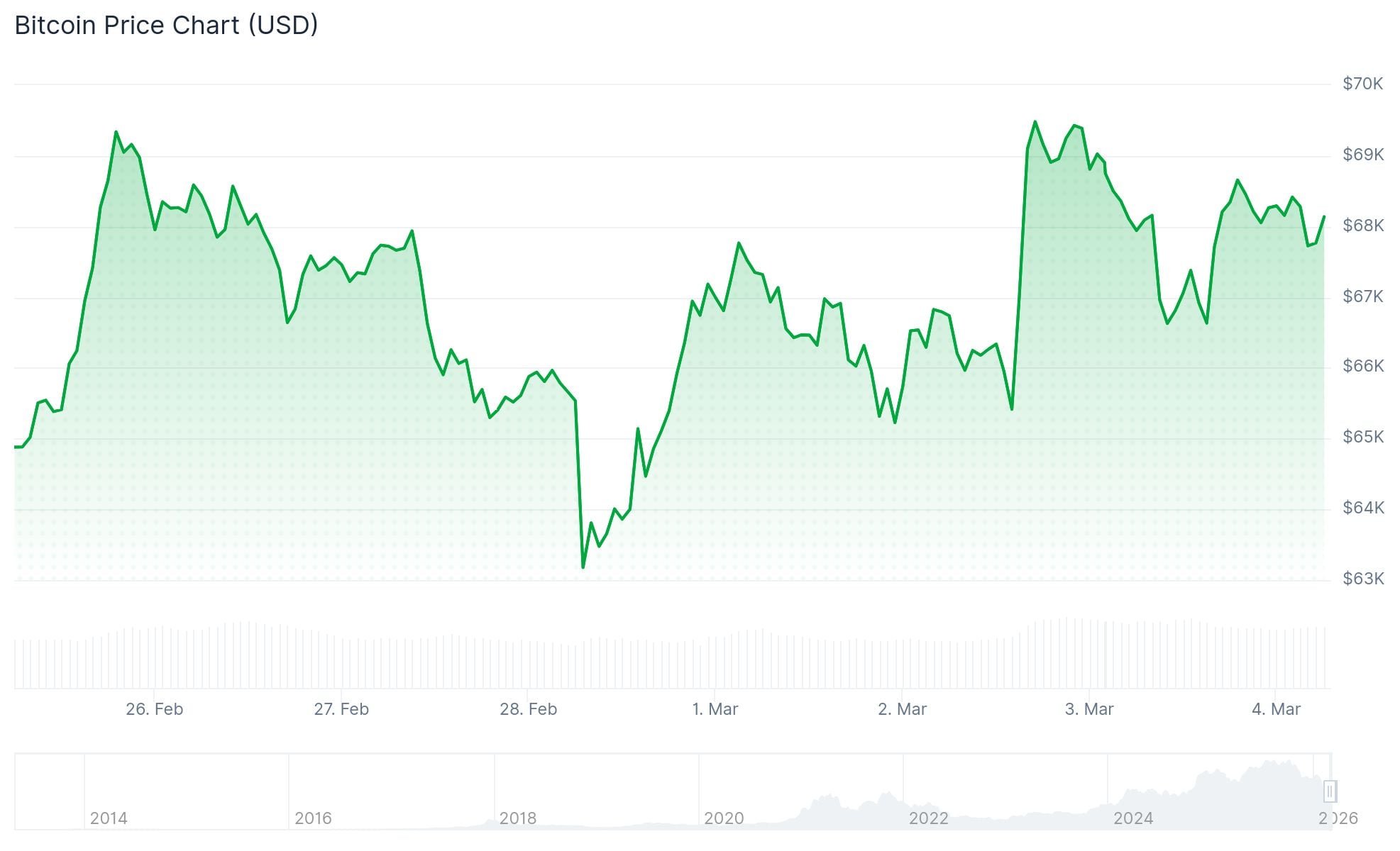
The rebound came after a volatile weekend session saw BTC tumble to approximately $63,000, with escalating Middle Eastern tensions cited as the primary catalyst.
According to market maker Enflux, the upward movement was primarily fueled by short liquidations rather than fresh bullish positioning. Bearish traders were forced to close positions as geopolitical fears failed to materialize into broader conflict.
“The market is not pricing catastrophe, but it is not pricing resolution either,” Enflux noted in correspondence with CoinDesk.
Cryptocurrency markets typically react more swiftly to geopolitical developments than legacy financial markets. Enflux characterized Bitcoin as functioning like a “pressure valve” for capital flows during periods of global uncertainty.
Institutional Demand Creates Support Zone
The price floor has been reinforced by consistent institutional accumulation. U.S. spot Bitcoin exchange-traded funds registered approximately $1.45 billion in aggregate net inflows across the previous five trading sessions.

In a March 2 conversation, Bitwise Chief Investment Officer Matt Hougan revealed that institutional allocators are viewing recent weakness as a strategic entry opportunity. He shared that one client finalized an $11 million commitment following two years of evaluation.
“They’re not surprised that crypto is volatile,” Hougan explained. “They’ve been waiting for an entry point.”
Hougan emphasized that typical Bitwise institutional clients require an average of eight meetings before committing capital, with many operating on quarterly decision-making cycles. The extended timelines reflect standard institutional due diligence rather than hesitation.
By the fourth quarter, three out of four major wirehouses gained approval to proactively discuss Bitcoin investment opportunities with their client base.
Blockchain Metrics Reveal Measured Sentiment
On-chain analytics from Glassnode indicate gradual improvement without confirming strong bullish momentum.
The Relative Strength Index for Bitcoin climbed to 41 from the previous week’s reading of 36. However, it remains beneath the 50 threshold typically associated with buyer dominance.
Daily trading volume expanded significantly to $9.6 billion from $6.6 billion, while spot market order flow has achieved greater equilibrium between buyers and sellers.
Derivatives market data continues to show seller pressure exceeding buyer interest, with funding rates for leveraged long positions declining noticeably.
Prediction market platforms reflect this cautious outlook. The likelihood of Bitcoin declining to $65,000 during March decreased by 11 percentage points to 73%. Similarly, the probability of touching $60,000 dropped 10 points to 41%.
A corresponding Polymarket contract measuring whether Bitcoin reaches $60,000 before $80,000 declined 12 percentage points to 61%.
As of publication, BTC was changing hands at $66,360.
Get 3 Free Stock Ebooks
Discover top-performing stocks in AI, Crypto, and Technology with expert analysis.
- Top 10 AI Stocks - Leading AI companies
- Top 10 Crypto Stocks - Blockchain leaders
- Top 10 Tech Stocks - Tech giants



