



Key Takeaways
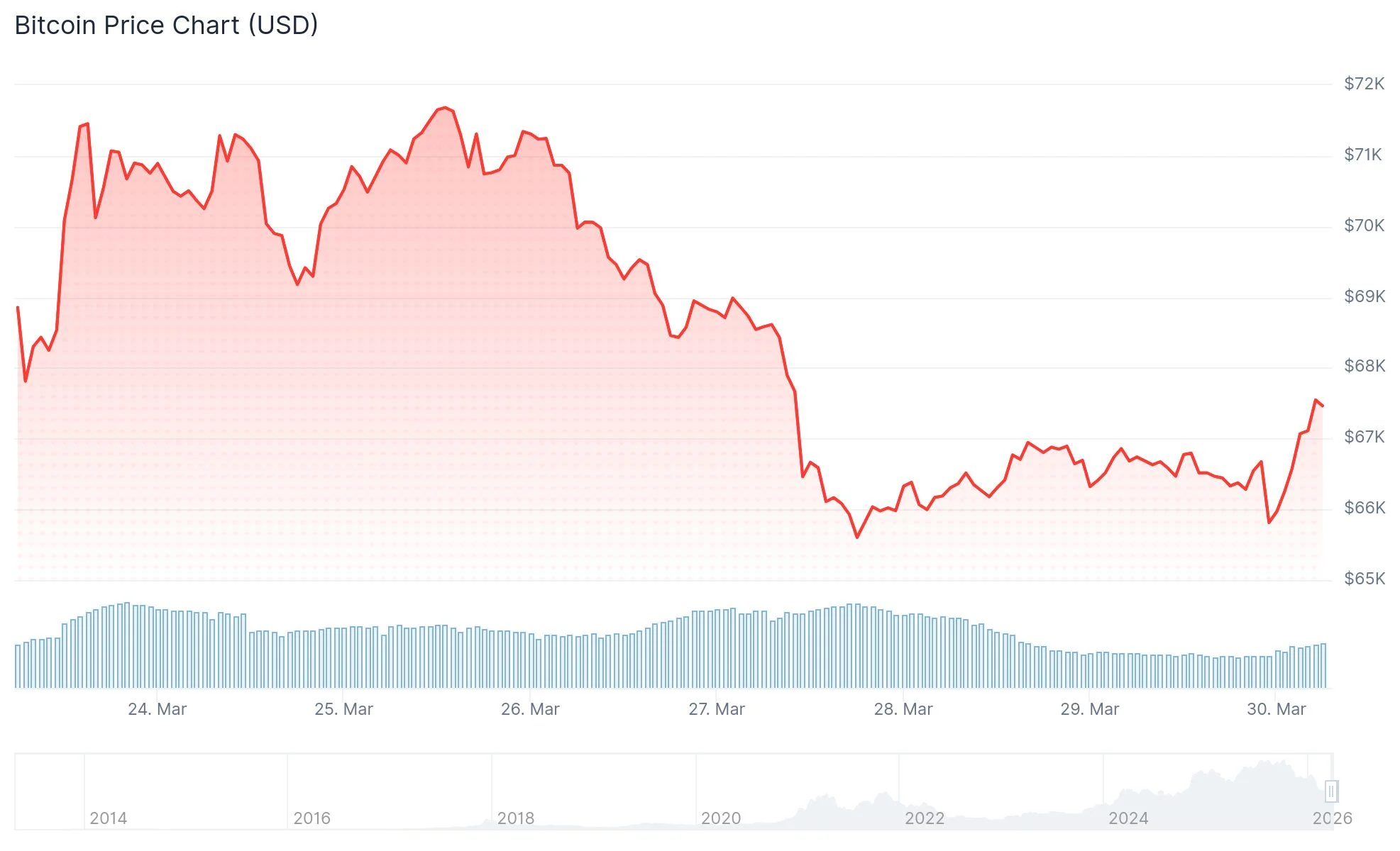
- BTC currently fluctuates between $66,500 and $67,000, declining from $71,000 the previous week and trading 47% beneath its record peak of $126,080.
- Long position volume on Bitfinex has reached its highest point in 28 months—traditionally an indicator of potential downside.
- Middle East tensions between the U.S. and Iran are fueling inflationary pressures, preventing Federal Reserve interest rate reductions.
- Market observers identify $60,000 as a crucial support threshold if market conditions deteriorate further.
- Professional investors maintain accumulation strategies, evidenced by more than $1.13 billion flowing into U.S. spot Bitcoin ETFs this month.
Bitcoin has maintained a trading range between $66,500 and $67,000 during the last day of market activity. This represents a decline from approximately $71,000 recorded seven days earlier, with the cryptocurrency momentarily dipping to $65,000 during weekend trading before staging a modest rebound. Current valuations place BTC 47% under its historical maximum of $126,080, achieved in October 2025.
The cryptocurrency Fear & Greed Index registers at merely 9, indicating “extreme fear” market sentiment.
A significant data metric is contributing to negative market outlook. Optimistic long positions on the Bitfinex exchange—bets anticipating upward price movement—have increased to 79,343, marking the most elevated reading since November 2023. Historical analysis reveals this type of long position accumulation typically functions as a contrarian signal. Specifically, BTC/USD longs on Bitfinex increased by 30% during Q4 2025, while bitcoin’s actual market price dropped 23% to $87,550.
The correlation remains reliable: Bitfinex long position peaks generally precede price declines, while decreasing long interest typically accompanies price recoveries.
Global Political Tensions Impact Market Dynamics
Ongoing U.S.-Iran hostilities continue applying pressure across worldwide financial markets. Iranian military operations have targeted Gulf region nations including Kuwait and Saudi Arabia, while diplomatic negotiations remain deadlocked. These developments have elevated crude oil valuations, intensifying inflation worries and diminishing prospects for Federal Reserve monetary easing—factors that negatively affect cryptocurrency valuations.

Rachael Lucas, cryptocurrency strategist at BTC Markets, characterized recent market movements as “a classic risk-off unwind.” Bitcoin briefly reached $72,000 midweek following diplomatic optimism, before retracing when negotiations faltered.
Jeff Mei, COO at BTSE, indicated that petroleum and natural gas prices will maintain elevated levels short-term, hampering economic expansion. “We believe that crypto prices have more room to fall, with bitcoin potentially falling to the $60,000 support level,” he stated.
Andri Fauzan Adziima, Research Lead at Bitrue, concurred that market behavior remains news-dependent. He suggested any reduction in U.S.-Iran tensions could trigger a surge past $70,000.
Institutional Accumulation Contrasts with Retail Hesitation
Retail and institutional market participants currently exhibit divergent behavior patterns. Lucas observed that individual investors are “hedging or sitting on the sidelines,” while institutional capital continues entering the market. U.S. spot bitcoin ETFs registered over $1.13 billion in monthly capital inflows, reversing four consecutive months of net outflows. Strategy has maintained its purchasing program, and Morgan Stanley is developing a competitive low-fee bitcoin ETF product.
Lucas emphasized: “When retail fear and institutional accumulation diverge this sharply, history suggests the institutions tend to be right.”
Macroeconomic releases scheduled this week, including initial jobless claims data and March non-farm payroll statistics, could alter market sentiment should employment numbers underperform expectations.
Get 3 Free Stock Ebooks
Discover top-performing stocks in AI, Crypto, and Technology with expert analysis.
- Top 10 AI Stocks - Leading AI companies
- Top 10 Crypto Stocks - Blockchain leaders
- Top 10 Tech Stocks - Tech giants



