



Quick Summary
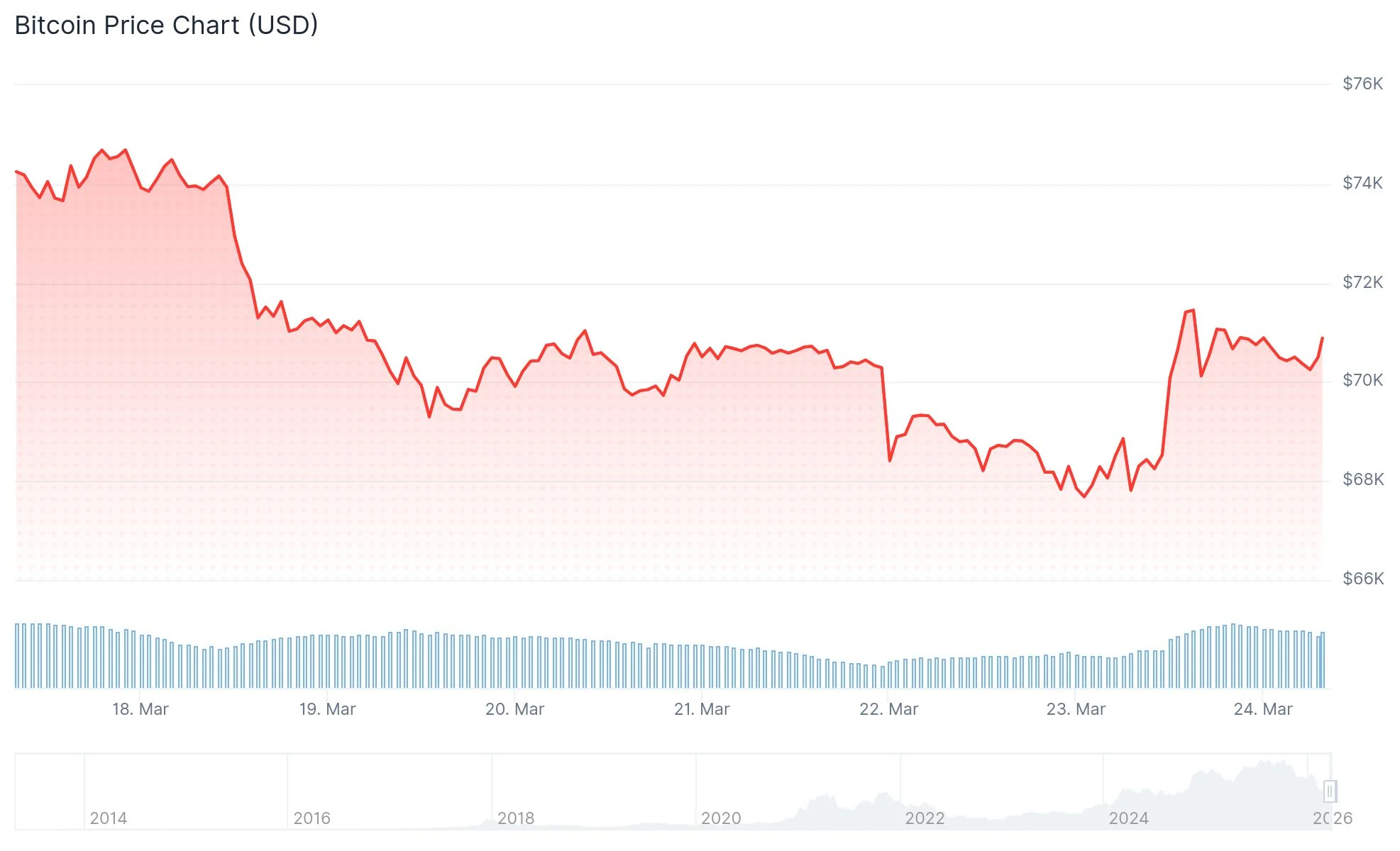
- Bitcoin (BTC) gained approximately 1.9% to reach $70,200 on Tuesday, maintaining momentum following President Trump’s announcement of a five-day halt on Iranian strikes.
- Tehran officials contradicted U.S. claims of peace negotiations, creating ambiguity in the geopolitical landscape and market sentiment.
- MicroStrategy (MSTR) unveiled plans to raise $42 billion in capital while revealing its acquisition of 1,031 BTC last week, pushing total holdings to 762,099 BTC.
- Trading volumes for Bitcoin on Binance reached their lowest point since September 2023, indicating the price surge lacks substantial buying support.
- U.S.-based Bitcoin spot ETFs attracted $167 million in net inflows on March 23, breaking a three-day outflow pattern.
Bitcoin pushed past the $70,000 threshold on Tuesday, continuing its recovery that began when President Donald Trump declared a temporary halt to planned military action against Iran’s energy facilities. Trump referenced “productive” diplomatic engagement with Iranian officials, providing a boost to risk-sensitive assets globally.
Yet, high-ranking Iranian representatives swiftly refuted assertions that any negotiations had occurred with the United States, directly challenging Trump’s narrative. This conflicting messaging left financial markets in limbo, uncertain about the trajectory of Middle Eastern tensions.
During Monday’s U.S. trading hours, Bitcoin peaked at $71,789 on Binance. By Tuesday’s opening, BTC hovered near $70,200, representing an approximate 1.9% increase across the previous 24-hour period.
Alternative cryptocurrencies followed suit with upward movement. Ether (ETH), Solana (SOL), and Dogecoin (DOGE) each posted gains around 5%. Cryptocurrency mining equities also surged, with Hut 8 (HUT) climbing over 11% while Riot Platforms and CleanSpark advanced 6–7%.
Trading Volume Data Reveals Fragile Foundation
While prices rose, underlying market metrics paint a less optimistic picture. March trading volumes on Binance are projected to register the weakest performance since Q3 2023, totaling approximately $52 billion — a significant decline from September 2023’s $88 billion.

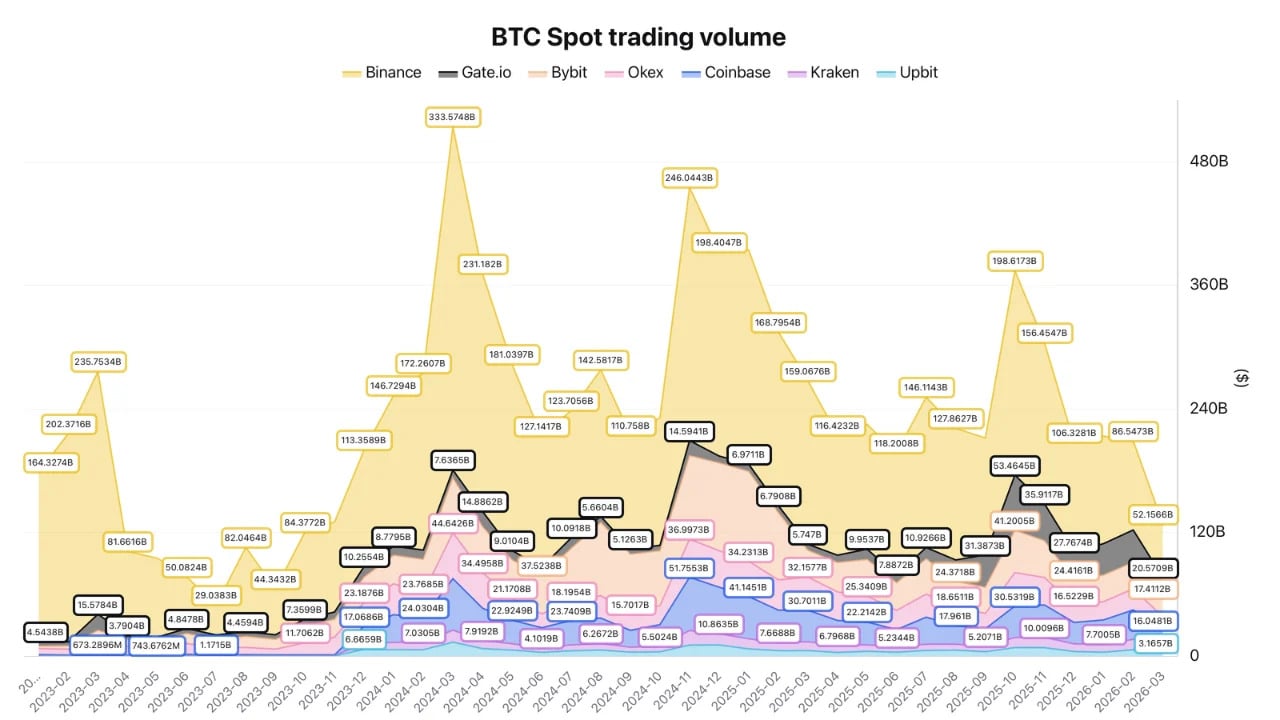
Exchange movement data reinforces this trend. Seven-day aggregate flows on Binance recorded $6.38 billion, marking the lowest reading since 2024 began. Meanwhile, Coinbase flows remained comparatively steady at $5.14 billion, suggesting more consistent engagement from long-term market participants.
The upward price action appears primarily fueled by forced liquidations of short positions rather than fresh capital inflow. Binance witnessed over $44 million in short liquidations within a single hour — representing the largest hourly short squeeze since February 6. Collective open interest contracted by roughly 9,700 BTC during the rally, signaling position closures rather than new market entries.
The Coinbase premium indicator remained in negative territory throughout, pointing to minimal participation from U.S. spot market buyers.
MicroStrategy Unveils $42 Billion Bitcoin Acquisition Strategy
MicroStrategy Inc. (MSTR), holding the largest corporate Bitcoin reserves, announced a new $42 billion at-the-market equity offering program on Monday. The initiative divides equally between a $21 billion common stock component and a $21 billion preferred stock component, with an additional $2.1 billion option available through a preferred series offering.
The corporation simultaneously disclosed its purchase of 1,031 BTC during the previous week, elevating total holdings to 762,099 coins. MicroStrategy shares have declined approximately 12% year-to-date in 2026.
Institutional ETF Capital Returns
Regarding exchange-traded fund activity, Wu Blockchain noted that U.S. Bitcoin spot ETFs registered $167 million in net inflows on March 23, based on SoSoValue analytics. This development concluded a three-day period of net withdrawals and signaled renewed institutional appetite, at least temporarily.
Wintermute analysts suggested Bitcoin could challenge the $74,000–$76,000 zone if crude oil prices achieve stability and Strait of Hormuz maritime traffic returns to normal operations. Conversely, should diplomatic initiatives collapse, a retreat toward the mid-$60,000 region remains plausible, according to their assessment.
Get 3 Free Stock Ebooks
Discover top-performing stocks in AI, Crypto, and Technology with expert analysis.
- Top 10 AI Stocks - Leading AI companies
- Top 10 Crypto Stocks - Blockchain leaders
- Top 10 Tech Stocks - Tech giants



