



Key Highlights
- United States spot Bitcoin exchange-traded funds witnessed $1.42 billion in net redemptions over the past week — marking the third-largest weekly withdrawal in history.
- BlackRock’s IBIT fund was responsible for approximately $966 million of the total outflows, including a staggering $448 million single-day exit.
- ETF redemptions forced the liquidation of roughly 19,021 BTC within seven days, representing the equivalent of 42 days’ worth of mining production.
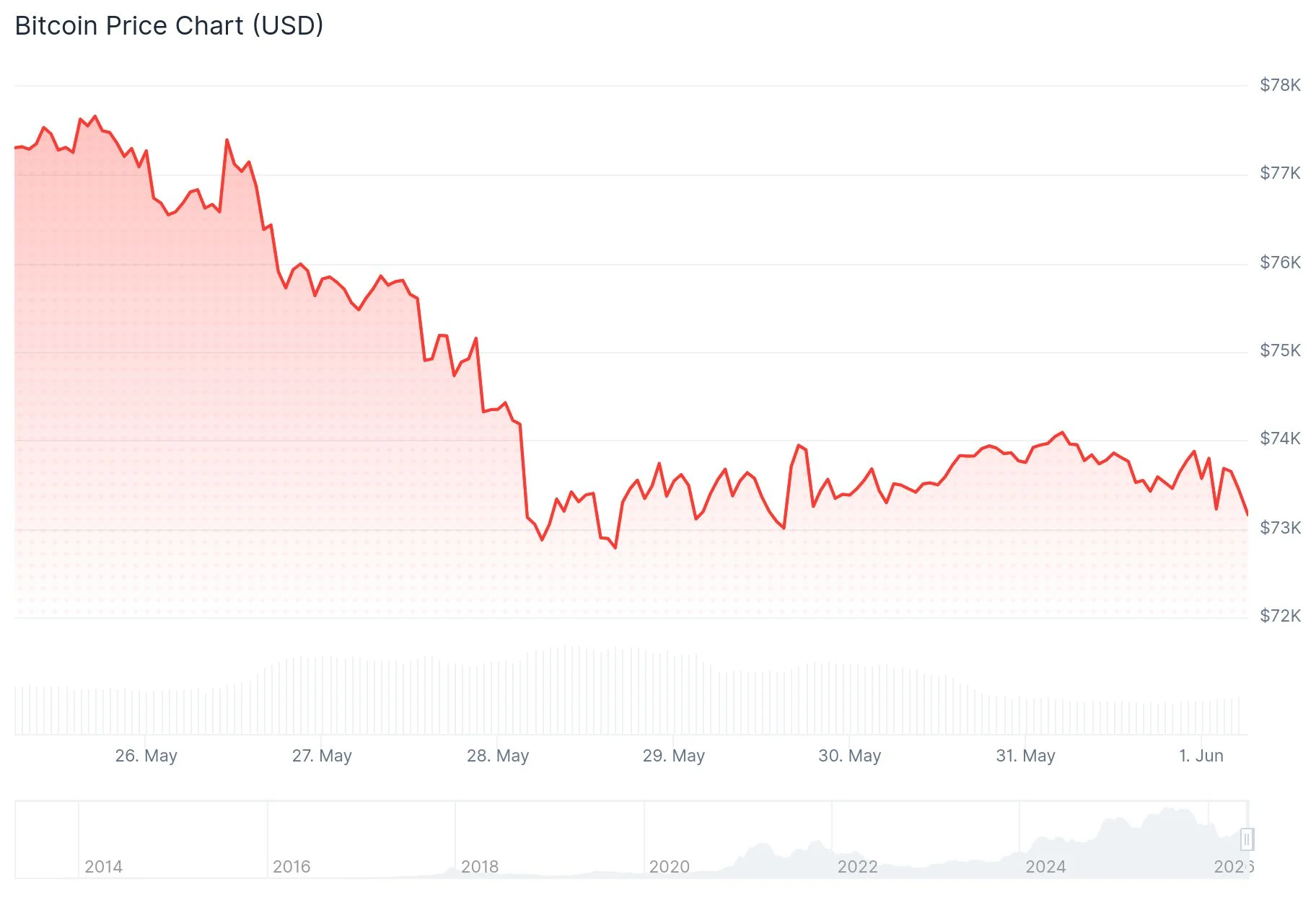
- Bitcoin’s valuation declined more than 4% throughout the week, settling near the $73,000 level.
- Macroeconomic headwinds — persistent inflation concerns, climbing Treasury yields, and escalating geopolitical risks — continue to fuel the downturn.
Bitcoin experienced a decline exceeding 4% over the past seven days, retreating to approximately $73,000 following a brief rally above $82,000 earlier in May. This downward pressure coincided with US spot Bitcoin exchange-traded funds recording $1.42 billion in net redemptions — representing the third-heaviest weekly withdrawal since these investment vehicles debuted, based on compiled data.
This marked the third consecutive week of substantial capital exits. Combined outflows over this three-week period have now surpassed $3.5 billion.
BlackRock’s Flagship Fund Dominates Redemptions
BlackRock’s IBIT, which holds the distinction of being the largest spot Bitcoin ETF by total assets under management, spearheaded the selling wave. The fund experienced approximately $966 million in outflows across the week. During its most severe single session, redemptions reached an alarming $448 million.
When ETF units undergo redemption, fund issuers are required to liquidate the corresponding Bitcoin holdings to fulfill these withdrawals. Throughout the week, all spot ETFs collectively offloaded approximately 19,021 BTC into the marketplace — an amount equivalent to what miners produce over a 42-day span.
Cryptocurrency market analyst Ali Charts (@alicharts) drew attention to an important technical threshold, stating: “I’m watching $72,650 closely on Bitcoin, as the MVRV Pricing Bands continue to identify it as a critical support level. If it fails, the next major demand zone sits between $54,300 and $51,000.” This crucial level hovers just beneath Bitcoin’s current trading position.

Macro Forces Behind the Selloff
The broader economic environment remains the primary catalyst. Recent inflation figures published in May diminished market expectations for Federal Reserve interest rate reductions. Elevated interest rates enhance the appeal of risk-free investments such as Treasury securities, consequently diminishing investor appetite for volatile digital assets like Bitcoin.
Geopolitical instability — including the possibility of renewed escalation in US-Iran hostilities — has compounded the pressure. Surging crude oil prices connected to these tensions threaten to drive inflation higher, further reducing the probability of monetary policy easing.
Market analyst AlphaBTC (@mark_cullen) offered his short-term outlook, indicating he anticipates a potential bounce toward $79,000 before a possible correction to the lower $60,000 range during the summer months.
The Crypto Fear & Greed Index persisted in “fear” territory throughout the entire week.
One encouraging sign emerged: the market’s capacity to absorb 19,021 BTC through spot transactions without triggering a more dramatic price collapse indicates that buying interest persists at present valuation levels.
Bitcoin was changing hands around $73,000 according to the most recent market data, with the $72,650 MVRV support threshold remaining a focal point for technical analysts.
Get 3 Free Stock Ebooks
Discover top-performing stocks in AI, Crypto, and Technology with expert analysis.
- Top 10 AI Stocks - Leading AI companies
- Top 10 Crypto Stocks - Blockchain leaders
- Top 10 Tech Stocks - Tech giants



