



Key Takeaways
- Stablecoin expansion may trigger 3%–5% erosion of traditional bank deposit bases within a five-year horizon
- Banks could experience approximately 3% earnings contraction due to elevated funding expenses
- Digital dollar alternatives have reached $314 billion in total value, with projections suggesting growth to $1.15 trillion
- Federal legislation through the GENIUS Act prevents stablecoin providers from offering yields to inactive users, slowing immediate deposit migration
- Regional institutions including Wintrust Financial and Webster Financial identified as facing elevated vulnerability
The digital currency landscape is experiencing rapid expansion. Stablecoin market capitalization currently stands at approximately $314 billion, representing significant growth from roughly $184 billion recorded in 2022.
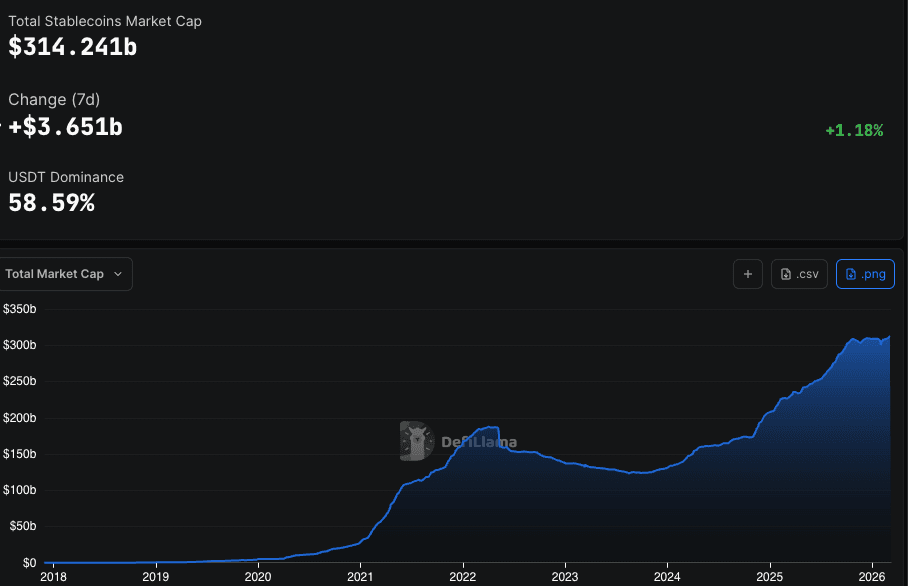
According to a fresh analysis from Jefferies, this expansion trajectory poses a subtle yet meaningful challenge to conventional banking profitability. The investment bank’s research suggests financial institutions may witness between 3% and 5% of their fundamental deposit holdings migrate away during the coming half-decade.
This deposit attrition would compel banks toward costlier funding alternatives. The research team, spearheaded by David Chiaverini, forecasts average earnings compression of approximately 3% across the banking sector.
“The intermediate-term risk of gradual deposit runoff from emerging activity-based yield opportunities and payments use cases should not be ignored,” the analysts wrote.
Stablecoins represent digital assets maintaining parity with traditional currencies such as the U.S. dollar. These instruments have gained substantial adoption in cryptocurrency markets while increasingly penetrating payment systems, corporate treasury functions, and international money movement.
Transaction volume through stablecoins climbed to $11.6 trillion throughout 2025. Outstanding supply reached $305 billion by year-end 2025, marking a 49% annual increase.

Jefferies’ forward-looking analysis anticipates the stablecoin ecosystem could balloon to somewhere between $800 billion and $1.15 trillion over the next five years.
Banking Sector Takes Notice
Bank of America CEO Brian Moynihan warned earlier this year that the banking system could be hurt by the “possibility of $6 trillion in deposits” moving into stablecoins and stablecoin-linked products.
Digital dollar alternatives operate continuously without time restrictions and integrate seamlessly with decentralized financial protocols capable of delivering returns that surpass traditional deposit accounts. This capability creates appeal among customers seeking enhanced returns on idle capital.
However, recent regulatory developments in the United States have tempered immediate concerns. The GENIUS Act, which became law in July 2025, explicitly prohibits licensed stablecoin issuers from distributing yields to holders who maintain passive positions.
This regulatory framework constrains the velocity at which customer funds might transition from conventional checking and savings products into digital alternatives.
Financial Institutions Prepare Competitive Response
Several prominent financial services organizations are taking proactive measures. Fidelity Investments has already introduced its proprietary offering, the Fidelity Digital Dollar.
Bank of America’s Moynihan indicated his institution stands ready to launch a stablecoin product pending congressional authorization. Goldman Sachs CEO revealed the firm has deployed substantial personnel resources toward tokenization initiatives and stablecoin development.
According to Jefferies’ assessment, banking institutions maintaining elevated concentrations of retail customer deposits and interest-bearing accounts face disproportionate exposure compared with larger institutions that have already committed capital to digital asset capabilities.
The research specifically identifies Wintrust Financial, Flagstar Financial, Webster Financial, Eagle Bancorp, and Axos Financial as the institutions under analytical coverage carrying the greatest vulnerability.
The Jefferies report was published on Tuesday, March 10, 2026.
Get 3 Free Stock Ebooks
Discover top-performing stocks in AI, Crypto, and Technology with expert analysis.
- Top 10 AI Stocks - Leading AI companies
- Top 10 Crypto Stocks - Blockchain leaders
- Top 10 Tech Stocks - Tech giants



