


Executive Summary
- AAVE token presently fluctuates within the $85–$95 range, maintaining a market capitalization near $1.3B–$1.5B
- Moderate growth scenario projects AAVE valued at $350–$600 through 2031, contingent on consistent DeFi sector expansion
- Optimistic projections place AAVE between $1,000–$1,800 should institutional participation in decentralized finance surge
- Conservative estimates position AAVE at $80–$150 if market adoption decelerates or competitive pressures intensify
- Weighted probability model forecasts approximately $620 per token by the end of 2031
As a premier decentralized lending platform in the cryptocurrency ecosystem, Aave enables participants to access credit and provide liquidity for digital assets without traditional banking intermediaries. The protocol, operational since 2020, has cultivated substantial economic throughput via its lending mechanisms and fee structure.
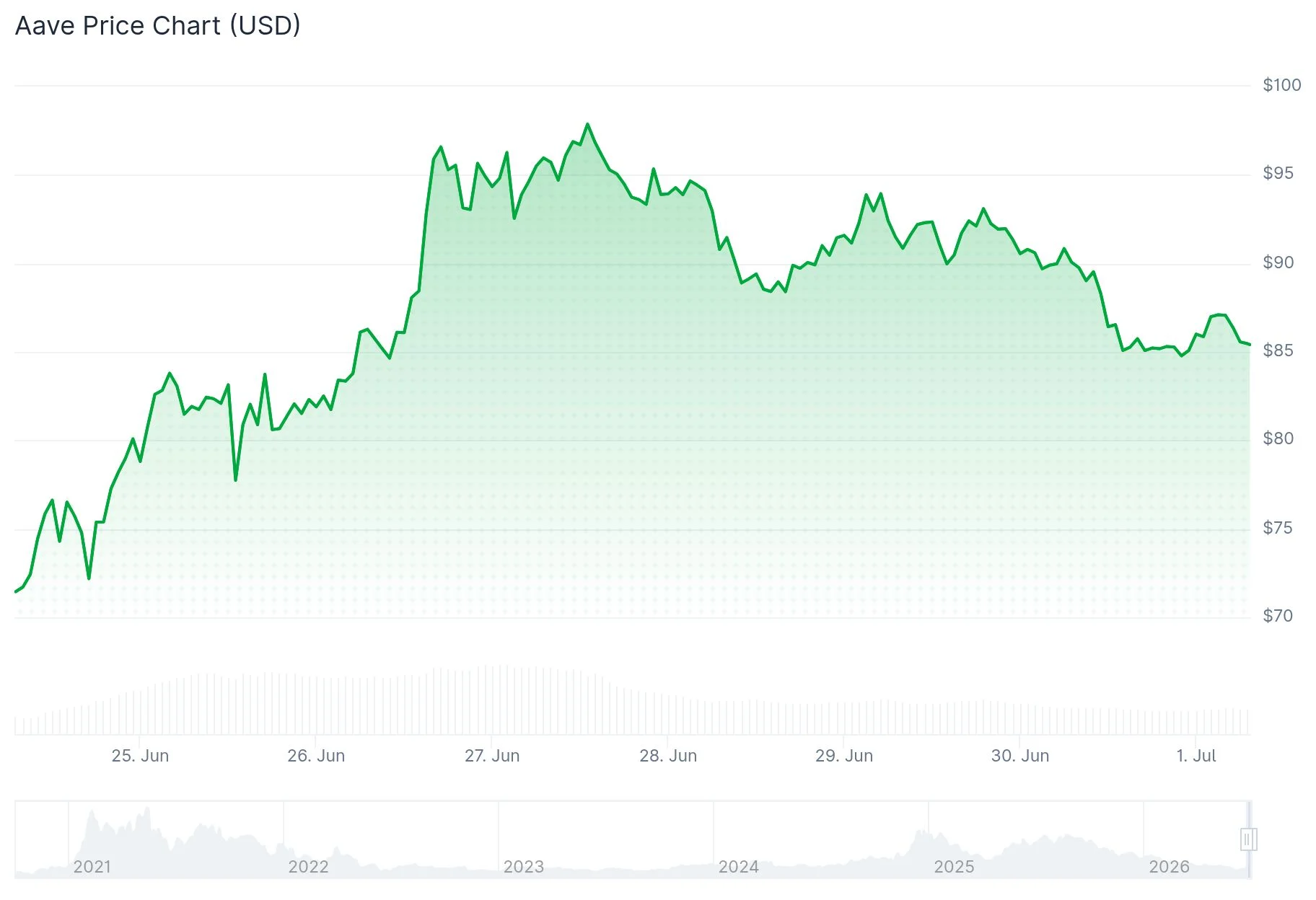
The AAVE token presently hovers in the $85 to $95 territory. Market capitalization registers between $1.3 billion and $1.5 billion. With a capped supply of merely 16 million tokens, AAVE ranks among the more supply-constrained assets in the digital currency landscape.
Analytical modeling incorporating probability distributions suggests a five-year target of approximately $620 per AAVE token by 2031.
A significant catalyst potentially supporting this valuation involves GHO, the protocol’s native decentralized stablecoin. This overcollateralized asset has demonstrated expansion in tandem with the broader platform. Sustained GHO adoption may generate additional demand throughout Aave’s infrastructure.
Moderate Scenario: $350 to $600
The central probability case presumes decentralized finance continues integrating into conventional financial systems. Under these conditions, blockchain-based lending expands, tokenization of traditional assets accelerates, and institutional participants progressively adopt distributed ledger technologies for financial operations.

Aave, positioned among the most established protocols in the lending vertical, would presumably capture proportional growth. Valuations spanning $350 to $600 correspond to market capitalizations between $5.5 billion and $9.5 billion.
This represents substantial appreciation from present valuations while maintaining conservative underlying assumptions.
Conservative Scenario: $80 to $150
The downside framework envisions decelerating DeFi momentum. Emerging competitive protocols, potential security exploits, restrictive regulatory frameworks, or diminished borrowing appetite could collectively suppress expansion.
Elevated traditional interest rate environments additionally constrain speculative leverage activity, directly impacting DeFi lending volumes. Should these headwinds persist throughout the forecast period, AAVE valuations may remain confined to the $80–$150 corridor through 2031.
The optimistic framework projects AAVE between $1,000 and $1,800. Realization demands mainstream financial institutions embracing regulated DeFi frameworks, widespread tokenization of securities, and blockchain lending achieving significant market penetration.
Such outcomes would establish Aave’s market capitalization between $16 billion and $29 billion — remaining substantially below current Bitcoin or Ethereum valuations.
AAVE’s constrained token economics suggest protocol utilization growth may more efficiently translate to price appreciation relative to cryptocurrencies featuring expansive supply schedules.
The protocol maintains operations across numerous blockchain networks while persistently broadening its technological footprint.
The probability-adjusted $620 target for 2031 incorporates a scenario wherein decentralized finance adoption progresses at measured rates, with Aave preserving its status among the sector’s dominant lending infrastructures.
Get 3 Free Stock Ebooks
Discover top-performing stocks in AI, Crypto, and Technology with expert analysis.
- Top 10 AI Stocks - Leading AI companies
- Top 10 Crypto Stocks - Blockchain leaders
- Top 10 Tech Stocks - Tech giants



