



Market Snapshot
- Dow Jones Industrial Average futures advanced 317 points, representing a 0.6% gain ahead of Tuesday’s opening bell.
- The tech-focused Nasdaq Composite notched its 23rd record close of 2026, driven by artificial intelligence optimism and Big Tech momentum.
- Nvidia stock advanced more than 2%, bringing the chipmaker’s total market capitalization near the $6 trillion milestone.
- The benchmark 10-year Treasury yield reached 5.3%, marking its highest close in nearly a quarter century.
- Energy markets saw selling pressure as Brent crude slipped under $100 per barrel after holding above that threshold for several weeks.
American equity futures pointed higher during early Tuesday trading hours. The ongoing technology sector rally maintained its momentum despite upward pressure on borrowing costs and increasing bond yields.
Futures tied to the Dow Jones Industrial Average rose by 317 points, translating to a 0.6% increase. The S&P 500 index advanced 0.5%, keeping it within striking distance—less than 1%—of its historical peak.
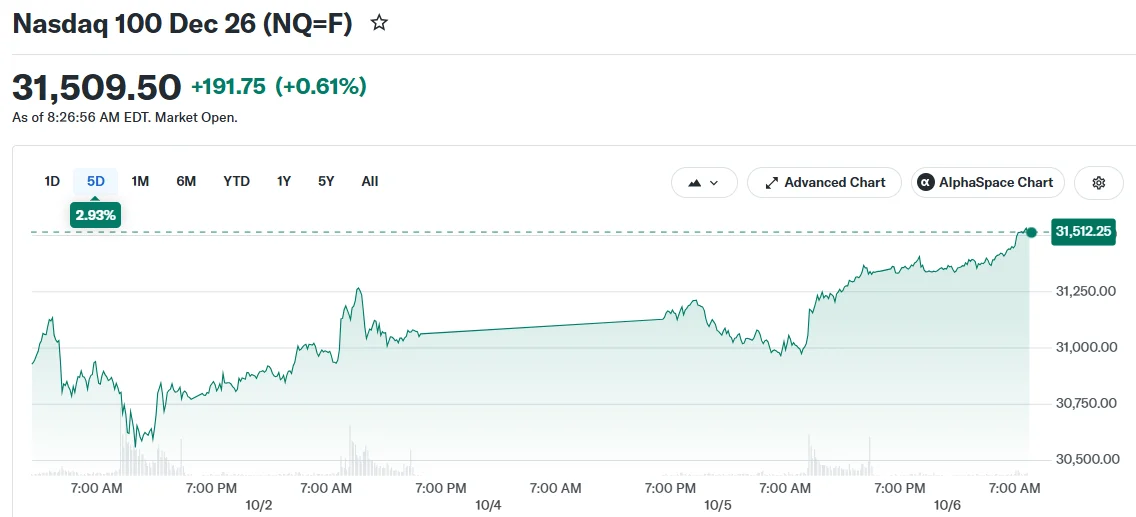
The Nasdaq 100 futures contract jumped 0.7%. Meanwhile, the technology-laden Nasdaq Composite had already secured its 23rd record closing level of 2026 in the preceding trading session.
Technology Giants Fuel Market Advance
Large-cap technology companies provided the primary thrust behind Monday’s market gains. Market participants remained laser-focused on the expansion of artificial intelligence capabilities throughout the industry.
Shares of Nvidia climbed over 2% during premarket activity. The semiconductor giant’s total market capitalization now stands just shy of the $6 trillion mark.

The chipmaker received an additional boost from positive developments involving one of its Asian partners. Taiwan-based manufacturing giant Foxconn released robust quarterly earnings results on Monday.
Those financial figures highlighted persistent worldwide appetite for artificial intelligence equipment and associated hardware components. Widespread enthusiasm surrounding AI applications has managed to overshadow economic concerns in other sectors, at least temporarily.
Market participants have consistently purchased equities during brief pullbacks throughout the current week.
Treasury Rates Reach Levels Last Seen Decades Ago
Government bond yields continue generating unease among certain market participants. The yield on the 10-year Treasury note maintained its position at 5.301% as Tuesday morning trading began.
This represents the highest closing figure recorded in 24 years. The 30-year Treasury yield remained anchored at 5.663%, a threshold last breached in 2002.
Both rates touched even loftier levels during Monday’s trading. The 10-year and 30-year yields peaked at 5.349% and 5.703% respectively during that session.
Despite these elevated borrowing costs, equity purchasers have continued viewing stocks as a viable protection mechanism against inflationary pressures. This perspective has helped mitigate some anxiety related to higher financing expenses.
Market watchers are now turning their attention to a scheduled Treasury Department auction of three-year notes on Tuesday. The offering amounts to $58 billion.
Shorter-maturity government bonds appear appealing to investors under current conditions. The probability of a Federal Reserve interest rate increase in October has also diminished.
That probability shift came after disappointing employment statistics were published last Friday. Market analysts anticipate the bond auction will attract solid demand given these circumstances.
Oil prices experienced downward movement on Tuesday as well, contributing to the positive sentiment across equity markets. Brent crude, which serves as the global pricing benchmark, declined 0.7% to settle at $99.62 per barrel.
This slide pushed the contract below the psychologically significant $100 threshold. West Texas Intermediate, the domestic US pricing standard, decreased 1.1% to reach $88.41 per barrel.
Market analysts attributed the energy price weakness to increasing production volumes from Middle Eastern sources. Petroleum exporters operating in the Persian Gulf area have been recalibrating their output levels.
Officials from Kuwait indicated the nation is currently producing at 75% of its pre-conflict capacity. Additionally, Saudi Arabia reduced the official selling price for its Arab Light crude grade destined for Asian customers receiving November deliveries.
The pullback in energy expenses has contributed to easing broader inflationary pressures. The economic data calendar remains sparse for this week with no significant reports on the horizon.
This absence leaves artificial intelligence-fueled equity speculation and inflation anxieties as the two dominant factors influencing market direction. Tuesday’s corporate earnings slate includes results from Constellation Brands and Lamb Weston Holdings.
Beyond those releases, the macroeconomic calendar remains largely empty through week’s end.
Get 3 Free Stock Ebooks
Discover top-performing stocks in AI, Crypto, and Technology with expert analysis.
- Top 10 AI Stocks - Leading AI companies
- Top 10 Crypto Stocks - Blockchain leaders
- Top 10 Tech Stocks - Tech giants



