



TLDR
- Gold plummeted 3% Monday, reaching a seven-week bottom at $4,156.45 per ounce.
- Crude oil price increases linked to Iran-US tensions over Strait of Hormuz shipping lanes are stoking inflation worries.
- Market participants now estimate a 70.3% probability the Federal Reserve will implement another rate increase in October.
- Silver plunged nearly 5%, with platinum and palladium also posting losses.
- Investors are monitoring upcoming PCE inflation figures and September employment data for additional market direction.
Gold prices experienced a significant downturn Monday, declining 3% to reach their weakest position in over seven weeks. Spot gold settled at $4,156.45 per ounce, with December-dated US gold futures dropping 3.1% to $4,188.80.
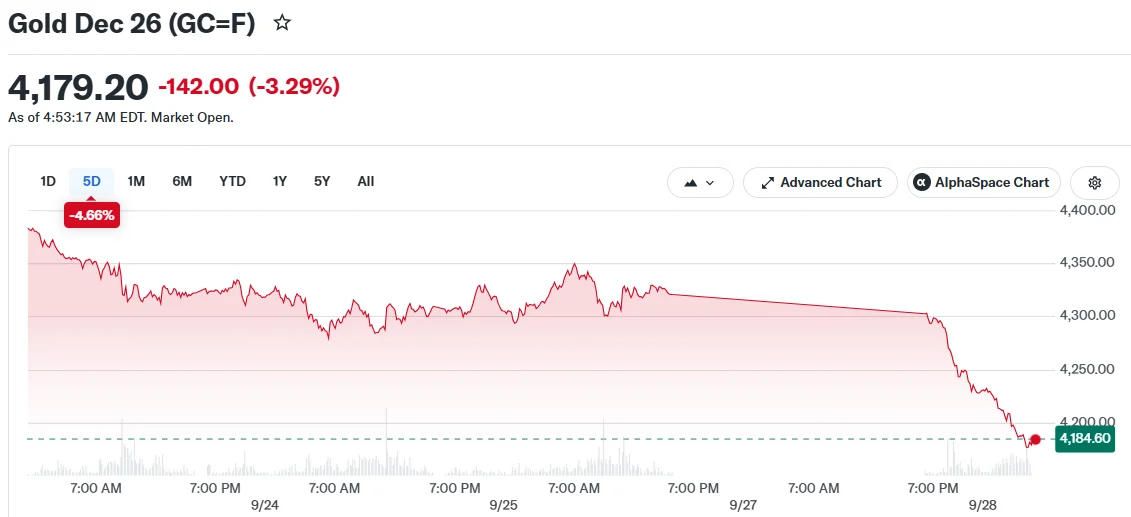
This decline follows an over 2% retreat last week. Elevated crude oil values and increasing speculation about another Federal Reserve rate adjustment are the primary catalysts driving the precious metal downward.
Crude Oil Rallies on Iran Standoff
Brent crude petroleum prices recovered after President Donald Trump turned down a diplomatic proposal from Iran. The rejected agreement would have ended the current standoff and permitted the reopening of the Strait of Hormuz, a critical passage for international oil transportation.
Iranian officials indicated they would not modify their requirements for reopening the strategic waterway. Trump mentioned he anticipates negotiations with Tehran to continue this week, though the dispute persists.
The United States-Iran confrontation has now extended into its eighth month. Brent crude petroleum has surged approximately 70% year-to-date.

Elevated energy expenses typically accelerate inflation as they increase costs throughout various economic sectors. This dynamic is amplifying pressure on the Federal Reserve to maintain higher interest rates.
Federal Reserve Rate Increase Probability Rises
Market participants now calculate a 70.3% likelihood that the Federal Reserve will implement another interest rate increase in October, based on CME’s FedWatch Tool data. The central bank previously raised its key rate by 25 basis points earlier this month.
Multiple Federal Reserve officials have indicated additional rate adjustments may be necessary. Cleveland Federal Reserve President Beth Hammack expressed concern that ongoing elevated inflation might train the public to view higher prices as acceptable. She emphasized the central bank must prevent this outcome.
Hammack additionally noted that long-dated Treasury yields are experiencing upward pressure from enhanced growth projections, concerns regarding government debt levels, and anticipation of further rate increases.
Elevated interest rates diminish gold’s appeal to investors. This occurs because gold generates no interest or dividend payments, so when fixed-income securities and deposit accounts provide superior returns, capital flows toward those alternatives.
The US dollar maintained strength Monday, simultaneously making gold pricier for purchasers holding foreign currencies. US Treasury yields continued their upward trajectory as well.
Additional precious metals declined in tandem with gold. Spot silver tumbled 4.8% to $61.17 per ounce. Platinum fell 2.4% to $1,735.88, while palladium decreased 2.2% to $1,239.60.
Notwithstanding the recent pullback, gold remains substantially below its all-time peak of nearly $5,600 achieved in January. The metal has oscillated within a range of approximately $4,230 to $4,510 throughout most of this month.
Appetite for gold exchange-traded funds has remained robust. Gold ETF inventories have increased by roughly 50 tonnes this month, despite price declines.
US consumer confidence also deteriorated in September, dropping to a four-month nadir. Heightened anxiety over price levels and overall economic conditions contributed to the decline.
Treasury Secretary Scott Bessent encouraged the Federal Reserve to maintain flexibility regarding interest rates. He suggested productivity improvements, partly attributed to artificial intelligence adoption and regulatory streamlining, could help moderate inflation.
Markets are now concentrating on upcoming economic releases. Wednesday delivers the August PCE inflation data, the Federal Reserve’s preferred inflation metric. Friday’s September employment report will provide additional insight into labor market conditions.
Both publications are anticipated to influence market expectations regarding the Federal Reserve’s subsequent interest rate decision.
Get 3 Free Stock Ebooks
Discover top-performing stocks in AI, Crypto, and Technology with expert analysis.
- Top 10 AI Stocks - Leading AI companies
- Top 10 Crypto Stocks - Blockchain leaders
- Top 10 Tech Stocks - Tech giants



