



Key Takeaways
- The 10-year Treasury rate has surged past 5.2%, marking its highest point in approximately 20 years.
- Long-term 30-year bonds have reached their peak level since 2004 amid widespread selling pressure.
- Mortgage borrowers face renewed pressure as 30-year fixed rates return to 7%, a threshold not crossed since the beginning of 2025.
- Financial advisors recommend considering short-duration Treasuries, asset-backed securities, and investment-grade corporate debt for yield-seeking investors.
- The yield surge extends beyond U.S. borders, with German and Japanese bonds also experiencing significant rate increases driven by inflation and fiscal concerns.
Treasury yields have experienced a dramatic surge throughout the week, pushing rates to heights not witnessed in approximately two decades. The benchmark 10-year Treasury note has broken through 5.2%, while its 30-year counterpart has touched levels unseen since 2004.
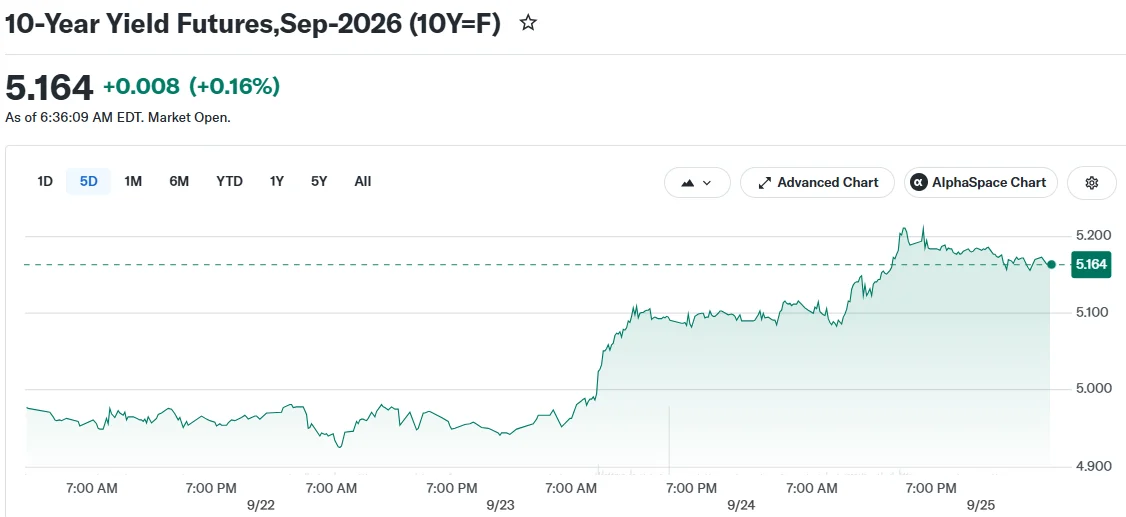
The relationship between bond valuations and their corresponding yields operates inversely. As bond valuations decline, yields increase proportionally, offering purchasers enhanced returns relative to their initial investment.
Forces Driving the Rate Surge
Multiple catalysts are fueling this dramatic shift. Market participants harbor growing concerns about inflationary pressures, amplified by elevated oil prices linked to geopolitical tensions involving Iran.
Federal deficit spending has escalated significantly. An increased supply of government debt flooding the market depresses valuations while elevating corresponding yields.
Technology firms investing heavily in artificial intelligence infrastructure are simultaneously flooding the market with corporate debt issuance. This additional supply compounds existing market pressure.

Recent economic indicators have demonstrated surprising resilience. Data released this week revealed business activity expanding at its most robust pace in over five years, potentially justifying additional Federal Reserve tightening measures.
The central bank implemented its first short-term rate increase last week since 2023. Market participants are pricing in the probability of at least one additional hike before year-end.
Consequences for Consumer Borrowing
The implications of rising Treasury rates extend far beyond institutional bond portfolios. Residential mortgage rates for 30-year fixed loans have climbed back to 7%, crossing that threshold for the first time since the start of 2025.
Elevated borrowing costs are significantly constraining housing affordability for prospective buyers. Corporate borrowing expenses and federal government financing costs are similarly experiencing upward pressure.
Conversely, individuals holding cash benefit from improved returns on deposit accounts and short-maturity bonds. The one-year Treasury bill currently delivers yields approaching 4.5%.
Equity markets have experienced collateral damage. The S&P 500 had approached record territory earlier in the week before the bond market turbulence curtailed its advance.
The iShares Core U.S. Aggregate Bond fund has declined nearly 5% year-to-date. By comparison, the S&P 500 maintains gains approaching 13% for the same period.
Strategic Responses from Market Professionals
Portfolio managers suggest that shorter-maturity fixed income instruments may provide superior risk-adjusted positioning currently. These securities exhibit reduced sensitivity to interest rate fluctuations compared to long-dated Treasuries.
Mortgage-backed and asset-backed securities are gaining increased attention as viable alternatives. Exchange-traded funds focused on these sectors currently offer yields near 4.5%.
Investment-grade corporate debt represents another segment garnering professional interest. Numerous blue-chip corporations maintain robust balance sheets despite the challenging rate backdrop.
Tax-exempt municipal bonds are experiencing renewed investor focus. Their tax-advantaged characteristics become increasingly compelling when paired with elevated nominal rates.
Developing market sovereign debt is attracting growing capital allocation. One fund specializing in short-term obligations from nations including Saudi Arabia and Mexico currently delivers 5.6% yields.
An International Phenomenon
This yield expansion transcends American borders. Germany’s 10-year government bond rate has climbed near 3.60%, representing its loftiest level since 2008.
Japan’s corresponding 10-year yield stands at 3.08%. This represents a dramatic reversal from the negative rates the nation experienced as recently as 2020.
Market analysts attribute the widespread pattern to escalating sovereign debt burdens and persistent inflation anxiety affecting developed economies globally, extending well beyond domestic U.S. factors.
Get 3 Free Stock Ebooks
Discover top-performing stocks in AI, Crypto, and Technology with expert analysis.
- Top 10 AI Stocks - Leading AI companies
- Top 10 Crypto Stocks - Blockchain leaders
- Top 10 Tech Stocks - Tech giants



