



Key Takeaways
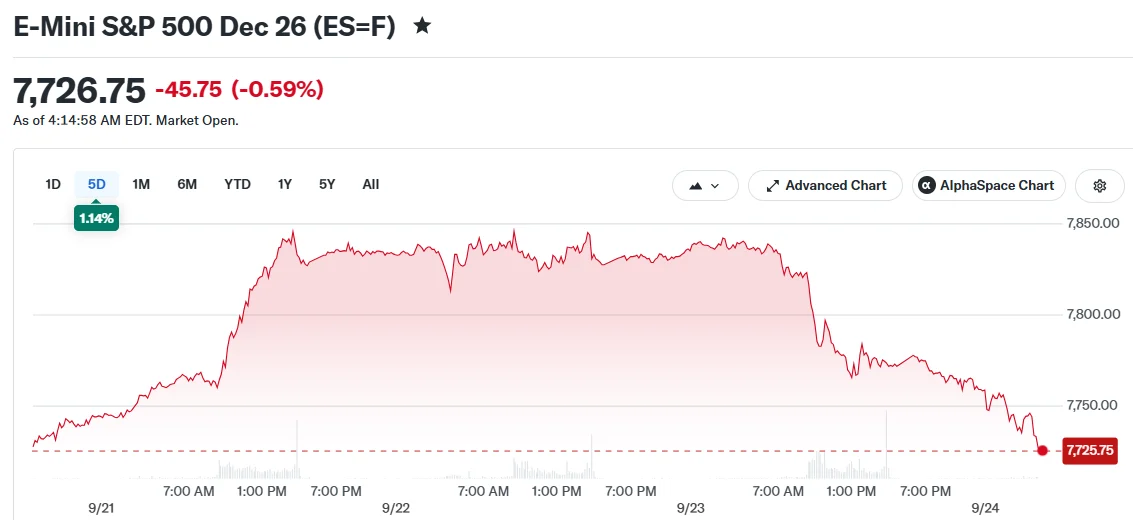
- Major indices declined Wednesday, with the Dow Jones shedding 352 points, the S&P 500 falling 0.75%, and the Nasdaq declining 1.13%.
- The benchmark 10-year Treasury yield surged to 5.135%, marking its highest point since July 2007.
- Federal Reserve Governor Michael Barr indicated additional policy tightening could be necessary to rein in inflation.
- Market expectations for an October interest rate increase jumped to over 66%, compared to 55.4% the previous session.
- Energy markets rallied, with Brent crude advancing 3.9% to reach $103.08 per barrel.
U.S. stocks tumbled Wednesday as Treasury yields soared to their highest levels in nearly eighteen years. Market participants increasingly worried that the Federal Reserve might implement additional interest rate increases in upcoming months.
The S&P 500 finished the session 0.75% lower at 7,706.03. The Nasdaq Composite slid 1.13% to settle at 26,936.04. The Dow Jones Industrial Average declined 352.10 points, representing a 0.68% loss, to close at 51,511.59.
The utilities and consumer discretionary sectors experienced the steepest declines. Each sector retreated more than 1% throughout the trading day.
Bond Yields Climb to Levels Not Seen Since 2007
The market downturn stemmed from ascending Treasury yields. The benchmark 10-year Treasury note advanced to 5.135%, representing its peak level since July 2007.
The single-session increase for the 10-year yield marked its largest daily gain since April 7, 2025. Meanwhile, the 2-year Treasury note reached 4.947%, its highest reading since May 2024.

The yield surge followed the release of purchasing managers’ index data that exceeded analyst forecasts. The report suggested persistent inflationary pressures throughout the economy.
Massimo Santicchia, who leads U.S. equities at Procyon, noted that while corporate earnings continue demonstrating strength, inflation is generating market uncertainty. He observed that the inflationary pressure is expanding beyond energy commodities into the services industry.
Santicchia suggested that a Federal Reserve pause appears improbable under current conditions. His outlook includes the possibility of two to three additional rate increases ahead.
Federal Reserve Governor Michael Barr reinforced this perspective during Wednesday remarks. He stated that additional policy modifications are probably required to return inflation toward the Fed’s objective.
Barr emphasized that economic expansion continues at a healthy pace and employment conditions remain robust. However, he highlighted that inflation persists above the Fed’s 2% target without showing rapid progress toward that benchmark.
He further noted that risks associated with achieving the inflation target have increased, while employment-related risks have diminished.
Market Pricing for Rate Increases Rises Alongside Energy Prices
Market participants are now assigning greater probability to an October rate increase. Data from the CME FedWatch tool shows odds of a 25-basis-point hike climbing above 66%.
This represents a significant jump from the previous day’s 55.4% probability. One month prior, those odds registered at merely 8.8%.
Oil prices advanced in tandem with the yield increase. Brent crude futures for November delivery jumped 3.9% to settle at $103.08 per barrel.
U.S. West Texas Intermediate crude closed 1.8% higher at $92.16 per barrel.
Geopolitical developments remained a focal point throughout the week. President Trump disclosed that U.S. and Iranian representatives held a three-hour meeting during the United Nations General Assembly in New York, characterizing it as a “very good meeting.”
Earlier, he had indicated to the U.N. that he confronts a “big decision” regarding whether to pursue a diplomatic agreement with Iran or adopt more aggressive measures.
The preceding Tuesday session painted a contrasting picture. The Nasdaq achieved a record closing high that day, while the Dow ended in negative territory and the S&P 500 finished essentially unchanged.
Moving forward, futures contracts indicated additional weakness Thursday morning as yield-related concerns continued. President Trump’s scheduled meeting with Chinese President Xi Jinping emerged as the primary market focus, with Treasury Secretary Scott Bessent announcing a two-month extension of the U.S.-China trade agreement through January 10.
Get 3 Free Stock Ebooks
Discover top-performing stocks in AI, Crypto, and Technology with expert analysis.
- Top 10 AI Stocks - Leading AI companies
- Top 10 Crypto Stocks - Blockchain leaders
- Top 10 Tech Stocks - Tech giants



