


TLDR
- Soitec shares climbed as high as 15.1% following an upgraded Q2 fiscal 2027 revenue growth projection to approximately 50% year-over-year, significantly above the previous 30% estimate.
- The revised forecast stems from robust demand for Photonics-SOI wafers critical to AI data center optical networking infrastructure.
- The company anticipates Q2’27 Photonics-SOI sales to reach approximately triple the Q2’26 figure of about $25 million.
- Soitec is securing customers through multi-year capacity agreements featuring deposits and locked-in pricing structures.
- With an approximate 95% market share in silicon photonics substrates, the company doesn’t foresee requiring additional manufacturing facilities until roughly 2029.
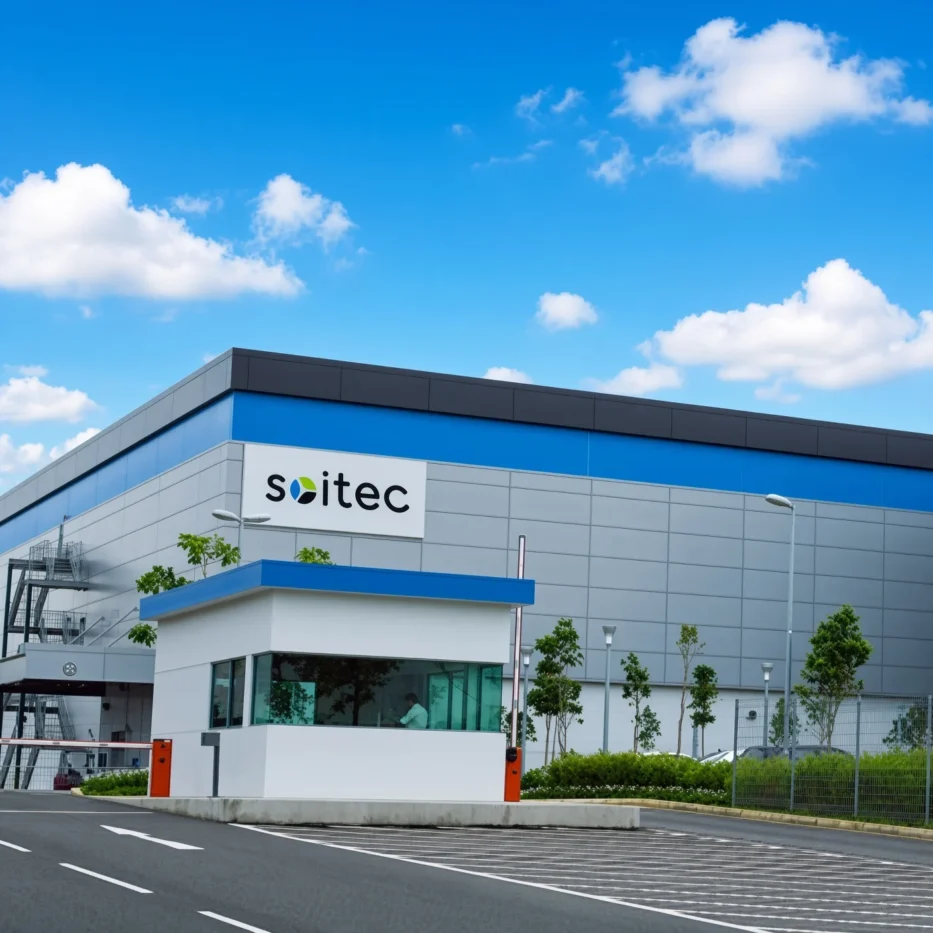
Soitec stock jumped as high as 15.1% Thursday after the French semiconductor materials manufacturer upgraded its second-quarter revenue growth projection to approximately 50% year-over-year at constant exchange rates, a substantial increase from the previously announced target exceeding 30%.
The manufacturer attributed the enhanced forecast to rising demand for its Photonics-SOI wafers, improved short-term customer order visibility, and operational flexibility in capacity management.
The firm now projects Photonics-SOI sales for Q2 fiscal 2027 at approximately triple the Q2’26 total of about $25 million. Looking at the half-year period, Soitec anticipates fiscal 2027 first-half revenue reaching around 2.3 times the comparable prior-year period of approximately $50 million.
For full-year fiscal 2027, the company forecasts Photonics-SOI revenue ranging between 2.5 and 3 times the fiscal 2026 baseline, which exceeded $100 million. CEO Laurent Remont characterized the resulting $200 million-plus projection as “absolutely a floor” rather than an upper limit.

Other business segments remain essentially stable. Total company revenue for fiscal 2025-2026 reached approximately €600 million.
Securing Multi-Year Customer Commitments
Soitec is taking proactive measures by executing multi-year Capacity Reservation Agreements with photonics clients, with approximately 80% of contracts anticipated to be finalized within one to two weeks.
These agreements mandate customer deposits linked to volume commitments. Customers meeting their committed volumes receive deposit refunds, while those falling short forfeit their deposits. Orders exceeding agreed levels trigger renewed pricing negotiations.
“That’s a way for us to have our customer with skin in the game,” Remont told Reuters.
Customers must also provide inventory tracking data, preventing excessive ordering aimed at monopolizing supply away from competitors.
The company expects to finalize agreements with eight of approximately 10 principal customers shortly.
Manufacturing Expansion and Facility Strategy
Silicon photonics demand has accelerated dramatically as cloud hyperscalers transition to optical connectivity within AI infrastructure, where traditional copper connections face power efficiency and performance limitations.
Soitec provides the substrate foundation for virtually all silicon photonics chips. UBS analysts estimate the company controls approximately 95% market share. Share prices have nearly quadrupled year-to-date.
Management doesn’t anticipate requiring new manufacturing facilities until approximately 2029. The company is currently utilizing two approaches: reallocating production capacity between product lines using shared infrastructure, and installing additional equipment within current cleanroom facilities.
Until five months ago, Soitec manufactured Photonics-SOI exclusively in France. The company has now qualified a Singapore facility for production.
A third alternative exists—an empty building in Singapore that could be equipped rather than constructing an entirely new fabrication plant. Management expects to decide on this option within six to twelve months.
Remont indicated no current need for U.S.-based manufacturing facilities “at this stage,” noting that customers are “more desperate to get wafers than being too picky about where the location for production is.”
Get 3 Free Stock Ebooks
Discover top-performing stocks in AI, Crypto, and Technology with expert analysis.
- Top 10 AI Stocks - Leading AI companies
- Top 10 Crypto Stocks - Blockchain leaders
- Top 10 Tech Stocks - Tech giants



