



Key Takeaways
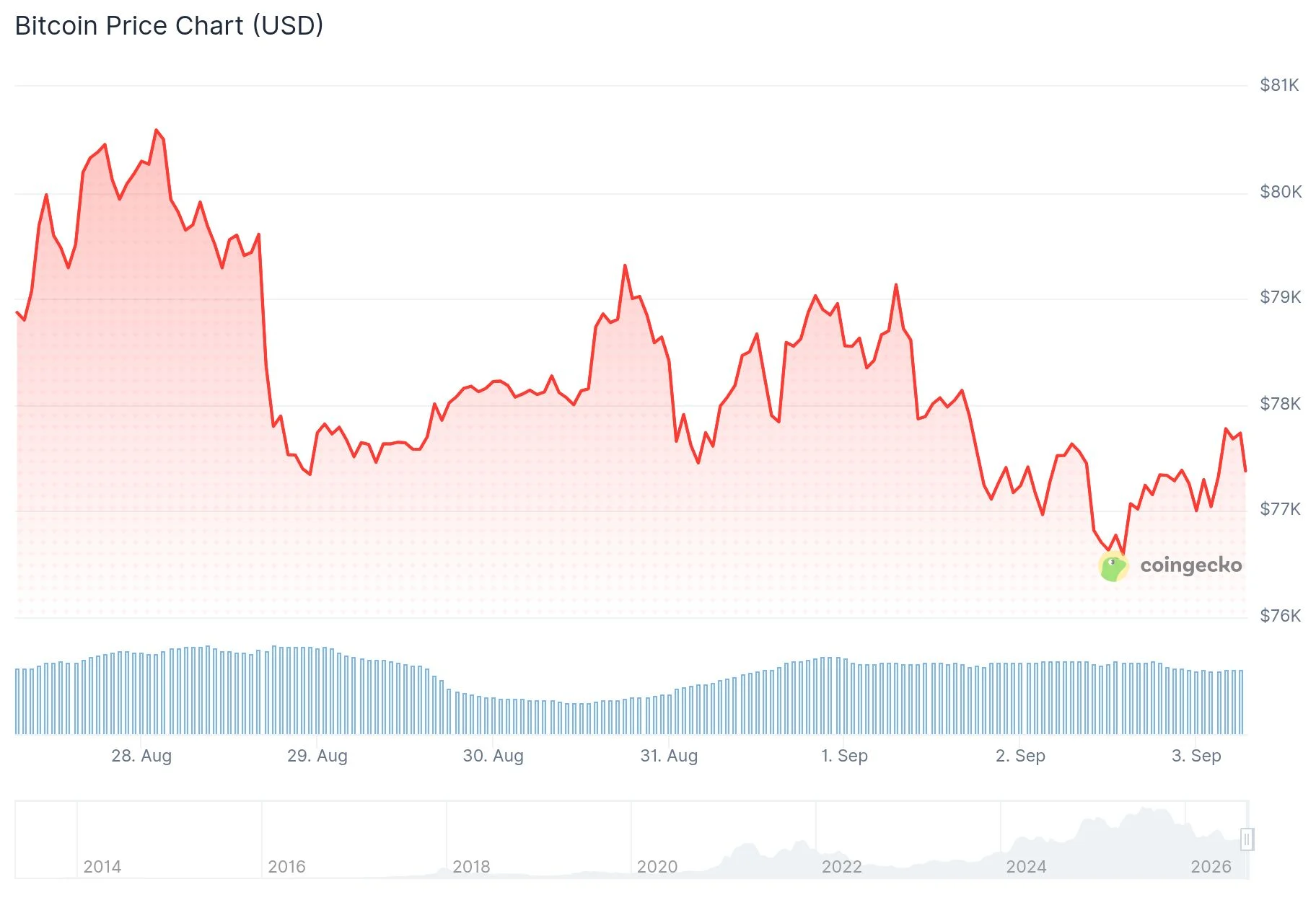
- BTC declined 0.2% to $77,132 on September 2, retreating from its impressive 25% August surge
- Escalating U.S.-Iran military confrontation and climbing Treasury yields weighed on risk assets
- Large holders accumulated roughly 6,765 BTC (approximately $521 million) amid the downturn
- BTC is navigating between critical zones: $62K–$65K accumulation base and $83K–$86K long-term holder resistance
- Approximately $14 billion in derivatives contracts are scheduled to expire on September 25
The leading cryptocurrency by market capitalization retreated toward the $77,000 threshold on September 2, 2026, as momentum from a robust August performance faded. Bitcoin registered a modest 0.2% decline to $77,132, relinquishing a portion of its substantial 25% monthly advance.
Two primary catalysts triggered the reversal: renewed military confrontation between the United States and Iran, coupled with surging government debt yields across global markets.
Washington and Tehran exchanged fresh strikes during Tuesday evening’s trading session. President Trump issued warnings regarding potential strikes on Iranian petroleum facilities, prompting Tehran to signal additional assaults on American installations throughout the Gulf region. Both nations maintained aggressive postures without indication of de-escalation.
Crude oil valuations spiked considerably following these developments, intensifying concerns about energy-related inflationary pressures. This scenario drove sovereign bond yields upward across the United States, Japan, Australia, and European markets, diminishing the appeal of high-risk assets such as Bitcoin for institutional and retail participants.
Trading desks now anticipate a Federal Reserve rate increase during September. Consumer price growth continues hovering significantly above the central bank’s 2% annual objective. The upcoming Friday employment figures will serve as a crucial indicator for monetary policy trajectory.

Large Holders Increase Positions
Market observer Ali Charts documented Bitcoin’s 5.82% correction from its August 28 peak of $81,474 down to $76,732. Notably, institutional-sized wallets maintained their buying activity throughout this period, acquiring approximately 6,765 BTC valued at roughly $521 million during the same timeframe.
Technical analyst CryptosBatman identified vulnerability at a significant trendline barrier, highlighting that the MACD indicator shifted bearish following the rejection near $81K levels, suggesting potential for additional downside if the negative divergence persists.
Strategy, the largest publicly-traded corporate Bitcoin treasury holder, executed its initial BTC acquisition in two months, providing modest price support.
Critical Price Zones Under Focus
Data from Glassnode’s latest analysis indicates Bitcoin is currently positioned between two significant threshold zones. The lower accumulation foundation rests at $62,000–$65,000, established during summer consolidation patterns. Resistance from Long-Term Holder distribution is densely clustered within the $83,000–$86,000 range.
Glassnode’s research further revealed that Bitcoin supply in profit expanded from 65% during May to 68% by late August at comparable price points, establishing elevated potential for profit-taking near resistance levels.
Near-term derivatives market sentiment moderated following Bitcoin’s inability to sustain levels above $80,000. The 25-delta skew metric reverted toward neutral territory after the price rejection.
Extended-duration options positioning demonstrated relative stability, with the 180-day skew exhibiting minimal fluctuation throughout both the rally phase and subsequent pullback.
The September 25 derivatives expiration encompasses approximately $14 billion in outstanding contracts, with strike price concentration predominantly situated above the $80,000 mark.
BTC was trading at $77,060, registering a 0.2% decline over the preceding 24-hour period at press time.
Get 3 Free Stock Ebooks
Discover top-performing stocks in AI, Crypto, and Technology with expert analysis.
- Top 10 AI Stocks - Leading AI companies
- Top 10 Crypto Stocks - Blockchain leaders
- Top 10 Tech Stocks - Tech giants



