



TLDR
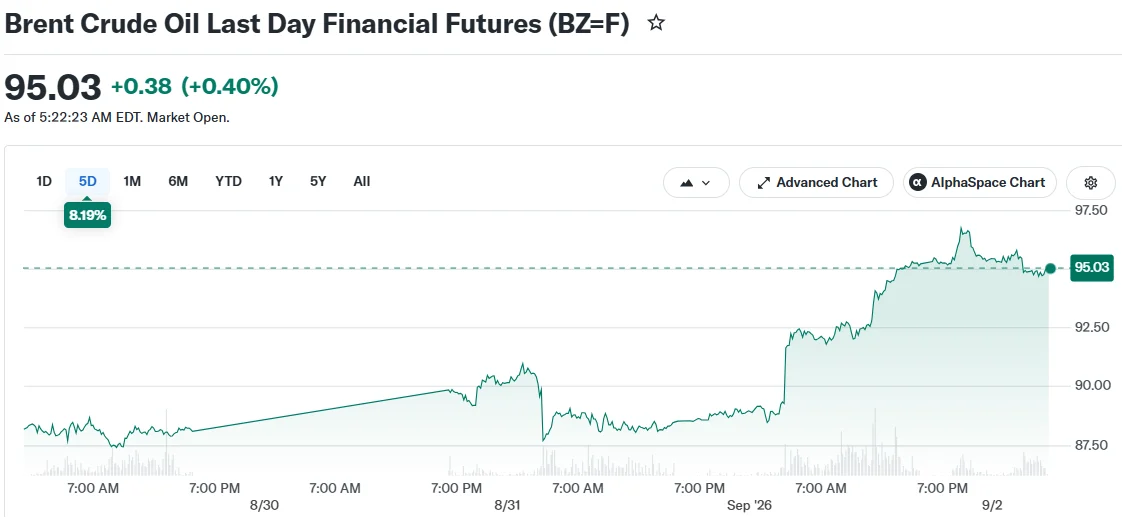
- Crude benchmarks extended gains Wednesday with Brent reaching $95.55 and WTI climbing to $90.73 per barrel
- Military exchanges intensified as Washington conducted new strikes on Iranian facilities while Tehran responded with drone and missile attacks targeting American installations in Jordan and Bahrain
- Unidentified projectiles hit two crude-carrying supertankers navigating the Strait of Hormuz earlier this week
- Tehran’s crude shipments have plummeted from approximately 2 million barrels daily in March to just 220,000-255,000 in August
- Treasury Secretary Scott Bessent projected the strategic waterway may lose relevance within 24 months as regional powers develop pipeline infrastructure
Energy markets witnessed a third consecutive session of price increases Wednesday following renewed American military operations against Iranian positions and subsequent counterattacks that heightened concerns over potential supply chain interruptions from Middle Eastern producers.
Brent crude contracts advanced 0.9% to settle at $95.55 per barrel after reaching an intraday peak of $97.04. The U.S. benchmark West Texas Intermediate increased 0.6% to close at $90.73 per barrel. Both markers had posted approximately 5% gains during the previous trading session.
American military forces executed additional strikes Tuesday targeting facilities associated with Iran’s Revolutionary Guard Corps located near the coastal cities of Bandar Abbas and Chabahar. Tehran’s military apparatus countered with missile and unmanned aerial vehicle operations directed at American installations in Jordan and Bahrain.
President Trump characterized the operations as responses to Iranian mine-laying attempts within the Strait of Hormuz and previous assaults on American positions in Jordan. He indicated willingness to authorize more substantial strikes should Iran continue retaliatory actions.
Iranian government officials communicated through official media channels their intention to respond, identifying American military installations and economic assets throughout the region as prospective targets.

Strategic Waterway Faces Growing Threats
The ongoing military confrontation has intensified anxieties regarding petroleum transit through the Strait of Hormuz, a chokepoint that previously facilitated approximately 20% of worldwide oil trade.
Earlier this week, two massive tankers transporting Saudi Arabian crude sustained damage from unidentified projectiles during their passage through the strait. Each vessel had taken on approximately 2 million barrels from Saudi Arabia’s Juaymah loading facility.
“Despite the ongoing standoff between Washington and Tehran, oil has continued moving through the Strait of Hormuz, though escalating hostilities undeniably increase transit risks,” according to ING analysts.
The U.S. energy secretary reported 17 million barrels transited the strait Monday. Market analysts, however, indicated vessel monitoring systems suggested reduced throughput.
Tehran’s Crude Shipments Collapse
Iranian petroleum exports have experienced a dramatic decline since hostilities commenced. Reuters analysis revealed loadings contracted to between 220,000 and 255,000 barrels daily in August, compared to roughly 2 million barrels per day in March.
Persian Gulf petroleum production has rebounded to approximately two-thirds of pre-conflict volumes, Goldman Sachs research indicates. A significant portion now flows through pipeline systems to Red Sea and Gulf of Oman terminals.
Treasury Secretary Scott Bessent noted that Gulf states, including the United Arab Emirates, Saudi Arabia, and Iraq, are aggressively expanding pipeline infrastructure to bypass the strait. He projected the waterway could become “worthless” within a two-year timeframe.
American petroleum stockpiles declined by 2.6 million barrels during the week concluded August 28, data from the American Petroleum Institute showed. This reversed a 4.2 million barrel build registered the preceding week.
ING analysts cautioned that middle distillate crack spreads, a critical profitability indicator for refiners, will likely remain elevated and subject to volatility, particularly as seasonal consumption patterns strengthen.
The military conflict is additionally complicating U.S. monetary policy considerations. Market expectations for a Federal Reserve rate hike in September have risen to approximately 70% probability, as escalating energy costs threaten to reignite inflationary pressures. The Fed’s upcoming September policy meeting has drawn heightened attention.
Get 3 Free Stock Ebooks
Discover top-performing stocks in AI, Crypto, and Technology with expert analysis.
- Top 10 AI Stocks - Leading AI companies
- Top 10 Crypto Stocks - Blockchain leaders
- Top 10 Tech Stocks - Tech giants



