


Key Highlights
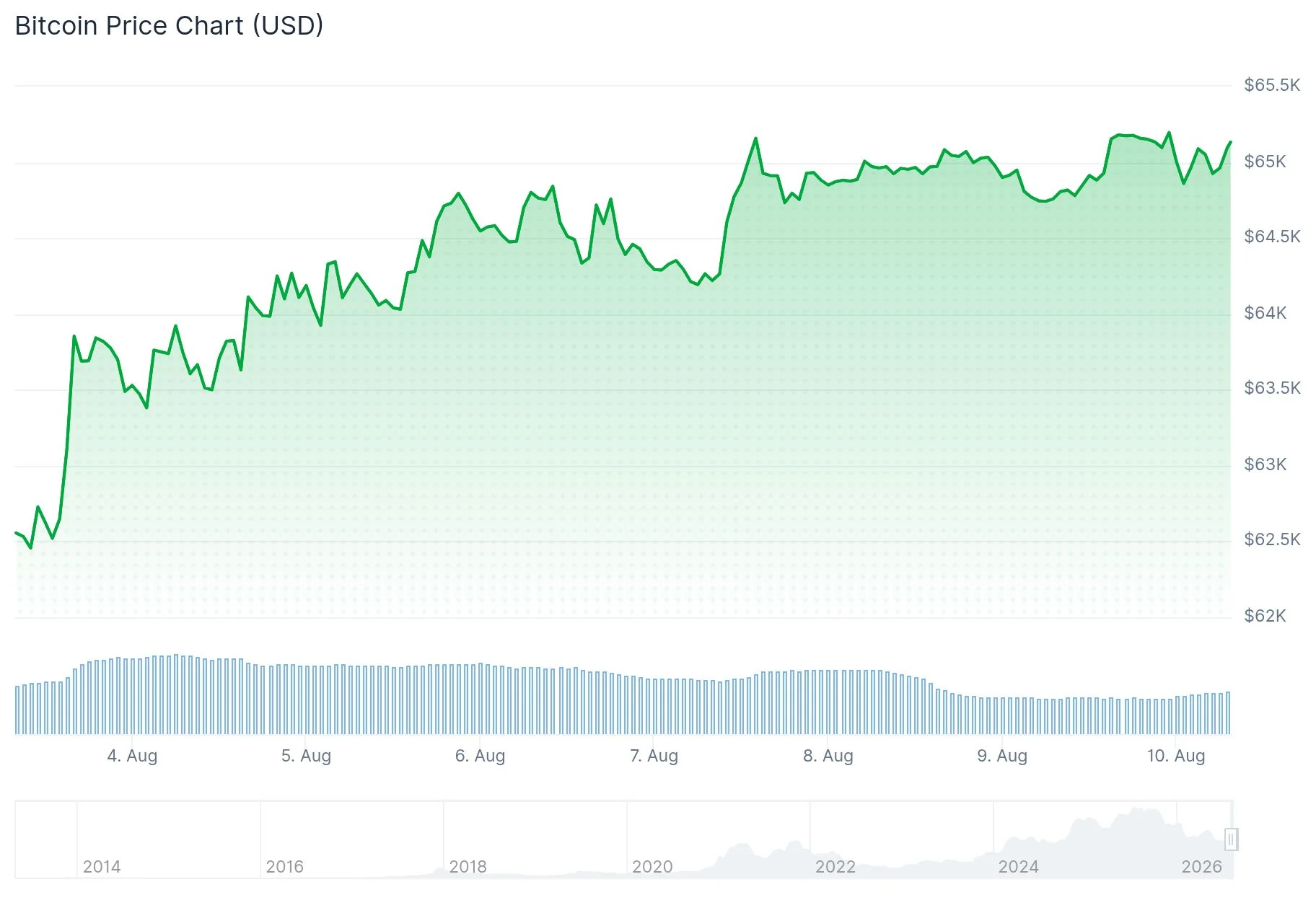
- Bitcoin surged past the $65,000 threshold on August 10, hovering around $64,955 at press time, marking a 3.4% weekly gain.
- July employment figures showed a 23,000 job decline, lowering market expectations for additional Federal Reserve rate increases.
- Spot Bitcoin ETFs in the United States recorded $854 million in net weekly capital flows, with BlackRock’s IBIT capturing $694 million.
- Consumer Price Index figures for July are scheduled for release on Wednesday, August 12, with forecasters anticipating headline inflation to decline to 3.4%.
- Crypto analyst Michaël van de Poppe identified $65,800 as a “critical level,” suggesting a possible rally toward $73,700.
The leading cryptocurrency crossed the $65,000 mark during Monday morning trading on August 10, hitting an intraday peak of $65,363 before experiencing a modest retracement. As of this writing, Bitcoin was changing hands near $64,955, representing a 0.3% increase over the previous 24 hours and a 3.4% advance across the past week.
The upward momentum materialized following Friday’s underwhelming U.S. employment statistics. Nonfarm payrolls contracted by 23,000 positions in July, while the unemployment rate remained steady around 4.1%. Additional revisions eliminated a combined 103,000 jobs from the May and June reporting periods.
These figures triggered a reassessment of monetary policy expectations. Futures markets now assign a 44% likelihood to a September interest rate increase by the Federal Reserve, down sharply from 67% measured one week prior.
The central bank maintained its benchmark rate within the 3.50% to 3.75% corridor at its July 29 meeting. Three committee members had advocated for a 25 basis point tightening, while the Fed acknowledged that inflation continues to exceed its 2% objective.
Market analyst Ted Pillows commented on the price trajectory, observing that BTC continues to trade above its ascending trendline and that sustained support at $63,000 would enhance the probability of further upside movement from present levels.

Institutional Capital Flows Accelerate
Professional investor interest intensified during the previous trading week. According to SoSoValue, U.S. spot Bitcoin exchange-traded funds absorbed $854 million in net capital between August 3 and August 7. BlackRock’s IBIT product independently captured $694 million of that aggregate figure.
Alternative tracking from Farside Investors indicates approximately $865.3 million flowed into these investment vehicles during the identical five-day period. The variance stems from different data collection methodologies rather than contradictory findings.
Notwithstanding the substantial ETF activity, Bitcoin traded sideways near $64,200 throughout most of the week before initiating Friday’s upward movement.
Chart Analysis and Resistance Zones
The Relative Strength Index registered 55.07, positioned above its moving average of 50.44, indicating modest bullish momentum. The Awesome Oscillator displayed a positive reading of 664.19, reinforcing this assessment while stopping short of signaling an imminent major breakout.
Cryptocurrency analyst Michaël van de Poppe designated $65,800 as the “critical level” in an August 9 analysis, highlighting bullish divergence patterns in both RSI and MACD indicators. His projection suggests BTC is “ready for a breakout to at least $73,700.”
The $65,000 to $66,000 zone has consistently functioned as a resistance barrier. Bitcoin was trading around $62,500 at the beginning of the previous week before rebounding to its current valuation.
Throughout the wider cryptocurrency ecosystem, Solana posted the strongest performance among leading digital assets, advancing nearly 5% over the seven-day period. XRP stood as the sole major cryptocurrency in negative territory, declining 4% during the week.
Wednesday’s Consumer Price Index release represents the next scheduled market-moving event, with economic forecasters projecting July headline inflation will moderate to 3.4% on an annual basis, while core inflation should decelerate to 2.5%.
Get 3 Free Stock Ebooks
Discover top-performing stocks in AI, Crypto, and Technology with expert analysis.
- Top 10 AI Stocks - Leading AI companies
- Top 10 Crypto Stocks - Blockchain leaders
- Top 10 Tech Stocks - Tech giants



