



Key Takeaways
- July employment data revealed a loss of 23,000 jobs, significantly underperforming expectations of 80,000 to 95,000 job additions
- Unemployment rate improved marginally to 4.1% from the previous month’s 4.2%
- Equity futures advanced broadly, with Nasdaq 100 contracts posting the strongest gains at 0.8%
- Bond yields declined sharply, with 2-year Treasury yields falling to 4.18% and 10-year yields sliding to 4.62%
- Crude oil prices climbed amid escalating US-Iran geopolitical tensions, with incidents reported near the Strait of Hormuz
July’s employment report delivered a surprise setback, revealing the US economy eliminated 23,000 positions—a dramatic departure from analyst projections anticipating job growth between 80,000 and 95,000. Despite the job losses, the unemployment rate showed modest improvement, declining to 4.1% from June’s 4.2% reading.
Equity markets greeted the disappointing employment figures with enthusiasm. Dow Jones futures advanced 0.2%, while S&P 500 futures posted a 0.4% increase. Technology-heavy Nasdaq 100 futures outperformed with an 0.8% rally.
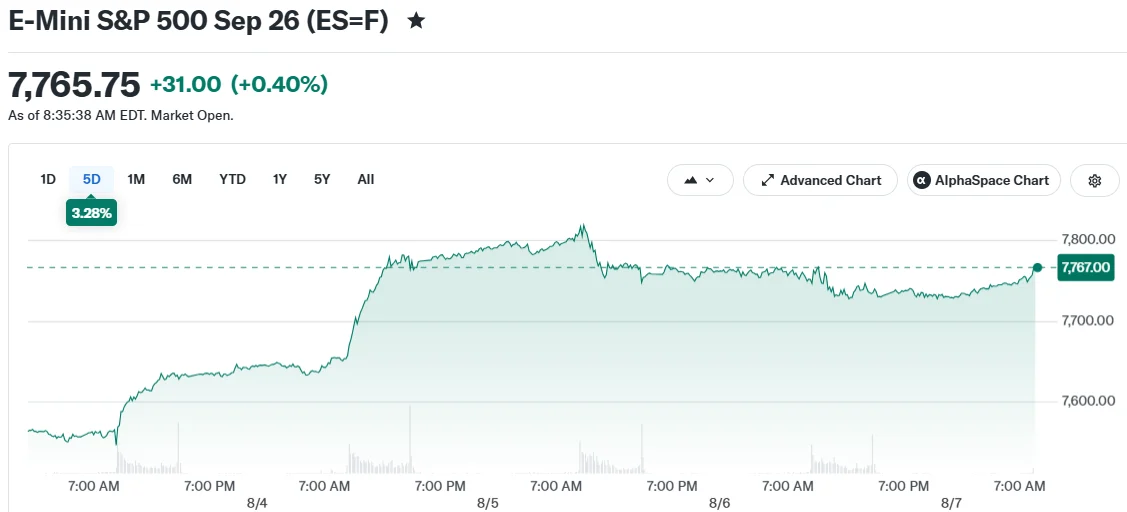
The unexpectedly weak employment data refocuses attention on Federal Reserve monetary policy decisions. Softening labor market conditions generally diminish the urgency for restrictive monetary policy, a development equity investors typically interpret favorably.
Bond Market Reacts to Employment Weakness
Fixed income markets demonstrated immediate response to the employment miss. Two-year Treasury note yields retreated to 4.18%, while benchmark 10-year yields slipped to 4.62%.
Declining Treasury yields indicate market participants are recalibrating expectations for future rate increases. Federal Reserve officials have been carefully balancing persistent inflation concerns against evolving labor market dynamics in their policy deliberations.

Additional insight arrives Friday with the New York Federal Reserve’s one-year inflation expectations survey. This consumer sentiment data will provide complementary perspective on inflation trajectory expectations.
Crude Prices Advance on Middle East Tensions
Oil prices continued their upward momentum Friday. The advance followed reports of explosive incidents near the Strait of Hormuz, attributed to Iranian forces intercepting what authorities characterized as threatening objects.
Diplomatic discussions between Iran and Oman regarding strait access remain ongoing. Recent intelligence suggests Iran may implement restrictions preventing US and Israeli maritime traffic through the strategic waterway.
The Strait of Hormuz represents a critical chokepoint for international petroleum transport. Supply disruptions in this region historically trigger crude price increases and potentially exacerbate inflationary pressures.
The interplay between elevated energy costs, inflation metrics, and Treasury market dynamics will command significant investor attention through the coming period.
Corporate earnings releases remain sparse Friday. Vistra Corp, Oklo, Under Armour, and Wendy’s headline today’s reporting schedule.
The convergence of disappointing employment data, declining bond yields, and intensifying Middle Eastern geopolitical risks establishes a complex backdrop entering the weekend.
Investor focus now turns to whether regular trading hours validate the optimistic direction established by pre-market futures activity.
Get 3 Free Stock Ebooks
Discover top-performing stocks in AI, Crypto, and Technology with expert analysis.
- Top 10 AI Stocks - Leading AI companies
- Top 10 Crypto Stocks - Blockchain leaders
- Top 10 Tech Stocks - Tech giants



