



Key Takeaways
- Spot gold advanced 1.1% to approximately $4,095 per ounce during Monday’s session
- Crude oil tumbled over 5% following a weekend pause in U.S.-Iran military confrontations
- President Trump suspended bombing operations against Iranian installations Friday following two weeks of continuous airstrikes
- Declining U.S. dollar and sliding Treasury yields provided additional tailwinds for precious metals
- Markets await Federal Reserve’s monetary policy announcement scheduled for Wednesday
Precious metal valuations pushed higher Monday as currency weakness and declining energy costs influenced investor positioning. The temporary cessation of U.S.-Iran military engagement triggered substantial crude oil selloffs, diminishing inflation concerns while directing capital toward traditional safe-haven instruments.
Spot gold appreciated 1.1% to reach $4,095.37 per ounce during early Monday trading. August-dated gold futures contracts advanced 0.7% to settle at $4,097.40 per ounce.
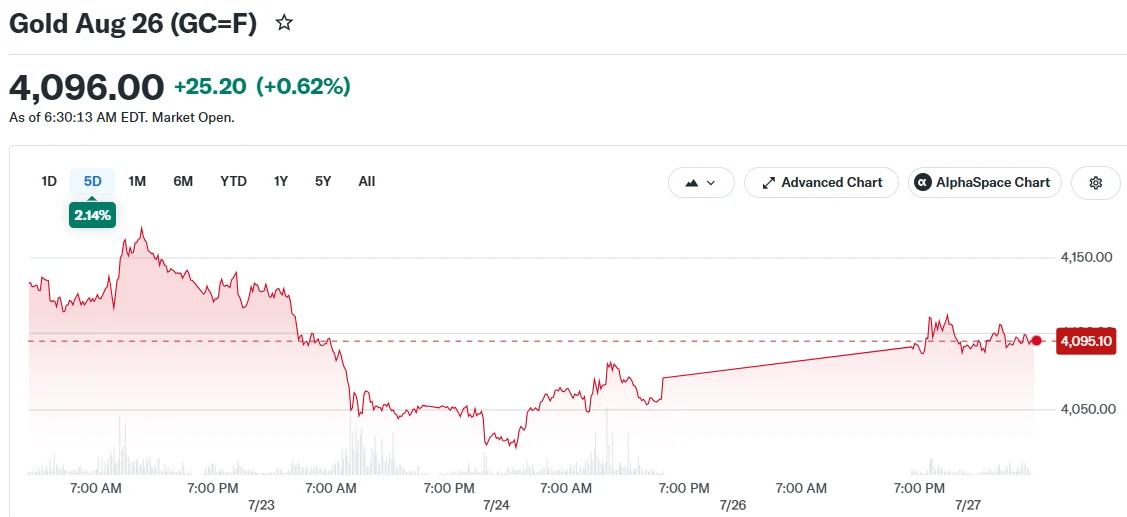
The yellow metal had already concluded the previous week with approximately 1% appreciation, despite experiencing significant intraday volatility.
Crude Prices Plunge Following Reduced Middle East Conflict
Oil prices plummeted more than 5% Monday, erasing substantial portions of the prior week’s rally. Brent crude had temporarily neared the $100-per-barrel threshold after market participants grew increasingly worried about possible supply disruptions affecting strategic waterways including the Strait of Hormuz and Red Sea shipping lanes.
President Donald Trump terminated the U.S. aerial bombardment campaign Friday following thirteen consecutive nights of operations targeting Iranian infrastructure. Administration officials characterized the suspension as establishing conditions favorable for diplomatic engagement.

Iranian forces refrained from launching counterstrikes against neighboring nations harboring U.S. military installations throughout the weekend period. This mutual restraint demonstrated by both parties contributed to stabilizing energy commodity markets.
The substantial decline in crude oil valuations may help moderate inflationary pressures over the coming weeks. Reduced energy expenses typically translate into lower consumer price indices, potentially affording the Federal Reserve greater latitude regarding monetary policy adjustments.
Fed Policy Announcement Expected Wednesday
Investor focus has shifted toward the Federal Reserve’s upcoming policy meeting scheduled for this week. The central banking institution is broadly anticipated to maintain current interest rate levels during Wednesday’s announcement.
Nevertheless, CME FedWatch probability models indicate approximately a 33% likelihood of a surprise rate increase. Market participants will scrutinize Fed Chair Kevin Warsh’s post-meeting commentary for forward guidance.
Traders seek insight regarding the potential timeline for rate reductions and policymakers’ assessment of prevailing inflation dynamics. Gold typically benefits from lower interest rate environments, as the non-yielding asset becomes more attractive relative to yield-bearing investments.
The U.S. Dollar Index depreciated 0.3% during Monday’s trading session. Currency weakness enhances gold’s affordability for international buyers conducting transactions in alternative currencies, generally boosting global demand.
U.S. Treasury yields also retreated, with the benchmark 10-year yield posting its sharpest single-session decline in four weeks.
Industrial and Precious Metals Broadly Advance
Silver climbed 2.1% to reach $59.39 per ounce. Platinum appreciated 2.3% to trade at $1,630.83 per ounce.
Copper futures listed on the London Metal Exchange increased 0.4% to $13,693.58 per tonne. U.S. copper futures contracts remained relatively flat at $6.36 per pound.
Market participants will maintain close surveillance of upcoming U.S. inflation metrics and employment statistics for additional indications regarding Federal Reserve policy trajectory.
Get 3 Free Stock Ebooks
Discover top-performing stocks in AI, Crypto, and Technology with expert analysis.
- Top 10 AI Stocks - Leading AI companies
- Top 10 Crypto Stocks - Blockchain leaders
- Top 10 Tech Stocks - Tech giants



