



Key Takeaways
- Friday trading saw the Dow gain 0.5%, the S&P 500 finish essentially unchanged, and the Nasdaq decline 0.6%
- Weekly performance showed all three benchmarks in negative territory, with the Nasdaq posting a 2% decline
- Tech giants collectively shed approximately $800 billion in market capitalization Thursday amid AI investment uncertainty
- Fresh tariffs ranging from 10% to 12.5% on the majority of US imports took effect
- Intel stock dropped almost 8% Friday even after surpassing earnings estimates
Wall Street wrapped up a week marked by significant volatility with uneven performance across major indices on Friday, as markets attempted to rebound from Thursday’s dramatic downturn.
The Dow Jones Industrial Average advanced 235 points, representing approximately a 0.5% increase. The S&P 500 managed to finish marginally positive. Meanwhile, the Nasdaq Composite declined 0.6%, pressured by ongoing weakness in technology shares.
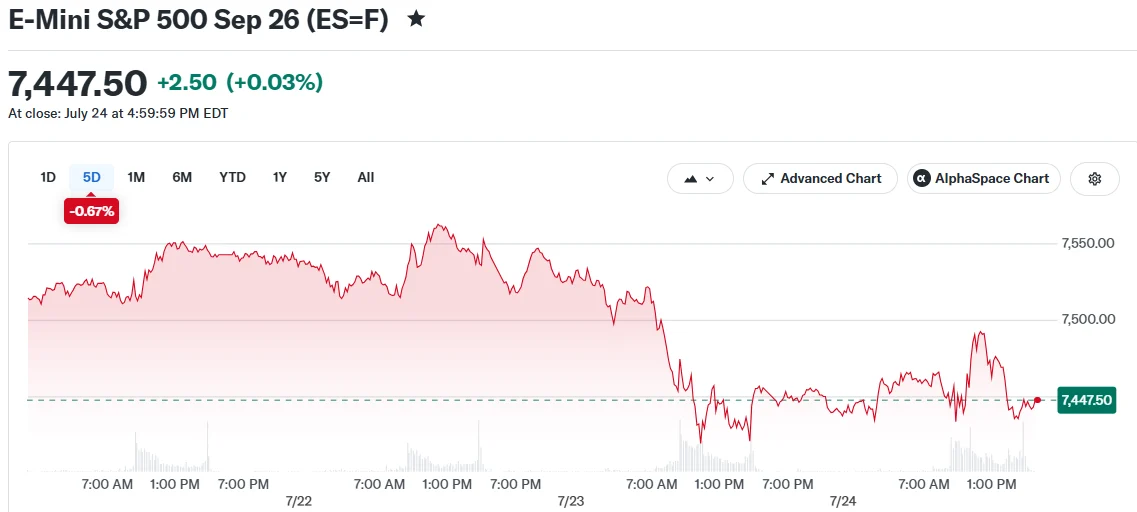
While the Dow managed modest Friday gains, the broader picture showed all three primary benchmarks closing the week lower. The technology-heavy Nasdaq experienced the steepest decline at 2% for the five-day period.
Technology Sector Rattled by AI Investment Concerns
Markets experienced severe turbulence Thursday as investors reassessed artificial intelligence capital expenditure strategies. The elite group of seven mega-cap technology companies saw their combined valuation contract by roughly $800 billion in just one trading session.

The catalyst came from Alphabet’s quarterly results released Wednesday after the closing bell. Market participants expressed growing apprehension about aggressive AI spending without demonstrable revenue generation or profitability.
Intel shares tumbled nearly 8% Friday despite delivering second-quarter financial results that exceeded analyst projections. The negative price action underscored heightened investor skepticism surrounding semiconductor stocks.
Major earnings reports from Apple, Amazon, Meta, and Microsoft are scheduled for the upcoming week. Given the market’s response to Alphabet’s disclosure, additional volatility appears likely.
Trade Policy and Energy Markets Compound Challenges
A new round of Section 301 tariffs became effective overnight, imposing duties between 10% and 12.5% on nearly all goods entering the United States. The measures affect major trade partners across multiple sectors.
Administration officials excluded certain energy commodities from the tariff framework, acknowledging elevated crude prices that have fueled inflation anxieties.
Oil prices retreated Friday, with Brent crude futures declining roughly 4% to settle under $96 per barrel. Nevertheless, the commodity remained positioned for a positive weekly performance after momentarily breaching the $100 threshold.
Treasury Market and Federal Reserve Expectations
The 2-year Treasury yield concluded the week at 4.33%, declining Friday and interrupting a six-session advance.
Futures markets now indicate a 62.1% probability that the Federal Reserve maintains its current interest rate stance at next Wednesday’s policy meeting. The likelihood of a rate increase has climbed to 37.9%, a substantial jump from the previous week’s 12.8% probability.
In corporate earnings news, Verizon, American Express, and NextEra Energy each exceeded bottom-line expectations while falling short on topline projections. Weakness in American Express and Alphabet shares contributed to the Dow’s negative weekly performance.
Economic data showed US business activity expanding at its strongest rate in eight months during July, based on S&P Global’s preliminary PMI reading, with World Cup-related activity providing some support.
Get 3 Free Stock Ebooks
Discover top-performing stocks in AI, Crypto, and Technology with expert analysis.
- Top 10 AI Stocks - Leading AI companies
- Top 10 Crypto Stocks - Blockchain leaders
- Top 10 Tech Stocks - Tech giants



